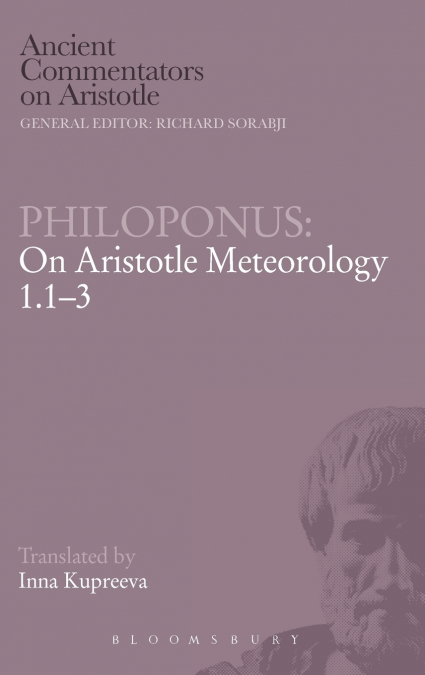
Philoponus

Philoponus

Philoponus / Philip J. Van Der Eijk

206,63 €
IVA incluido
Disponible
Editorial:
Bloomsbury Publishing plc
Año de edición:
2006
Materia
Filosofía occidental: antigua, hasta c. 500
ISBN:
9780715633076
206,63 €
IVA incluido
Disponible

Selecciona una librería:

  • Librería Samer Atenea
  • Librería Aciertas (Toledo)
  • Kálamo Books
  • Librería Perelló (Valencia)
  • Librería Elías (Asturias)
  • Donde los libros
  • Librería Kolima (Madrid)
  • Librería Proteo (Málaga)

Until the launch of this series over fifteen years ago, the 15,000 volumes of the ancient Greek commentators on Aristotle, written mainly between 200 and 600 AD, constituted the largest corpus of extant Greek philosophical writings not translated into English or other European languages. This text by Philoponus rejects accounts of soul, or as we would say of mind, which define it as moving, as cognitive, or in physical terms. Chapter 3 considers Aristotle’s attack on the idea that the soul is in motion. This was an attack partly on his teacher, Plato, since Plato defines the soul as self-moving. Philoponus agrees with Aristotle’s attack on the idea that a thing must be in motion in order to cause motion. But he offers what may be Ammonius’ interpretation of Plato’s apparently physicalistic account of the soul in the Timaeus as symbolic. What we would call the mind-body relation is the subject of Chapter 4. Plato and Aristotle attacked a physicalistic theory of soul, which suggested it was the blend, ratio, or harmonious proportion of ingredients in the body.Philoponus attacked the theory too, but we learn from him that Epicurus had defended it. In Chapter 5, Philoponus endorses Aristotle’s rejection of the idea that the soul is particles and of Empedocles’ idea that the soul must be made of all four elements in order to know what is made of the same elements. He also rejects, with Aristotle, definitions of the soul as moving or cognitive as ignoring lower forms of life. He finally discusses Aristotle’s rejection of Plato’s localisation of parts of the soul in parts of the body, but asks if new knowledge of the brain and the nerves do not require some kind of localisation.


Artículos relacionados

  • The Nature of Things
    Lucretius Lucretius
    De rerum natura (On the Nature of Things) is a 1st century BC didactic poem by the Roman poet and philosopher Lucretius with the goal of explaining Epicurean philosophy to a Roman audience. Lucretius presents the principles of atomism; the nature of the mind and soul; explanations of sensation and thought; the development of the world and its phenomena; and explains a variety o...
    Disponible

    36,76 €

  • Pompeii
    Fergus Mason
    Pompeii was one of most advanced cities of its time; it had a complex water system, gymnasium, and an amphitheater. Despite it's advancements, there was one thing it wasn't ready for: Mount Vesuvius—the volcano that led to its ultimate doom.  The 79 AD eruption of Mount Vesuvius was one of the worst disasters in all of European history. In a near instant, over 15,000 p...
    Disponible

    10,36 €

  • Middle Platonism and Neoplatonism, Volume 1
    Stephen Gersh
    'It is generally agreed that those types of philosophy that are loosely called ’Platonic’ and ’Neoplatonic’ played a crucial role in the history of European culture during the centuries between antiquity and the Renaissance. However, until now no scholar has attempted to describe the evolution of these forms of thought in a single comprehensive academic study.' So writes Stephe...
    Disponible

    179,17 €

  • Middle Platonism and Neoplatonism, Volume 2
    Stephen Gersh
    It is generally agreed that those types of philosophy that are loosely called 'Platonic' and 'Neoplatonic' played a crucial role in the history of European culture during the centuries between antiquity and the Middle Ages. However, until now no scholar has attempted to describe the evolution of these forms of thought in a single comprehensive academic study. Middle Platonism a...
    Disponible

    215,18 €

  • Porphyry’s Commentary on Ptolemy’s Harmonics
    Andrew Barker
    ...
    Disponible

    77,17 €

  • The Roots of Platonism
    John Dillon
    ...
    Disponible

    25,29 €