LIBROS DEL AUTOR: philoponus

37 resultados para LIBROS DEL AUTOR: philoponus

  • Philoponus
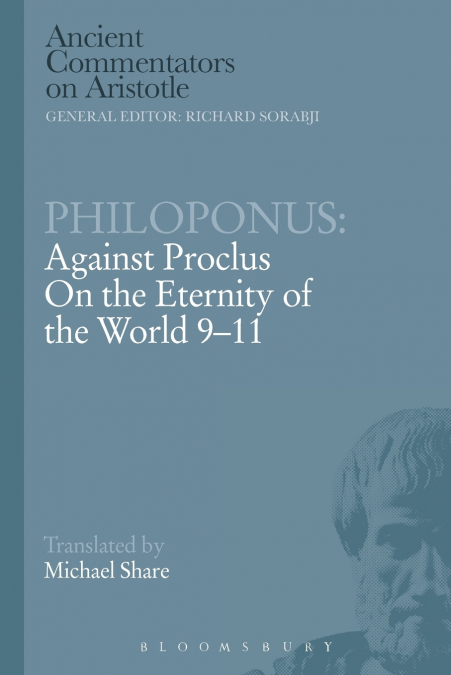
    Philoponus / Michael Share
    This is a post-Aristotelian Greek philosophical text, written at a crucial moment in the defeat of paganism by Christianity, AD 529, when the Emperor Justinian closed the pagan Neoplatonist school in Athens. Philoponus in Alexandria was a brilliant Christian philosopher, steeped in Neoplatanism, who turned the pagans’ ideas against them. Here he attacks the most devout of the e...
    Disponible

    67,14 €

  • Philoponus
    Philoponus / James Wilberding
    In chapters 12-18 of Against Proclus, Philoponus continues to do battle against Proclus’ arguments for the beginninglessness and everlastingness of the ordered universe. In this final section there are three notable issues under discussion. The first concerns the composition of the heavens and its manner of movement. Philoponus argues against the Aristotelian thesis that there ...
    Disponible

    66,98 €

  • Philoponus
    Philoponus / Michael Share
    This is one of the most interesting of all post-Aristotelian Greek philosophical texts, written at a crucial moment in the defeat of paganism by Christianity, AD 529, when the Emperor Justinian closed the pagan Neoplatonist school in Athens. Philoponus in Alexandria was a brilliant Christian philosopher, steeped in Neoplatonism, who turned the pagans’ ideas against them. Here h...
    Disponible

    66,93 €

  • Philoponus
    Philoponus / Inna Kupreeva
    Until the launch of this series over ten years ago, the 15,000 volumes of the ancient Greek commentators on Aristotle, written mainly between 200 and 600 AD, constituted the largest corpus of extant Greek philosophical writings not translated into English or other European languages. Subjects covered in this, the third and last, volume of translation of this work include: why t...
    Disponible

    66,82 €

  • Philoponus
    Philoponus / William Charlton
    In On The Soul 2.1-6, Aristotle differs from Plato in his account of the soul, by tying it to the body. The soul is the life-manifesting capacities that we all have and that distinguish living things, and explain their behaviour. He defines soul and life by reference to the capacities for using food to maintain structure and reproduce, for perceiving and desiring, and for ratio...
    Disponible

    67,01 €

  • Philoponus
    Philoponus / William Charlton
    In this, one of the most original ancient texts on sense perception, Philoponus, the sixth century AD commentator on Aristotle, considers how far perceptual processes are incorporeal. Colour affects us in the same way as light which, passing through a stained glass window, affects the air, but colours only the masonry beyond. Sounds and smells are somewhat more physical, travel...
    Disponible

    66,87 €

  • Philoponus
    Philoponus / Sarah Broadie
    Philoponus’ commentary on the last part of Aristotle’s Physics Book 4 does not offer major alternatives to Aristotle’s science, as did his commentary on the earlier parts, concerning place, vacuum and motion in a vacuum. Aristotle’s subject here is time, and his treatment of it had led to controversy in earlier writers. Philoponus does offer novelties when he treats motion roun...
    Disponible

    67,25 €

  • Philoponus
    Philoponus / Richard D. McKirahan
    In this part of the Posterior Analytics, Aristotle elaborates his assessment of how universal truths of science can be scientifically explained as inevitable in demonstrative proofs. But he introduces complications: some sciences discuss phenomena that can only be explained by higher sciences and again sometimes we reason out a cause from an effect, rather than an effect from a...
    Disponible

    66,94 €

  • Philoponus
    Philoponus / Richard D. McKirahan
    Aristotle’s Posterior Analytics elaborates for the first time in the history of Western philosophy the notions of science and the requirements for the distinctive kind of knowledge scientists possess. His model is mathematics and his treatment of science amounts to a philosophical discussion, from the perspective of Aristotelian syllogistic, of mathematical proofs and the princ...
    Disponible

    67,02 €

  • Philoponus
    Philoponus / Inna Kupreeva
    Of Philoponus’ commentary on the Meteorology only that on chapters 1-9 and 12 of the first book has been preserved. It is translated in this series in two volumes, the first covering chapters 1-3; the second (this volume) chapters 4-9 and 12. The subjects discussed here include the nature of fiery and light phenomena in the sky, the formation of comets, the Milky Way, the prope...
    Disponible

    66,94 €

  • Philoponus
    Philoponus / Inna Kupreeva / L. G. Westerink
    Aristotle’s Meteorology influenced generations of speculation about the earth sciences, ranging from atmospheric phenomena to earthquakes. The commentary of John Philoponus (6th century AD) on the opening three chapters of Meteorology is here translated for the first time into English by Dr Inna Kupreeva, building on the work of L.G. Westerink. Philoponus, who today is increasi...
    Disponible

    67,24 €

  • Philoponus
    Philoponus / Michael Share
    In one of the most original books of late antiquity, Philoponus argues for the Christian view that matter can be created by God out of nothing. It needs no prior matter for its creation. At the same time, Philoponus transforms Aristotle’s conception of prime matter as an incorporeal ’something - I know not what’ that serves as the ultimate subject for receiving extension and qu...
    Disponible

    67,09 €

  • Philoponus
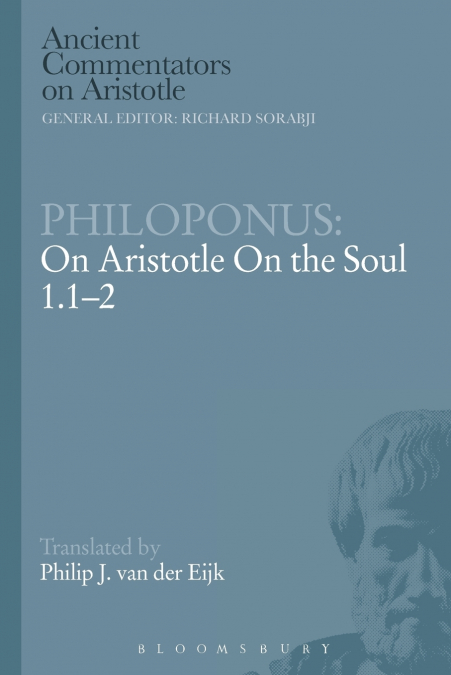
    Philip J. Van Der Eijk / Philoponus
    This text by Philoponus, the sixth-century commentator on Aristotle, is notable for its informative introduction to psychology, which tells us the views of Philoponus, of his teacher and of later Neoplatonists on our psychological capacities and on mind-body relations. There is an unusual account of how reason can infer a universally valid conclusion from a single instance, and...
    Disponible

    66,82 €

  • Philoponus
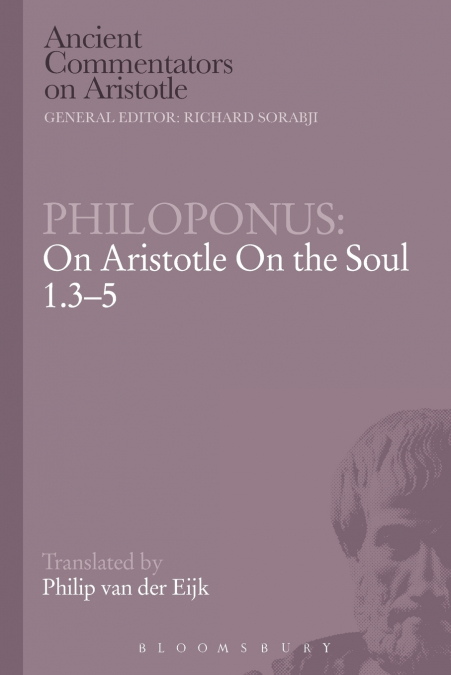
    Philip J. Van Der Eijk / Philoponus
    Until the launch of this series over fifteen years ago, the 15,000 volumes of the ancient Greek commentators on Aristotle, written mainly between 200 and 600 AD, constituted the largest corpus of extant Greek philosophical writings not translated into English or other European languages. This text by Philoponus rejects accounts of soul, or as we would say of mind, which define ...
    Disponible

    66,82 €

  • Philoponus
    John Philoponus / Christian Wildberg
    Philoponus’ treatise Against Aristotle on the Eternity of the World, an attack on Aristotle’s astronomy and theology is concerned mainly with the eternity and divinity of the fifth element, or ’quintessence’, of which Aristotle took the stars to be composed. Pagans and Christians were divided on whether the world had a beginning, and on whether a belief that the heavens were di...
    Disponible

    67,03 €

  • Philoponus
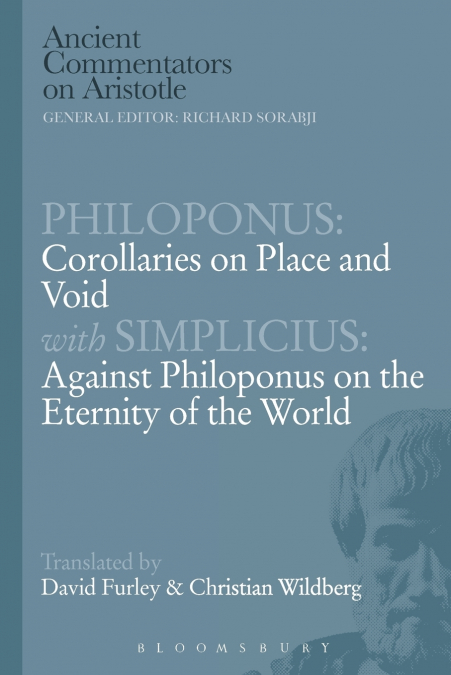
    Philoponus / C. Wildberg / D. Furley
    In the Corollaries on Place and Void, Philoponus attacks Aristotle’s conception of place as two-dimensional, adopting instead the view more familiar to us that it is three-dimensional, inert and conceivable as void. Philoponus’ denial that velocity in the void would be infinite anticipated Galileo, as did his denial that speed of fall is proportionate to weight, which Galileo g...
    Disponible

    67,20 €

  • Philoponus
    Philoponus / Catherine Osborne
    Aristotle’s Physics 1.4-9 explores a range of questions about the basic structure of reality, the nature of prime matter, the principles of change, the relation between form and matter, and the issue of whether things can come into being out of nothing, and if so, in what sense that is true. Philoponus’ commentaries do not merely report and explain Aristotle and the other think...
    Disponible

    67,02 €

  • Philoponus
    Philoponus / Owen Goldin
    The Posterior Analytics contains Aristotle’s philosophy of science. In Book 2, Aristotle asks how the scientist discovers what sort of loss of light constitutes lunar eclipse. The scientist has to discover that the moon’s darkening is due to the earth’s shadow. Once that defining explanation is known the scientist possesses the full scientific concept of lunar eclipse and can u...
    Disponible

    66,87 €

  • Philoponus
    Inna Kupreeva / John Philoponus
    Of Philoponus’ commentary on the Meteorology only that on chapters 1-9 and 12 of the first book has been preserved. It is translated in this series in two volumes, the first covering chapters 1-3; the second (this volume) chapters 4-9 and 12. The subjects discussed here include the nature of fiery and light phenomena in the sky, the formation of comets, the Milky Way, the prope...
    Disponible

    285,15 €

  • Philoponus
    Philoponus / Richard D. McKirahan
    In this part of the Posterior Analytics, Aristotle elaborates his assessment of how universal truths of science can be scientifically explained as inevitable in demonstrative proofs. But he introduces complications: some sciences discuss phenomena that can only be explained by higher sciences and again sometimes we reason out a cause from an effect, rather than an effect from a...
    Disponible

    285,15 €

  • Philoponus
    Philoponus / Inna Kupreeva / L.G. Westerink
    Aristotle’s Meteorology influenced generations of speculation about the earth sciences, ranging from atmospheric phenomena to earthquakes. The commentary of John Philoponus (6th century AD) on the opening three chapters of Meteorology is here translated for the first time into English by Dr Inna Kupreeva, building on the work of L.G. Westerink. Philoponus, who today is increasi...
    Disponible

    285,43 €

  • Philoponus
    Philoponus / Sarah Broadie
    Philoponus’ commentary on the last part of Aristotle’s Physics Book 4 does not offer major alternatives to Aristotle’s science, as did his commentary on the earlier parts, concerning place, vacuum and motion in a vacuum. Aristotle’s subject here is time, and his treatment of it had led to controversy in earlier writers. Philoponus does offer novelties when he treats motion roun...
    Disponible

    285,44 €

  • In Aristotelis Analytica Priora Commentaria ...
    John 6th cent Philoponus
    In Aristotelis Analytica Priora Commentaria is a Latin commentary on Aristotle’s 'Prior Analytics' by John Philoponus, a prominent 6th-century philosopher and theologian. This work offers valuable insights into Aristotelian logic and reasoning as understood in late antiquity. Philoponus’s commentary provides a detailed analysis of Aristotle’s arguments and methods, reflecting t...
    Disponible

    29,69 €

  • In Aristotelis Categoriae Commentarium ...
    John 6th cent Philoponus
    In Aristotelis Categoriae Commentarium is a Latin commentary on Aristotle’s Categories by John Philoponus, a prominent philosopher of the 6th century. This work provides invaluable insights into Aristotelian logic and metaphysics through the lens of late antique thought. Philoponus’s commentary is essential for scholars interested in the interpretation and transmission of Arist...
    Disponible

    25,30 €

  • In Aristotelis Meteorologicorum Librum Primum Commentarium ...
    John 6th cent Philoponus
    In Aristotelis Meteorologicorum Librum Primum Commentarium is a Latin commentary on the first book of Aristotle’s 'Meteorology' by John Philoponus, a 6th-century philosopher and scholar. This work offers valuable insights into classical interpretations of Aristotle’s scientific writings and provides a window into the intellectual milieu of late antiquity. Philoponus’s commentar...
    Disponible

    29,69 €

  • Philoponus
    Philoponus / Michael Share
    In one of the most original books of late antiquity, Philoponus argues for the Christian view that matter can be created by God out of nothing. It needs no prior matter for its creation. At the same time, Philoponus transforms Aristotle’s conception of prime matter as an incorporeal ’something - I know not what’ that serves as the ultimate subject for receiving extension and qu...
    Disponible

    286,71 €

  • In Cap. I Geneseos, De Mundi Creatione Libri Septem (1630)
    Joannes Philoponus / Balthasar Corderius
    In libro ''De Mundi Creatione Libri Septem'' auctore Philopono, Joannes, Capite I Geneseos, completa narratio de creatione mundi continetur. Auctor describit, quomodo Deus, ex nihilo, omnia creavit, initio coelum et terram. Deinde, auctor explicat ordine creationis caelorum, luminarium, maris et terrae, animalium et hominis. Auctor quoque disputat de ratione creationis, contra ...
    Disponible

    41,67 €

  • Philoponus
    Philoponus / Owen Goldin
    The Posterior Analytics contains Aristotle’s philosophy of science. In Book 2, Aristotle asks how the scientist discovers what sort of loss of light constitutes lunar eclipse. The scientist has to discover that the moon’s darkening is due to the earth’s shadow. Once that defining explanation is known the scientist possesses the full scientific concept of lunar eclipse and can u...
    Disponible

    285,06 €

  • Philoponus
    Philoponus
    Aristotle’s Physics 1.4-9 explores a range of questions about the basic structure of reality, the nature of prime matter, the principles of change, the relation between form and matter, and the issue of whether things can come into being out of nothing, and if so, in what sense that is true. Philoponus’ commentaries do not merely report and explain Aristotle and the other think...
    Disponible

    285,21 €

  • Philoponus
    Philoponus / Richard D. McKirahan
    Aristotle’s Posterior Analytics elaborates for the first time in the history of Western philosophy the notions of science and the requirements for the distinctive kind of knowledge scientists possess. His model is mathematics and his treatment of science amounts to a philosophical discussion, from the perspective of Aristotelian syllogistic, of mathematical proofs and the princ...
    Disponible

    285,21 €


01 02