Andrew G. Reif / Joseph W. Duris / et al.
 Librería Samer Atenea
 Kálamo Books
 Librería Elías (Asturias)
 Librería Kolima (Madrid)
 Librería Proteo (Málaga)
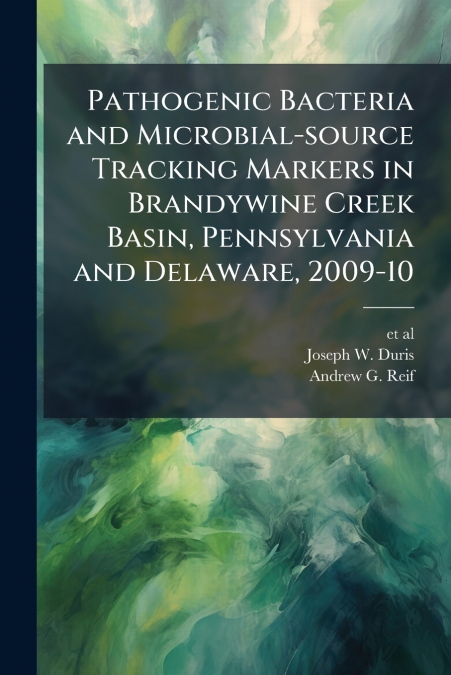
The City of Wilmington, Delaware, is in the downstream part of the Brandywine Creek Basin, on the main stem of Brandywine Creek. Wilmington uses this stream, which drains a mixed-land-use area upstream, for its main drinking-water supply. Because the stream is used for drinking water, Wilmington is in need of information about the occurrence and distribution of specific fecally derived pathogenic bacteria (disease-causing bacteria) and their relations to commonly measured fecal-indicator bacteria (FIB), as well as information regarding the potential sources of the fecal pollution and pathogens in the basin. This study focused on five routinely sampled sites within the basin, one each on the West Branch and the East Branch of Brandywine Creek and at three on the main stem below the confluence of the West and East Branches. These sites were sampled monthly for 1 year. Targeted event samples were collected on two occasions during high flow and two occasions during normal flow. On the basis of this study, high flows in the Brandywine Creek Basin were related to increases in FIB densities, and in the frequency of selected pathogen and source markers, in the West Branch and main stem of Brandywine Creek, but not in the East Branch. Water exceeding the moderate fullbody-contact single-sample recreational water-quality criteria (RWQC) for Escherichia coli (E. coli) was more likely to contain selected markers for pathogenic E. coli (eaeA,stx1, and rfbO157 gene markers) and bovine fecal sources (E. hirae and LTIIa gene markers), whereas samples exceeding the enterococci RWQC were more likely to contain the same pathogenic markers but also were more likely to carry a marker indicative of human source (esp gene marker). On four sample dates, during high flow between October and March, the West Branch was the only observed potential contributor of selected pathogen and bovine source markers to the main stem of Brandywine Creek. Indeed, the stx2 marker, which indicates a highly virulent type of pathogenic E. coli, was found only in the West Branch and main stem at high flow but was not found in the East Branch under similar conditions. However, it must be noted that throughout the entire year of sampling there were occasions, during both high and normal flows, when both the East and West Branches were potential contributors of pathogen and microbial-source tracking markers to the main stem. Therefore, this study indicates that under selected conditions (high flow, October through March), West Branch Brandywine Creek Basin was the most likely source of elevated FIB densities in the main stem. These elevated densities are associated with more frequent detection of selected pathogenic E. coli markers (rfbO157 stx1) and are associated with MST markers of bovine source. However, during other times of the year, both the West Branch and East Branch Basins are acting as potential sources of FIB and fecally derived pathogens.This work has been selected by scholars as being culturally important, and is part of the knowledge base of civilization as we know it. This work was reproduced from the original artifact, and remains as true to the original work as possible. Therefore, you will see the original copyright references, library stamps (as most of these works have been housed in our most important libraries around the world), and other notations in the work.This work is in the public domain in the United States of America, and possibly other nations. Within the United States, you may freely copy and distribute this work, as no entity (individual or corporate) has a copyright on the body of the work.As a reproduction of a historical artifact, this work may contain missing or blurred pages, poor pictures, errant marks, etc. Scholars believe, and we concur, that this work is important enough to be preserved, reproduced, and made generally available to the public. We appreciate your support of the preservation process, and tha...