O próximo stress térmico terminal e Brassica Juncea

O próximo stress térmico terminal e Brassica Juncea

Narender Mohan / Nisha Kumari

65,61 €
IVA incluido
Disponible
Editorial:
KS OmniScriptum Publishing
Año de edición:
2025
Materia
Botánica y ciencias de las plantas
ISBN:
9786208938161
65,61 €
IVA incluido
Disponible

Selecciona una librería:

  • Librería Samer Atenea
  • Librería Aciertas (Toledo)
  • Kálamo Books
  • Librería Perelló (Valencia)
  • Librería Elías (Asturias)
  • Donde los libros
  • Librería Kolima (Madrid)
  • Librería Proteo (Málaga)

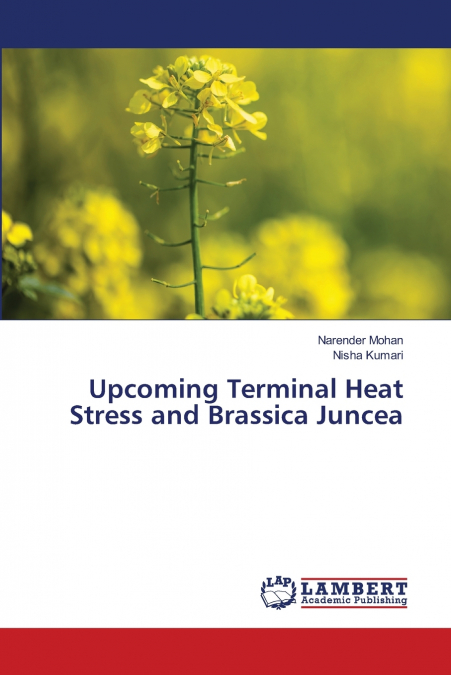
A mostarda indiana [Brassica juncea (L.) Czern & Coss.] é a segunda maior cultura de sementes oleaginosas na Índia, a seguir à soja. Representa cerca de 30 % do total das sementes oleaginosas e 27 % do reservatório de óleo alimentar do país. O género Brassica pertence à família das Brassicaceae (crucíferas), que inclui cerca de 100 espécies cultivadas principalmente para produtos hortícolas, óleo, forragem ou condimentos. A Brassica é predominantemente cultivada no Rajastão, Uttar Pradesh, Haryana, Madhya Pradesh e Gujrat. Cresce em diversas situações agro-ecológicas, tais como sementeira atempada/sementeira tardia, sequeiro/irrigado, cultura única e mista com cereais (trigo e cevada, etc.) e leguminosas Rabi (outubro-abril) (grão-de-bico, lentilhas, etc.). É cultivada com uma precipitação anual de 400 a 500 mm, temperatura anual de 60C - 27 0C e pH do solo de 4,3 a 8,3 como cultura de sequeiro ou irrigada, plantada entre setembro (cedo), outubro (atempadamente) e novembro (tarde). A sementeira atempada contribui para uma elevada produtividade, uma germinação mais rápida das sementes, uma capacidade vigorosa de cobertura do solo, uma maior tolerância ao calor e à seca e uma maior resistência aos insectos e às doenças.
Artículos relacionados

  • The Green Architecture
    Ali Mirshafieyan / Ghazal Yeganeh / Maryam Zamani Motlagh
    Protecting green energy as well as non-renewable energy, as well as their sustainable use, many advances in the technology of extracting oil products and other reserves under the ground have caused many improvements. In this regard, proposing the design of buildings in which the consumption of fossil fuels reaches its lowest level is considered one of the important solutions in...
    Disponible

    82,54 €

  • Responsible Use and Management of Agrochemicals
    Juan Carlos Nava
    Uso y manejo responsable de agroquímicos is a work product of the author’s experiences (undergraduate and graduate professor, with research and extension projects), aimed at producers, companies, professionals, students, advisors, researchers, among others.Due to its structure and content, it is expected to be a valuable aid to all people directly or indirectly involved in the ...
    Disponible

    49,45 €

  • Hope in the Soil
    Ellen G White
    Before edible classrooms began 'sprouting' in elementary schools, before buzzwords like 'sustainable agriculture', 'organic,' or 'veganic' came into existence, an exceptional woman named Ellen G. White penned numerous letters and articles on the importance of farming, an outdoor life, and manual labor. Though often remembered for other things, Mrs. White was actively engaged in...
    Disponible

    18,38 €

  • The Green Revolution
    Binitha Sophine Emmanuel
    The Green Revolution, a transformative era in the annals of agriculture, emerged as a game-changing force during the mid-20th century, fundamentally reshaping the methodology of food production and steering the trajectory of global food security. Characterized by a sequence of technological breakthroughs, the Green Revolution aimed to substantially augment agricultural producti...
    Disponible

    53,23 €

  • Utilization of Stingless Bees, Tetragonula laeviceps (Smith)
    Dr. J. J. Pastagia / Dr. V. C. Gadhiya
    The present investigations on utilization of stingless bees, T. laeviceps Smith in net house condition carried out with the broad aspects like flowers visited by stingless bees, T. laeviceps Smith, toxicity of insecticides to T. laeviceps Smith workers, floral biology of musk melon, foraging behavior of stingless bees, T. laeviceps Smith in net house condition, effect of pollin...
    Disponible

    84,80 €

  • La révolution verte
    Binitha Sophine Emmanuel
    La révolution verte, une ère transformatrice dans les annales de l’agriculture, est apparue comme une force qui a changé la donne au milieu du 20e siècle, remodelant fondamentalement la méthodologie de la production alimentaire et orientant la trajectoire de la sécurité alimentaire mondiale. Caractérisée par une série de percées technologiques, la révolution verte visait à augm...
    Disponible

    53,29 €

Otros libros del autor

  • Bevorstehender terminaler Hitzestress und Brassica Juncea
    Narender Mohan / Nisha Kumari
    Indischer Senf [Brassica juncea (L.) Czern & Coss.] ist nach Sojabohnen die zweitgrößte Ölsaat in Indien. Er macht fast 30 % der gesamten Ölsaaten und 27 % des Speiseöls des Landes aus. Die Gattung Brassica gehört zur Familie der Brassicaceae (Kreuzblütler) und umfasst etwa 100 Arten, die hauptsächlich als Gemüse, Öl, Futtermittel oder Gewürze angebaut werden. Brassica wird vor...
    Disponible

    65,61 €

  • Stress thermique terminal à venir et Brassica Juncea
    Narender Mohan / Nisha Kumari
    La moutarde indienne [Brassica juncea (L.) Czern & Coss.] est la deuxième culture oléagineuse en Inde après le soja. Elle représente près de 30 % du total des graines oléagineuses et 27 % de la réserve d’huile comestible du pays. Le genre Brassica appartient à la famille des Brassicaceae (crucifères) et comprend une centaine d’espèces cultivées principalement pour les légumes, ...
    Disponible

    65,61 €

  • Stress termico terminale e Brassica Juncea in arrivo
    Narender Mohan / Nisha Kumari
    La senape indiana [Brassica juncea (L.) Czern & Coss.] è la seconda coltura di semi oleosi in India dopo la soia. Rappresenta quasi il 30% del totale dei semi oleosi e il 27% del pool di oli commestibili del Paese. Il genere Brassica appartiene alla famiglia delle Brassicaceae (crucifere) e comprende circa 100 specie coltivate principalmente per ortaggi, olio, foraggio o condim...
    Disponible

    65,61 €

  • Upcoming Terminal Heat Stress and Brassica Juncea
    Narender Mohan / Nisha Kumari
    Indian mustard [Brassica juncea (L.) Czern & Coss.] is the second largest oilseed crop in India after soyabean. It accounts for nearly 30 % of the total oilseeds and 27 % to edible oil pool of the country. The genus Brassica belongs to the family Brassicaceae (cruciferae) comprising of about 100 species mainly grown for vegetables, oil, fodder or condiments. Brassica is predomi...
    Disponible

    64,43 €