
NO FOOD IS GOOD ENOUGH

NO FOOD IS GOOD ENOUGH

David H. Dighton

28,74 €
IVA incluido
Disponible
Editorial:
MediCause
Año de edición:
2026
Materia
Ciencia: cuestiones generales
ISBN:
9781919458120
28,74 €
IVA incluido
Disponible

Selecciona una librería:

  • Librería Samer Atenea
  • Kálamo Books
  • Librería Elías (Asturias)
  • Librería Kolima (Madrid)
  • Librería Proteo (Málaga)

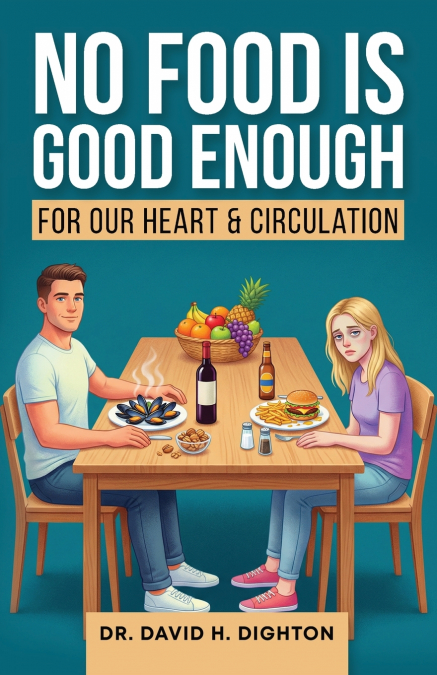
Natural food was not designed for humans. The plants and animals we regard as food, has long had its own raison d’être. So, who knows what food is best for our heart and circulation, when most of it is compromised by too many calories, detrimental fats, few protective substances, by taste and cost? How are we to make scientifically informed food choices?Most people have fixed ideas about food - especially, what is ’bad for them’ (fats in ’junk food’, they think). Far fewer know what might be positively good for their heart and arteries (rather than just ’not so bad’). Most believe that fresh fruit and vegetables, nuts, fish, olive oil and salads are best. Are these myths based on hearsay or is there a scientific basis for them?Nobody has yet devised a readily usable index for ’how good’ or ’how bad’ any particular food, food group or diet is for our arteries, heart and circulation. Can certain foods protect us from heart attacks and strokes? If so, how strong might each protective nutrient be? Perhaps, only drugs like ’statins’ can be relied on to do the job.I was once asked by a heart patient of mine (who had just had a heart by-pass), what he should eat to help protect his arteries. I had to admit I wasn’t sure. So, I undertook some research. Some animal experiments have observed artery ’furring’ in relationship to various nutrients. There were those that caused ’furring’, while others had a protective effect.Although, I did manage to collect together a few damaging nutrients, like saturated fat, I was only able to find sixteen protective ones. Soon, other questions arose. Where are these nutrients to be found in food? And, how much does each food contain? How bad are the damaging nutrients, and how good the protective ones?Few books list the full nutrient content of natural foods; that of prepared foods often remaining secret. Even then, not every known protective nutrient will be listed. Nutrients like allicin (in garlic), resveratrol and flavonoids in wine and deep colored fruit - all likely to be of importance - but rarely mentioned.We have long needed a usable index for both potential effects; alternatively, one could use their ratio - the Cardiac Value of Food. But wait! Perhaps it’s not the ratio that counts most. Perhaps the ’good’ nutrients easily overwhelm the dangerous effects of the ’bad’ ones. That vital question has yet to be answered.This book introduces an index for each food, food group and diet, based not on hearsay, but on actual nutrient content. This is a new approach to food choice, especially for those with a family history of coronary heart disease and those who already have it.As a cardiologist with almost 60-years of experience, I have always had doubts about the role food plays in the generation of artery ’furring’ (atherosclerosis), coronary artery disease, heart attacks and strokes. I don’t believe those who carry strong artery ’furring’ genes will completely overcome their problem, just by choosing what I think is best to eat. But since we must all eat, there will be best and worst food choices to consider. I believe those with no trace of ’furring’ genes can probably eat what they like, regardless of any best or worst food concept, taken from either animal experiments or population studies.If we are to get the maximum nutrient benefit for the heart and circulation, taking supplements might be the answer. At least, there should not be any damaging nutrients or too many calories.In the meantime, most of us have one prominent desire - to enjoy the food we eat; foods that hopefully help us to survive healthily within our social and cultural groups.
Artículos relacionados

  • Cases on Research-Based Teaching Methods in Science Education
    Eugene de Silva
    While the great scientists of the past recognized a need for a multidisciplinary approach, today’s schools often treat math and science as subjects separate from the rest. This not only creates a disinterest among students, but also a potential learning gap once students reach college and then graduate into the workforce. Cases on Research-Based Teaching Methods in Science Educ...
  • Enhancing Qualitative and Mixed Methods Research with Technology
    Shalin Hai-Jew
    In light of the expensive nature of quantitative research, such as experiments, researchers must seek other methods of understanding the world around them. As such, new qualitative methods are gaining ground in the modern research community. Enhancing Qualitative and Mixed Methods Research with Technology explores the integration of new digital tools into the research process. ...
  • Emerging Research on Bioinspired Materials Engineering
    Mohamed Bououdina
    Bioinspired materials can be defined as the organic or inorganic materials that mimic naturally occurring substances. With applications in a number of fields such as biomedical, chemical, mechanical, and civil engineering, research on the development of biologically-inspired materials is essential to further advancement. Emerging Research on Bioinspired Materials Engineering pr...
  • Contemporary Knowledge and Systems Science
    As branches of research and knowledge continue to expand, platforms for gathering and understanding new information become important aspects of organizational improvement. Contemporary Knowledge and Systems Science provides emerging research on the methods and applications of knowledge systems in social science, economics, and technological developments. While highlighting topi...
  • BOUQUET OF DYSON, A
    BERNSTEIN JEREMY / Jeremy Bernstein
    University of Texas at Austin My friendship with Freeman Dyson goes back over a half century. My first contact with him goes back to the late 1950s, when I was at the Institute for Advanced Study, and then evolved when I was a consultant at General Atomics in La Jolla, California. Freeman was then trying to design a space ship — the Orion — which would be propelled by atomic bo...
    Disponible

    33,35 €

  • CLOUDS ARE NOT SPHERES
    LESMOIR-GORDON NIGEL / NIGEL LESMOIR-GORDON
     The time is right, following Benoît Mandelbrot's death in 2010, to publish this landmark book about the life and work of this maverick math genius.This compact book celebrates the life and achievements of Benoît Mandelbrot with the ideas of fractals presented in a way that can be understood by the interested lay-person. Mathematics is largely avoided. Instead, Mandelbrot&#...

Otros libros del autor

  • Always Tired?
    David H. Dighton
    Why do we get tired? They are:We have an illness. We spend too much energy on our emotions. We spend too much energy on stress and solving problems. We do not sleep well enough to refresh our energy.Millions of people complain of feeling tired all the time. Most tiredness is trivial with an obvious temporary cause - late nights, overwork or worry. Sometimes it worsens, becomes ...
    Disponible

    20,30 €

  • A Life
    David H. Dighton
    This is my second offering of haiku-like poems.  These are also about life and living - about the essence of human existence; the essence of being - of love, understanding, human interaction and fate.I have tried to capture the idea of an ’essence’ to life; not just that which pervades the whole physical universe, but that sub-set focussed entirely on our human existence as sen...
    Disponible

    6,57 €

  • Tired All The Time
    David H. Dighton
    Why do we get tired from time to time? Why are some ’Tired All the Time’?Why do some progress further - to fatigue and exhaustion, and suffer medical consequences?For 50-years I have dealt with medical and cardiac patients complaining of these problems, and within I explain:The Causes: Few have a medical cause, so is it stress, strain, constitution or our mental energy spending...
    Disponible

    38,96 €

  • Tired All The Time
    David H. Dighton
    Why do we get tired from time to time? Why are some ’Tired All the Time’?Why do some progress further - to fatigue and exhaustion, and suffer medical consequences?For 50-years I have dealt with medical and cardiac patients complaining of these problems, and within I explain:The Causes: Few have a medical cause, so is it stress, strain, constitution or our mental energy spending...
  • Tiredness, Chronic Fatigue & Exhaustion
    David H. Dighton
    Tiredness, fatigue, and exhaustion (TFE) affect millions of people in the UK and the USA, affecting lifestyle, productivity and road traffic accidents. Although they can result from age, unfitness, infection, heart failure, and hypothyroidism, they more often result from patient behaviour, home, and work relationships, social circumstances, and lifestyle stresses that cause dis...
  • Essential Adult Cardiology
    David H. Dighton
    This is a practical textbook of adult cardiology aimed at medical students, junior doctors, and those more senior who need to know more about cardiac trial results and recent research advances. It represents a digest of 50 years of practical clinical experience, much of which will be valuable to nurses and paramedics engaged with heart problems. The book covers basic topics thr...
    Disponible

    24,84 €