
Nissan

Nissan

Etienne Psaila

21,37 €
IVA incluido
Consulta disponibilidad
Editorial:
Independently Published
Año de edición:
2026
Materia
Historia de Asia
ISBN:
9798901940334

Selecciona una librería:

  • Librería Samer Atenea
  • Librería Aciertas (Toledo)
  • Kálamo Books
  • Librería Perelló (Valencia)
  • Librería Elías (Asturias)
  • Donde los libros
  • Librería Kolima (Madrid)
  • Librería Proteo (Málaga)

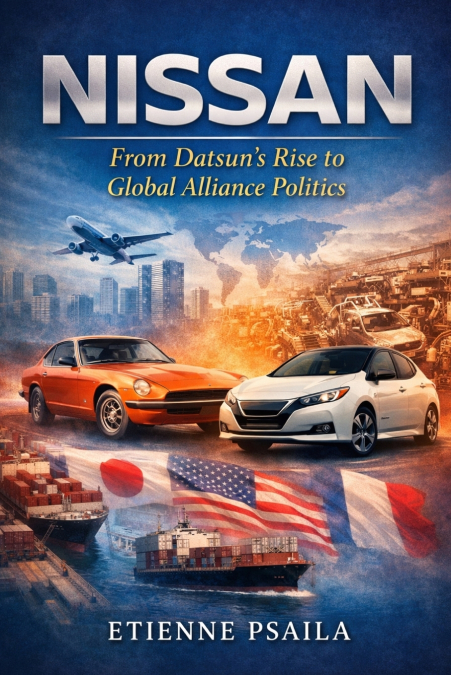
Nissan’s history is often told through its most visible symbols: the Datsun badge on early export cars, the Z’s long shadow over performance identity, and the LEAF’s role as a mass-market EV statement. This book takes a different approach-treating the cars as evidence, but tracing the deeper forces that made those cars possible (or inevitable): capital structure, labor systems, supply chains, regulation, and the internal politics of product planning at scale.From the DAT and Datsun lineage in an industrializing Japan to the postwar export discipline that hardened quality systems, Nissan repeatedly learned by being forced to compete under constraints it did not choose. The company’s global rise, its U.S. manufacturing commitments, its motorsport mythology, and its periodic strategic drift are presented as parts of one continuous story: a manufacturer navigating the collision of engineering ambition with market math.In the modern era, the narrative tightens around governance and timing-how the Renault-Nissan alliance was built to solve a crisis, how its structure later became a strategic arena, and how electrification deadlines have turned product cadence and battery decisions into corporate survival questions. The result is a fact-only, narrative account of Nissan not simply as a carmaker, but as an industrial institution shaped by external pressure and internal choices.

Artículos relacionados

  • Understanding Aikido
    Jan J Sunderlin
    Understanding Aikido: Essential Information and Perceptions (Special Edition) presents an historical, cultural, and philosophical look at the development of the Japanese martial art of Aikido. Sunderlin focuses on the influences brought to bear on Morihei Ueshiba, the founder of Aikido, and the subsequent cultivation of the latter's martial art as a vessel of Budo. The author a...
    Disponible

    63,06 €

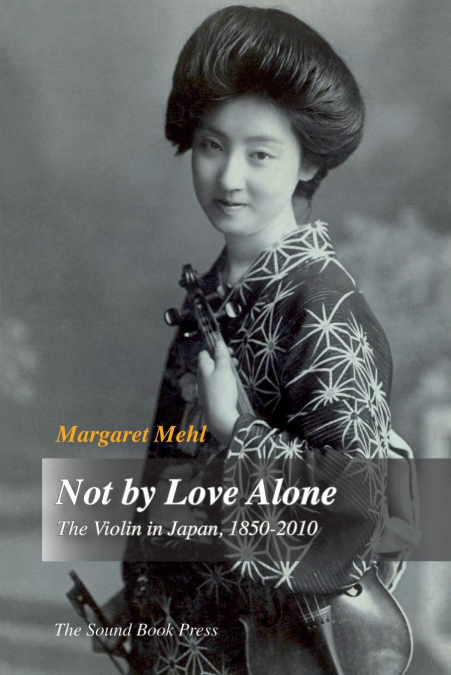
  • Not by Love Alone
    Margaret Mehl
    Suzuki Shin'ichi, the Tokyo String Quartet, Midori - How did Japanese violinists manage to revolutionize violin teaching, win international competitions, conquer Western concert stages, study at world-famous conservatoires and take up positions in leading orchestras and prestigious music faculties? What enabled the Japanese to master Western classical music within a few decades...
    Disponible

    29,32 €

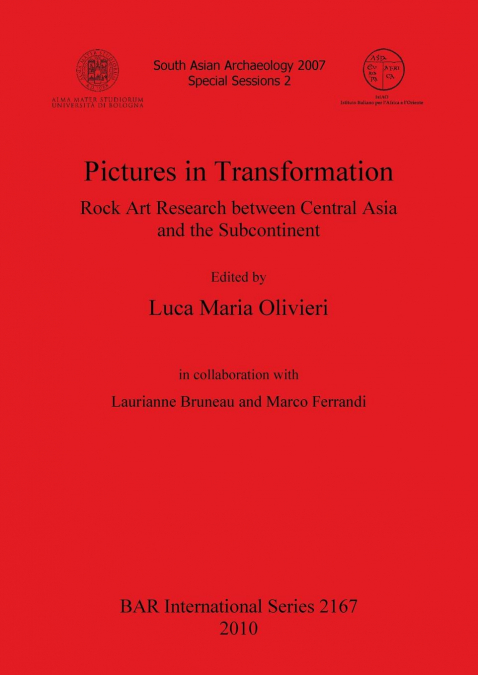
  • Pictures in Transformation
    Luca Maria Olivieri
    ...
    Disponible

    54,79 €

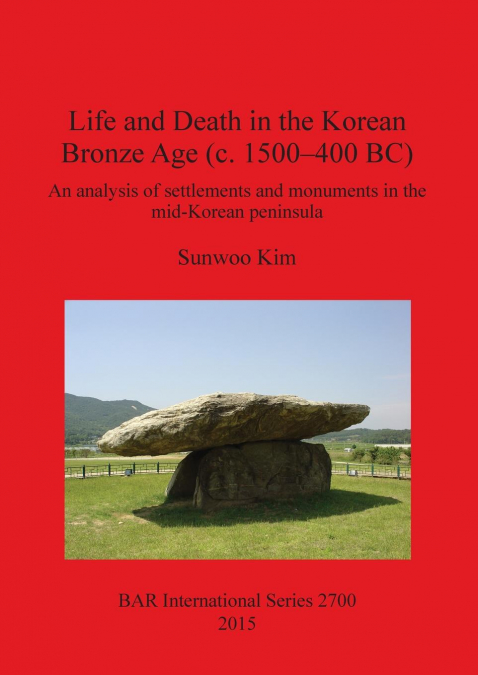
  • Life and Death in the Korean Bronze Age (c. 1500-400 BC)
    Sunwoo Kim
    This research focuses on the Bronze Age in selected areas of Korea; Seoul, Incheon, and Gyeonggi province. Two forms of evidence - settlements and monuments - are taken into account to identify their relationship with landscape and the social changes occurring between ca. 1500 to 400 cal BC. Life and death in the Bronze Age in Korea has not been synthetically investigated befor...
    Disponible

    108,34 €

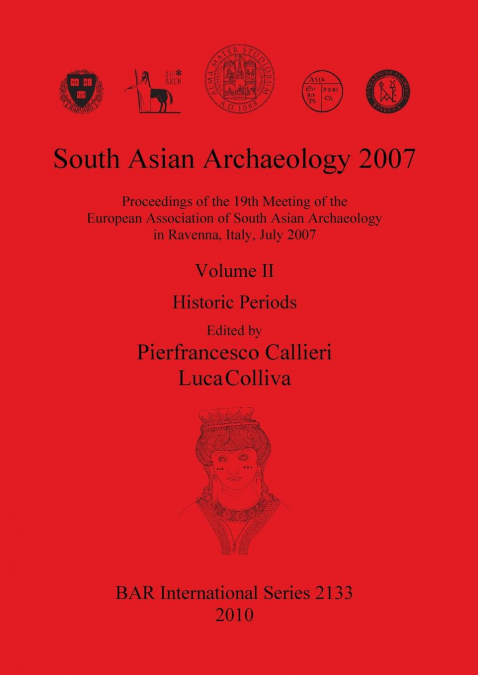
  • South Asian Archaeology 2007
    Proceedings of the 19th Meeting of the European Association of South Asian Archaeology in Ravenna, Italy, July 2007.                     ...
    Disponible

    182,04 €

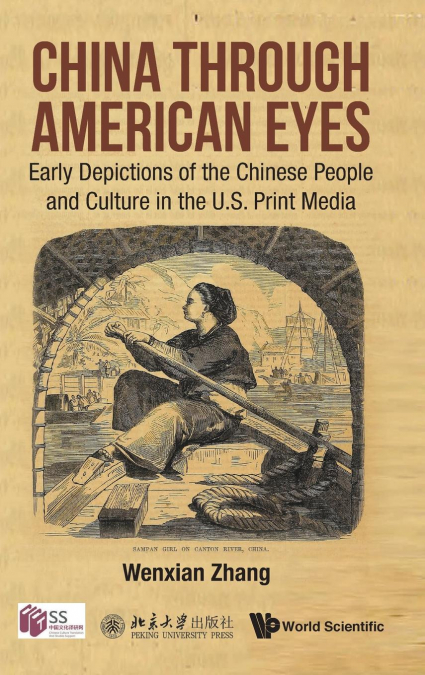
  • CHINA THROUGH AMERICAN EYES
    Wenxian Zhang / ZHANG WENXIAN
    Cultural understanding between the United States and China has been a long and complex process. The period from the mid-nineteenth century to the early twentieth century is not only a critical era in modern Chinese history, but also the peak time of illustrated news reporting in the United States. Besides images from newspapers and journals, this collection also contains pictur...

Otros libros del autor

  • Geely
    Etienne Psaila
    Geely’s rise is one of the defining industrial stories of the 21st-century car business-not because it followed the familiar path of a single brand climbing the ladder, but because it built modern automotive power the way the industry increasingly works: through platforms, capital, partnerships, and governance. From its beginnings in China’s reform-era private economy to its em...
  • BYD
    Etienne Psaila
    A battery company becoming a major automaker isn’t a catchy headline-it’s a blueprint for how the global car business is being rebuilt around electrification, supply security, and manufacturing scale. BYD’s rise tracks an industrial transformation that began in Shenzhen’s fast-moving, export-facing manufacturing economy and grew into one of the defining automotive stories of th...
  • SAIC
    Etienne Psaila
    SAIC’s ascent is one of the defining industrial stories of modern China: a Shanghai-based state enterprise that learned to build at world scale by combining policy mandate, foreign partnership, and an unforgiving culture of mass production. This book follows that trajectory from the city’s early workshops and planned-economy production routines through the reform-era opening th...
  • Lancia
    Etienne Psaila
    Lancia’s story is one of engineering audacity meeting industrial constraint. From Turin in 1906, the company built a reputation for doing things the difficult way on purpose-pioneering structural ideas, refining ride and handling when most rivals still chased simple durability, and repeatedly treating innovation as a core identity rather than a marketing layer.That same identit...
  • McLaren Automotive
    Etienne Psaila
    McLaren Automotive didn’t inherit a century of road-car tradition-it built a modern supercar business almost from first principles, using racing discipline as its operating system and carbon fibre as its defining architecture. From the MP4-12C onward, McLaren set out to prove that extreme performance could be engineered into a repeatable, warrantied, global product: light, stif...
  • Lotus
    Etienne Psaila
    Lotus has always been more than a marque; it’s been a methodology. Built in a Britain that prized ingenuity over abundance, the company turned constraint into an advantage-treating mass as the enemy, structure as an art, and steering feel as a non-negotiable. From the earliest 'specials' and kit-car pragmatism through the defining road cars that taught the industry what handlin...