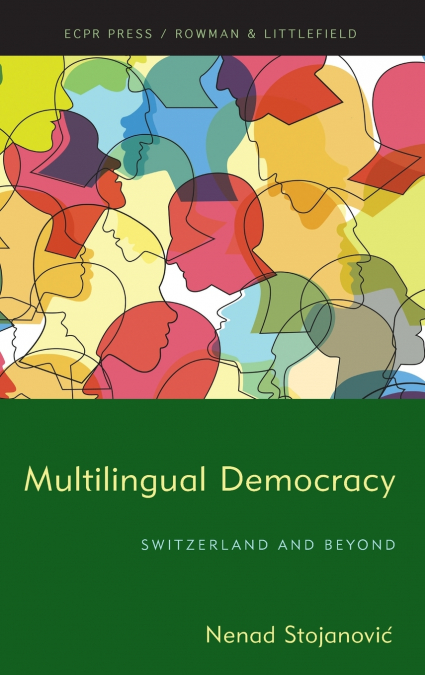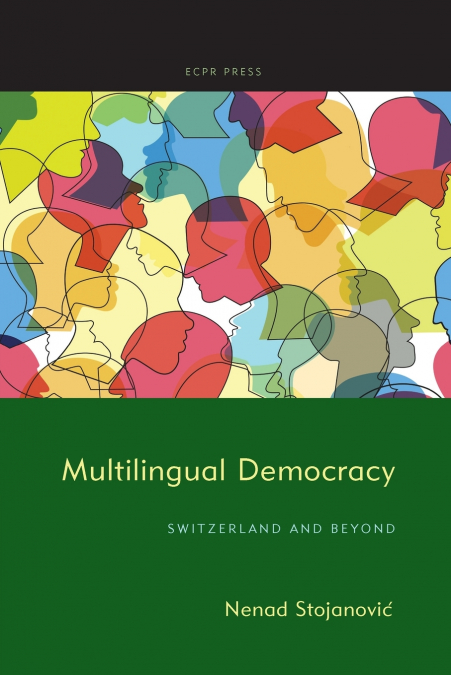

Multilingual Democracy

Multilingual Democracy

Nenad Stojanović

107,46 €
IVA incluido
Disponible
Editorial:
ECPR Press
Año de edición:
2024
Materia
Estructuras políticas: democracia
ISBN:
9781910259900
107,46 €
IVA incluido
Disponible

Selecciona una librería:

  • Librería Samer Atenea
  • Librería Aciertas (Toledo)
  • Kálamo Books
  • Librería Perelló (Valencia)
  • Librería Elías (Asturias)
  • Donde los libros
  • Librería Kolima (Madrid)
  • Librería Proteo (Málaga)

Most experts on divided societies and institutional design broadly agree that it is more difficult to establish and maintain a stable, functioning democracy in a country with multiple languages and linguistically fragmented public spheres than in more homogeneous countries. Multilingual countries such as Canada and Belgium have been experiencing considerable difficulties in past decades (see the almost successful 1995 referendum on sovereignty in Quebec or the institutional deadlock and the rise of Flemish nationalism in Belgium since the 1970s). The prospects for the EU to become a viable democracy are even more haunted by multilingualism, considering that it has 24 official languages and no lingua franca. Switzerland, however, is also a multilingual country without a lingua franca, fragmented into 22 mono-lingual and three multilingual cantons, as well as into four distinct public spheres (German, French, Italian, Romansh). And yet it is widely seen as one of the most stable and successful democracies. Conventional wisdom in political science literature suggests that 'consociational' political institutions account for the success of Swiss multilingual democracy. This book offers a different institutional explanation. The author argues that in mainstream literature important Swiss institutions - in particular direct democracy, Parliament and the federal executive - have largely been misinterpreted: they have been labelled as consociational, whereas they are rather a product of 'centripetalism', an approach to institutional design in which political incentives are directed toward intergroup compromise because of the need to appeal to voters across group lines in order to form majorities. This approach to achieving long-term democratic stability stands in sharp contrast to consociationalism.


Artículos relacionados

  • Argumentos de filosofía política de la tercera y cuarta transformaciones de México. Una aproximación interdisciplinar
    Ana Paola Tiro Chagoyán / Virginia Aspe Armella
    Presentamos al lector el tercero de los tres libros que fueron resultado del proyecto de investigación semilla Fondo Fomento a la Investigación de la Universidad Panamericana que en nuestro caso fue titulado Argumentos de filosofía política de las cuatro transformaciones de México, etapa primera, la Ilustración mexicana de los siglos XVIII y primeros años del XIX, la Independen...
    Disponible

    30,68 €

  • Making Democracy Fun
    Josh A. Lerner
    ...
    Disponible

    33,87 €

  • Resist Turbulent Times
    Verda Harris-Olayinka
    Resist Turbulent Times is for Everyday People and College students (who are also Everyday Ppl) - and their professors who assign textbooks for their students.Verda H. Olayinka followed the advice of noted Kemetic (African) American visionary, Harold Cruse who advised theCultural Intellectual to 'Synthesize a Black Social Science methodology in the process of developing a functi...
    Disponible

    16,64 €

  • By Executive Order
    Andrew Rudalevige
    How the executive branch-not the president alone-formulates executive orders, and how this process constrains the chief executive’s ability to act unilaterallyThe president of the United States is commonly thought to wield extraordinary personal power through the issuance of executive orders. In fact, the vast majority of such orders are proposed by federal agencies and shaped ...
    Disponible

    43,00 €

  • The Autocratic Middle Class
    Bryn Rosenfeld
    How middle-class economic dependence on the state impedes democratization and contributes to authoritarian resilienceConventional wisdom holds that the rising middle classes are a force for democracy. Yet in post-Soviet countries like Russia, where the middle class has grown rapidly, authoritarianism is deepening. Challenging a basic tenet of democratization theory, Bryn Rosenf...
  • The Autocratic Middle Class
    Bryn Rosenfeld
    How middle-class economic dependence on the state impedes democratization and contributes to authoritarian resilienceConventional wisdom holds that the rising middle classes are a force for democracy. Yet in post-Soviet countries like Russia, where the middle class has grown rapidly, authoritarianism is deepening. Challenging a basic tenet of democratization theory, Bryn Rosenf...
    Disponible

    54,14 €

Otros libros del autor

  • Multilingual Democracy
    Nenad Stojanović
    Most experts on divided societies and institutional design broadly agree that it is more difficult to establish and maintain a stable, functioning democracy in a country with multiple languages and linguistically fragmented public spheres than in more homogeneous countries. Multilingual countries such as Canada and Belgium have been experiencing considerable difficulties in pas...