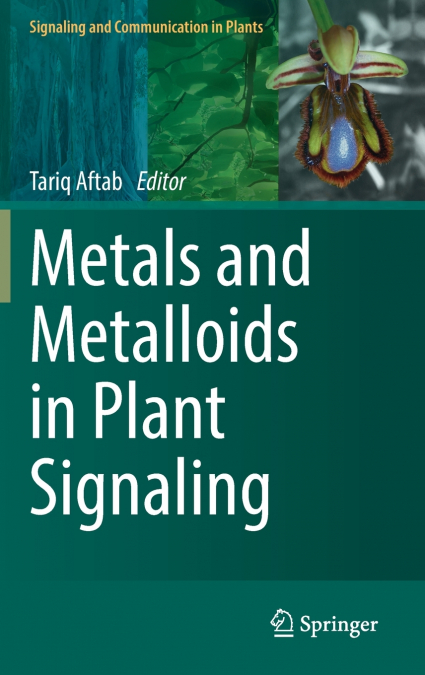

Metals and Metalloids in Plant Signaling

Metals and Metalloids in Plant Signaling

Tariq Aftab

307,32 €
IVA incluido
Consulta disponibilidad
Editorial:
Springer Nature B.V.
Año de edición:
2024
Materia
Botánica y ciencias de las plantas
ISBN:
9783031590238

Selecciona una librería:

  • Librería Samer Atenea
  • Librería Aciertas (Toledo)
  • Kálamo Books
  • Librería Perelló (Valencia)
  • Librería Elías (Asturias)
  • Donde los libros
  • Librería Kolima (Madrid)
  • Librería Proteo (Málaga)

In many parts of the world, soil and water are slightly to moderately contaminated with metals and metalloids such as Cd, Cu, Zn, Ni, Co, Cr, Pb, Si, B and As. This could be due to long-term use of phosphatic fertilizers, sewage sludge application, dust from smelters, industrial waste and bad watering practices in agricultural lands. Beside natural factors, human activities have contributed to the enormous increase in heavy metal and/or metalloid pollution in the environment. Metal and metalloid stress are major abiotic stress factors that limit crop production and reduce agricultural yield. The primary response of plants is the generation of reactive oxygen species (ROS) upon exposure to high levels of metals/metalloids. They either generate ROS directly through Haber-Weiss reactions or overproduction of ROS and occurrence of oxidative stress in plants could be the indirect consequence of metals/metalloids toxicity. The indirect mechanisms include their interaction with the antioxidant system, disrupting the electron transport chain or disturbing the metabolism of essential elements. One of the most deleterious effects induced by heavy metals exposure in plants is lipid peroxidation, which can directly cause biomembrane deterioration.The impact of metals/metalloids on plant water relations has to be distinguished from their effects on water availability in soils, on root growth, limiting water uptake, as well as other phytotoxic effects. If soils are high in soluble salts (including heavy metal salts), the osmotic potential in the soil solution might be lower than the potential of the cell sap in root. Under these circumstances, the soil solution would severely restrict the rate of water uptake by plants and lead to osmotic stress. Further, the negative influence metals/metalloids have on the growth and activities of soil microorganisms, may also indirectly affect the growth of plants.In the book 'Metals and Metalloids in Plant Signaling', we elucidated the effects of metals/metalloids on signaling and communication cascades in plants. The general aim of the present book is to provide a comprehensive analysis of the current situation and development in the field and to develop a science-based theoretical foundation for the conceptualization, and practical application. The various chapters are based on the consideration of metals/metalloids in terms of their action on different regulatory and functional systems of plants (signaling, metabolism, uptake, and transport mechanisms, etc.).
Artículos relacionados

  • The Green Architecture
    Ali Mirshafieyan / Ghazal Yeganeh / Maryam Zamani Motlagh
    Protecting green energy as well as non-renewable energy, as well as their sustainable use, many advances in the technology of extracting oil products and other reserves under the ground have caused many improvements. In this regard, proposing the design of buildings in which the consumption of fossil fuels reaches its lowest level is considered one of the important solutions in...
    Disponible

    82,54 €

  • Responsible Use and Management of Agrochemicals
    Juan Carlos Nava
    Uso y manejo responsable de agroquímicos is a work product of the author’s experiences (undergraduate and graduate professor, with research and extension projects), aimed at producers, companies, professionals, students, advisors, researchers, among others.Due to its structure and content, it is expected to be a valuable aid to all people directly or indirectly involved in the ...
    Disponible

    49,45 €

  • Hope in the Soil
    Ellen G White
    Before edible classrooms began 'sprouting' in elementary schools, before buzzwords like 'sustainable agriculture', 'organic,' or 'veganic' came into existence, an exceptional woman named Ellen G. White penned numerous letters and articles on the importance of farming, an outdoor life, and manual labor. Though often remembered for other things, Mrs. White was actively engaged in...
    Disponible

    18,38 €

  • The Green Revolution
    Binitha Sophine Emmanuel
    The Green Revolution, a transformative era in the annals of agriculture, emerged as a game-changing force during the mid-20th century, fundamentally reshaping the methodology of food production and steering the trajectory of global food security. Characterized by a sequence of technological breakthroughs, the Green Revolution aimed to substantially augment agricultural producti...
    Disponible

    53,23 €

  • Utilization of Stingless Bees, Tetragonula laeviceps (Smith)
    Dr. J. J. Pastagia / Dr. V. C. Gadhiya
    The present investigations on utilization of stingless bees, T. laeviceps Smith in net house condition carried out with the broad aspects like flowers visited by stingless bees, T. laeviceps Smith, toxicity of insecticides to T. laeviceps Smith workers, floral biology of musk melon, foraging behavior of stingless bees, T. laeviceps Smith in net house condition, effect of pollin...
    Disponible

    84,80 €

  • La révolution verte
    Binitha Sophine Emmanuel
    La révolution verte, une ère transformatrice dans les annales de l’agriculture, est apparue comme une force qui a changé la donne au milieu du 20e siècle, remodelant fondamentalement la méthodologie de la production alimentaire et orientant la trajectoire de la sécurité alimentaire mondiale. Caractérisée par une série de percées technologiques, la révolution verte visait à augm...
    Disponible

    53,29 €

Otros libros del autor

  • Plant Responses to Cadmium Toxicity
    Tariq Aftab
    This book offers an exploration of how plants respond to the presence of cadmium, shedding light on both the physiological and molecular mechanismsIn an era of growing environmental concern, this edited book serves as an invaluable resource, shedding light on the intricate interplay between plants and cadmium, a menacing environmental pollutant. Cadmium’s pervasive presence in ...
  • Auxins, Cytokinins and Gibberellins Signaling in Plants
    Tariq Aftab
    Plant hormones have pivotal roles in the regulation of plant growth, development, and reproduction. Their signaling pathways are interconnected in a complex network, which provides plants with an enormous regulatory potential to rapidly adapt to their environment and to utilize their limited resources for growth and survival in a cost-efficient manner. Auxin is a hormone molecu...
    Disponible

    308,73 €

  • Environmental Challenges and Medicinal Plants
    Tariq Aftab
    Medicinal plants supply the ever-growing needs of humankind for natural chemicals, such as pharmaceuticals, nutraceuticals, agrochemicals, and chemical additives. These plants contain bioactive secondary metabolites, which possess antimalarial, anthelminthic, anti-inflammatory, analgesic, antimicrobial, antiarthritic, antioxidant, antidiabetic, antihypertensive, anticancer, ant...
    Disponible

    247,73 €

  • Emerging Contaminants and Plants
    Tariq Aftab
    Emerging contaminants (ECs) are predominantly unregulated anthropogenic chemicals that occur in air, soil, water, food, and plant/animal tissues in trace concentrations. ECs are persistent in the environment, capable of perturbing the physiology of target receptors and, therefore, are increasingly regarded as a subject of concern. This volume aims to enhance understanding of em...
  • Emerging Contaminants and Plants
    Tariq Aftab
    Emerging contaminants (ECs) are predominantly unregulated anthropogenic chemicals that occur in air, soil, water, food, and plant/animal tissues in trace concentrations. ECs are persistent in the environment, capable of perturbing the physiology of target receptors and, therefore, are increasingly regarded as a subject of concern. This volume aims to enhance understanding of em...
    Disponible

    47,50 €

  • Omics Analysis of Plants under Abiotic Stress
    Tariq Aftab
    This new volume highlights the various emerging techniques and molecular applications that are currently being used in plant abiotic stress physiology. It provides a thorough overview of omics approaches in response to stressors such as low water accessibility (drought), excess water (flooding/waterlogging), extremes of temperatures (cold, chill, frost, and heat), salinity, min...