
Mathematical Properties of Population-Genetic Statistics

Mathematical Properties of Population-Genetic Statistics

Noah A. Rosenberg

80,01 €
IVA incluido
Disponible
Editorial:
Princeton University Press
Año de edición:
2025
Materia
Evolución
ISBN:
9780691168333
80,01 €
IVA incluido
Disponible

Selecciona una librería:

  • Librería Samer Atenea

  • Kálamo Books
  • Librería Elías (Asturias)
  • Librería Kolima (Madrid)
  • Librería Proteo (Málaga)

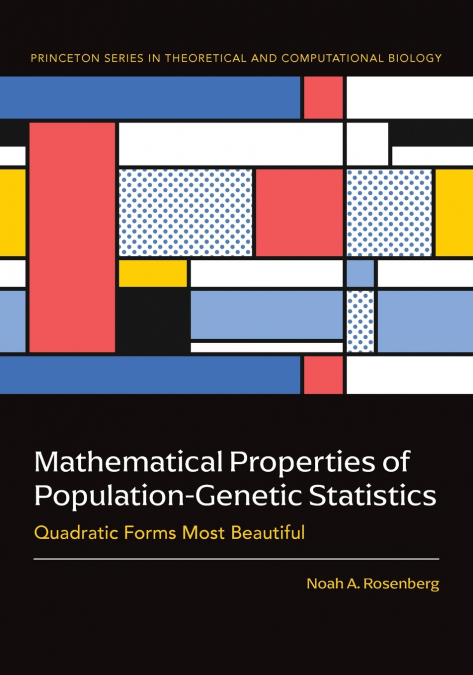
A powerful new approach to interpreting population-genetic data in evolution and ecologyPopulation genetics uses statistical analysis to catalog genetic variation among populations and species. Summary statistics computed from allele frequencies—mathematical functions that measure features of genetic similarity and diversity—are key to this global effort. Yet despite their widespread use in evolutionary biology, ecology, and conservation biology, their mathematical properties have largely been overlooked. This book shows how to use the mathematical bounds on summary statistics to make better interpretations of population-genetic data.Noah Rosenberg discusses how the behavior of these statistics depends not only on the biology of the populations they seek to describe but also on the mathematical properties of the functions used to compute them, properties that produce constraints on the values of the statistics and influence their interpretation. Focusing on the concept of homozygosity—a quadratic function of allele frequencies in a population—he demonstrates how to account for mathematical constraints when measuring genetic similarity and diversity. Rosenberg illustrates the results using examples from empirical data and shares strategies that readers can use to apply this mathematical perspective to different kinds of summary statistics, including those for measuring biodiversity in ecological communities.Drawing inspiration from Charles Darwin, who marveled at evolution’s “endless forms most beautiful and most wonderful,” this book presents a groundbreaking approach to the study of genetic variation. It is sure to stimulate new research in population biology and deeper thinking about the meaning and interpretation of essential measurements of the world’s genomes.
Artículos relacionados

  • From Logos to Bios
    Wynand de Beer
    ...
  • L’età dell’oro dei cacciatori
    Alberto Peruffo
    L'universo, il pianeta Terra, l'uomo. L'avventura della specie umana si dipana lentamente dall'essere unicellulare fino all'uomo dei giorni nostri che, tra mille travagli, ha raggiunto la condizione di assoluta supremazia.La presenza nell'uomo moderno dei geni del DNA dell'uomo di Neanderthal ha chiarito che, questi antichi uomini, facevano parte, a ...
    Disponible

    40,53 €

  • Exploring Genome’s Junkyard
    Subir Ranjan Kundu
    Exploring Genome’s Junkyard: In the Labyrinth of Evolution narrates the progress of biological evolution, beginning with the conceptual introspection of gene and continuing with the contemporary understanding of the structural and function aspects of the human genome. Recent advances in human genome research have led scientists to the term 'biological dark matter,' which refers...
  • European Hair, Eye, and Skin Color
    Peter Frost
    Europeans, especially those from northern and eastern Europe, are unique in having diverse hair and eye colors and a skin almost as pale as an albino’s. Those colors are not only brighter than the original black and brown but also 'purer'-they lie within thin slices of the visible spectrum. Overall, that color scheme is more developed in women, who naturally have a higher incid...
  • Mitochondrial Eve and Y-Chromosomal Adam
    Subir Ranjan Kundu
    Mitochondrial Eve and Y-Chromosomal Adam discusses theoretical ideas, interpretations, and paleontological evidence to narrate the origin and evolutionary story of Sapiens through the transitional stages of archaic human species involved in the evolutionary pilgrimage, from the great apes and to modern humans. Author Subir Ranjan Kundu investigates the DNA footprints of primate...
  • When Evolution Stops
    Armando Simon
    Evolution is a fact. The evidence for it is simply overwhelming. However, the original mechanism that generates the evolutionary process, as first put forth simultaneously by Charles Darwin and Alfred R. Wallace and which became known as Natural Selection, has now been seen to be too simplistic by some scientists aside from the hard-core neo-Darwinists who insist that nothing w...
    Disponible

    28,77 €