N. Christian Smoot / NChristian Smoot
 Librería Samer Atenea
 Kálamo Books
 Librería Elías (Asturias)
 Librería Kolima (Madrid)
 Librería Proteo (Málaga)
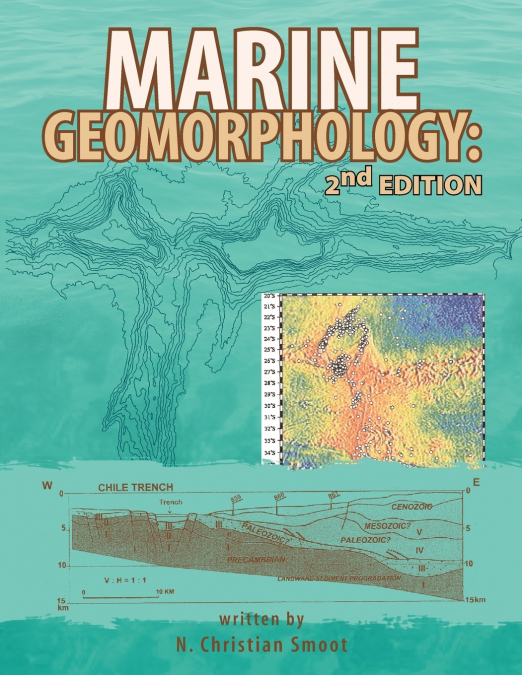
Several years ago I realized there was a need for a marine geomorphology book. As a de facto teacher of new hires in the Bathymetry Division of the Naval Oceanographic Office, I wrote and updated that training manual four times between 1980 and 1997. After I retired in 1998, I decided to do just that, using the materials that I had learned about and taught over the years. However, what was really 'out there' on the ocean floor and what was supposed to be out there were not the same. As the surveyed regions evolved, the realization came that things were not as they should be with the tectonic working hypothesis. My paper content evolved with the ocean data, so much so that trying to get that published in the main-stream journals became more and more difficult for whatever reasons. Using all of the survey data for the north Atlantic basin yielded what we called a 'superchart,' one which showed the basin in its entirety. Initially, I was thrown into a hotbed of NAVOCEANO’s researchers in 1973, working with Peter Vogt primarily for about five months. Daily talks with Peter, Bill Ruddiman, Allen Lowrie, Fred Bowles, Troy Holcombe, and constant exposure to Lou Hemler taught me what was then known about the ocean floor. Dave Epp came to NAVOCEANO on an ONR contract to look at the location of all the seamounts in that basin. Our study revealed a number considerably less than that which had been proposed, about 900. We published that data. From the same superchart I constructed a basin-wide diagram of the fracture valleys. We presented both at an AGU meeting. The astute observer noticed that all of the seamount chains were associated with the ends of the fracture valleys. This tied in with a few of the surveys I had been senior scientist on in the Pacific where we discovered many seamounts lying in the fracture zones. Will Sager, Don Hussong, Patty Fryer, Brian Tucholke, and Brian Taylor were all allowed in to see the NAVOCEANO data bases on Office of Naval Research contracts, and I had the pleasure of working with them all. They taught me a lot about plate tectonics, but mainly they taught me to look at the data and see what was there. At that time, the late 1980s, I realized that all was not as predicted by the plate tectonic hypothesis, but was still able to get ready acceptance of papers on whatever I was writing about. This was soon to change. By the early 1990s I ceased publishing for a time to digest other aspects, such as earthquake populations at subduction zones. The realization that deep earthquakes occurred only at nine spots worldwide was another eye-opener. Trying to get this information published became more of a hassle that it was worth, as I was getting tired of butting heads with the stone walls of main-stream journal reviewers. In fact, it became next to impossible. One author, tired of butting heads with me, published some drivel trying to attack the data by saying that the positions were incorrect. I admit that I was not allowed to say the minutes, as in degrees- seconds-minutes, but we’re not talking about minuscule features here. Most of these are at least 50 nm in diameter! At this time a new book in the NAVOCEANO library was brought to my attention by my old friend, Allen Lowrie. In it was a paper citing some of my work. I wrote to the author, thinking him to be a bright young star on the horizon, that I had found a kindred spirit. Little did I know that the primary author was a world-famous exploration geologist who was actually older than I. We collaborated for the rest of his life, and I started publishing in different journals. Life anew! In the early 1990s we were able to access the information from the GEOSAT, and Earth-orbitting satellite collecting gravity data. Applying a high-pass filter to that data revealed basin-wide trends. A comparison of the GEOSAT data of the north Atlantic fracture valley diagram I had done a few years before r