Inicio > Matemáticas y ciencia > Biologia, ciencias de la vida > Botánica y ciencias de las plantas > Lutte contre les principaux insectes ravageurs du haricot à grappes
Lutte contre les principaux insectes ravageurs du haricot à grappes

Lutte contre les principaux insectes ravageurs du haricot à grappes

Kaushik Parmar / Nitesh Litoriya / Ravi Kalasariya

66,99 €
IVA incluido
Disponible
Editorial:
KS OmniScriptum Publishing
Año de edición:
2026
Materia
Botánica y ciencias de las plantas
ISBN:
9786209407796
66,99 €
IVA incluido
Disponible

Selecciona una librería:

  • Librería Samer Atenea
  • Kálamo Books
  • Librería Elías (Asturias)
  • Librería Kolima (Madrid)
  • Librería Proteo (Málaga)

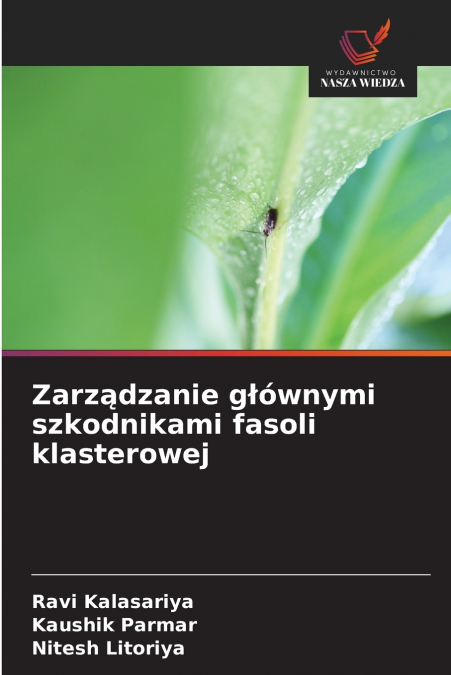
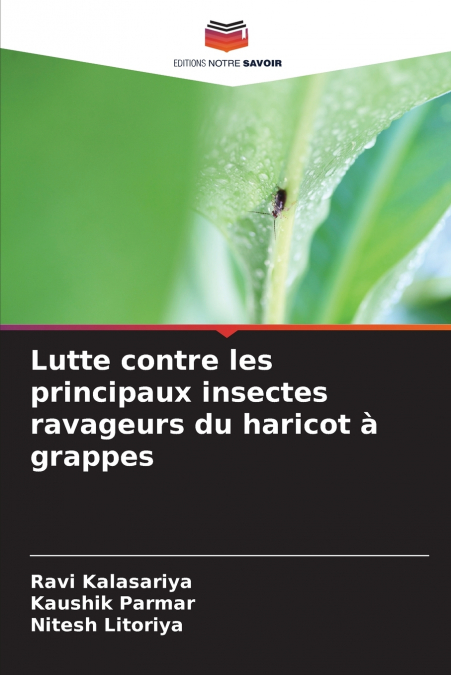
Le haricot à grappes (Cyamopsis tetragonaloba (Linn.) Taub.) tire son nom du mot sanskrit GAUAAHAR , qui signifie fourrage pour les vaches ou autre bétail. Le haricot à grappes est utilisé comme légume pour la consommation humaine, mais il est également cultivé pour l’alimentation du bétail et comme engrais vert. Étant une légumineuse, il est également une bonne source de calcium, de fer et de vitamines. Le haricot à grappes est attaqué par différents insectes nuisibles à différents stades de croissance de la culture, ce qui entraîne des pertes cumulatives importantes en termes de rendement. Un seul insecticide ne permet pas de lutter efficacement contre les insectes nuisibles, car ceux-ci ont des habitudes et causent des dégâts de nature différente. La lutte contre les insectes nuisibles est une condition fondamentale pour obtenir un rendement plus élevé et de meilleure qualité des cultures de plein champ. Un seul insecticide ne permet pas de lutter efficacement contre ces ravageurs qui attaquent le haricot à grappes à différents stades de son développement. Il est donc primordial de mettre au point une lutte contre les insectes nuisibles qui non seulement permette de lutter efficacement contre les différents ravageurs qui attaquent cette culture, mais qui soit également sans danger pour les abeilles mellifères.
Artículos relacionados

  • The Green Architecture
    Ali Mirshafieyan / Ghazal Yeganeh / Maryam Zamani Motlagh
    Protecting green energy as well as non-renewable energy, as well as their sustainable use, many advances in the technology of extracting oil products and other reserves under the ground have caused many improvements. In this regard, proposing the design of buildings in which the consumption of fossil fuels reaches its lowest level is considered one of the important solutions in...
    Disponible

    82,54 €

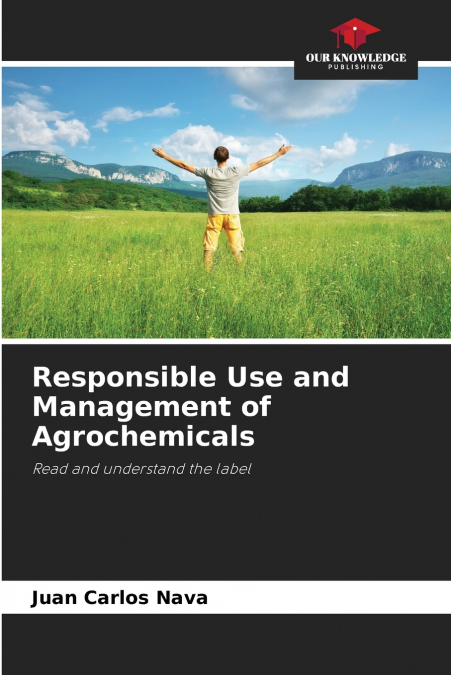
  • Responsible Use and Management of Agrochemicals
    Juan Carlos Nava
    Uso y manejo responsable de agroquímicos is a work product of the author’s experiences (undergraduate and graduate professor, with research and extension projects), aimed at producers, companies, professionals, students, advisors, researchers, among others.Due to its structure and content, it is expected to be a valuable aid to all people directly or indirectly involved in the ...
    Disponible

    49,45 €

  • Hope in the Soil
    Ellen G White
    Before edible classrooms began 'sprouting' in elementary schools, before buzzwords like 'sustainable agriculture', 'organic,' or 'veganic' came into existence, an exceptional woman named Ellen G. White penned numerous letters and articles on the importance of farming, an outdoor life, and manual labor. Though often remembered for other things, Mrs. White was actively engaged in...
    Disponible

    18,38 €

  • The Green Revolution
    Binitha Sophine Emmanuel
    The Green Revolution, a transformative era in the annals of agriculture, emerged as a game-changing force during the mid-20th century, fundamentally reshaping the methodology of food production and steering the trajectory of global food security. Characterized by a sequence of technological breakthroughs, the Green Revolution aimed to substantially augment agricultural producti...
    Disponible

    53,23 €

  • Utilization of Stingless Bees, Tetragonula laeviceps (Smith)
    Dr. J. J. Pastagia / Dr. V. C. Gadhiya
    The present investigations on utilization of stingless bees, T. laeviceps Smith in net house condition carried out with the broad aspects like flowers visited by stingless bees, T. laeviceps Smith, toxicity of insecticides to T. laeviceps Smith workers, floral biology of musk melon, foraging behavior of stingless bees, T. laeviceps Smith in net house condition, effect of pollin...
    Disponible

    84,80 €

  • La révolution verte
    Binitha Sophine Emmanuel
    La révolution verte, une ère transformatrice dans les annales de l’agriculture, est apparue comme une force qui a changé la donne au milieu du 20e siècle, remodelant fondamentalement la méthodologie de la production alimentaire et orientant la trajectoire de la sécurité alimentaire mondiale. Caractérisée par une série de percées technologiques, la révolution verte visait à augm...
    Disponible

    53,29 €

Otros libros del autor

  • Gestão das principais pragas de insetos do feijão-de-cacho
    Kaushik Parmar / Nitesh Litoriya / Ravi Kalasariya
    O feijão-de-cacho (Cyamopsis tetragonaloba (Linn.) Taub.) deriva da palavra sânscrita GAUAAHAR, que significa forragem para vacas ou, de outra forma, forragem para o gado. O feijão-de-cacho é utilizado como vegetal para consumo humano e também é cultivado para alimentação de gado e como cultura de adubo verde. Por ser uma cultura leguminosa, é também uma boa fonte de Ca, Fe e v...
    Disponible

    66,91 €

  • Gestione dei principali insetti nocivi del fagiolo rampicante
    Kaushik Parmar / Nitesh Litoriya / Ravi Kalasariya
    Il fagiolo rampicante (Cyamopsis tetragonaloba (Linn.) Taub.) deriva dalla parola sanscrita 'GAUAAHAR', che significa foraggio per bovini o, in alternativa, foraggio per il bestiame. Il fagiolo rampicante è utilizzato come ortaggio per il consumo umano e coltivato anche come mangime per il bestiame e come coltura da sovescio. Essendo una coltura leguminosa, è anche una buona fo...
    Disponible

    66,91 €

  • Zarządzanie głównymi szkodnikami fasoli klasterowej
    Kaushik Parmar / Nitesh Litoriya / Ravi Kalasariya
    Fasola klasterowa (Cyamopsis tetragonaloba (Linn.) Taub.) wywodzi się od sanskryckiego słowa „GAUAAHAR', które oznacza paszę dla krów lub inną paszę dla zwierząt gospodarskich. Fasola klasterowa jest wykorzystywana jako warzywo do spożycia przez ludzi, a także uprawiana jako pasza dla bydła i jako roślina nawozu zielonego. Jako roślina strączkowa jest również dobrym źródłem wap...
    Disponible

    66,91 €

  • Bekämpfung der wichtigsten Schädlinge der Clusterbohne
    Kaushik Parmar / Nitesh Litoriya / Ravi Kalasariya
    Der Name „Clusterbohne' (Cyamopsis tetragonaloba (Linn.) Taub.) leitet sich vom Sanskrit-Wort „GAUAAHAR' ab, was „Kuhfutter' oder „Viehfutter' bedeutet. Clusterbohnen werden als Gemüse für den menschlichen Verzehr verwendet und auch als Viehfutter und Gründüngungspflanze angebaut. Als Hülsenfrucht sind sie außerdem eine gute Quelle für Ca, Fe und Vitamine. Clusterbohnen werden ...
    Disponible

    66,99 €