 Librería Samer Atenea
 Kálamo Books
 Librería Elías (Asturias)
 Librería Kolima (Madrid)
 Librería Proteo (Málaga)
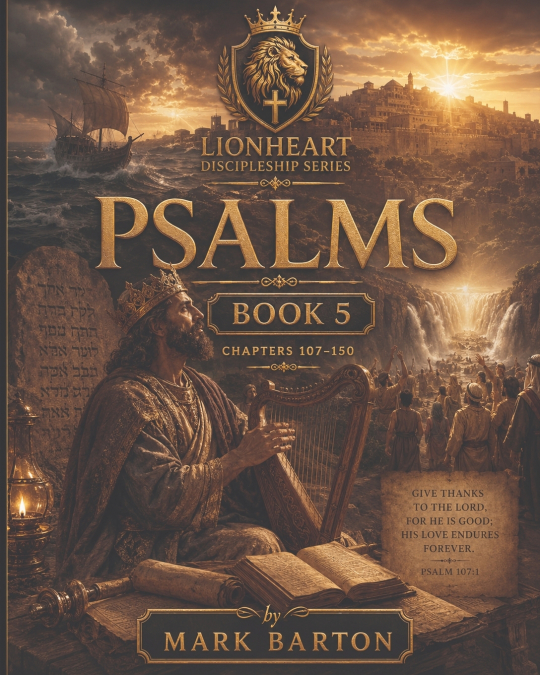
Psalms 107-150, traditionally recognized as Book 5 of the Psalter, brings the entire Book of Psalms to its magnificent conclusion, moving from restoration and thanksgiving through renewed devotion to God’s Word, pilgrimage, remembrance of the Davidic covenant, and finally an overwhelming crescendo of universal praise. Psalm 107 opens by calling the redeemed to give thanks to the Lord because His steadfast love endures forever, portraying people lost, imprisoned, afflicted, and endangered who cry to God in their distress and experience His deliverance-a fitting picture of a people gathered and restored by divine mercy. Psalms 108-110 turn toward victory and kingship, with Psalm 110 presenting David’s exalted Lord as both king and priest, a passage the New Testament repeatedly applies to Jesus Christ and His sovereign, priestly reign. Psalms 111-118 celebrate God’s mighty works, righteousness, compassion, covenant faithfulness, and saving power, culminating in Psalm 118’s celebration of the rejected stone becoming the cornerstone and the one who comes in the name of the Lord, themes later explicitly connected with Christ in the New Testament. At the center of Book 5 stands Psalm 119, Scripture’s longest psalm, whose sustained meditation on God’s Word teaches that His commands, promises, statutes, and truth guide, strengthen, correct, comfort, and preserve His people as they walk faithfully with Him. Psalms 120-134, the Songs of Ascents, then portray worshipers journeying toward Jerusalem, transforming pilgrimage into a spiritual picture of dependence upon God, communal worship, unity, perseverance, and joyful approach to His presence. Psalms 135-137 call Israel to remember the Lord’s sovereign acts in creation and history, while Psalm 137 gives painful voice to the grief of exile, refusing to treat the wounds of displacement and Jerusalem’s destruction as insignificant. Psalms 138-145 return prominently to Davidic prayers and praise, where suffering, opposition, human frailty, and dependence upon God are increasingly overshadowed by confidence in His kingdom, compassion, righteousness, and enduring faithfulness. Psalm 145 becomes a majestic declaration that God’s kingdom is everlasting and that His gracious rule extends from generation to generation. The Psalter then reaches its intended destination in Psalms 146-150, five consecutive psalms framed by the command 'Praise the LORD.' Human rulers cannot provide ultimate salvation, but the Creator remains faithful forever, executes justice, cares for the vulnerable, restores His people, governs creation, and deserves the praise of everything He has made. The final Psalm steadily expands the congregation of worship until the invitation becomes universal: 'Let everything that has breath praise the LORD.' Thus, the storyline of Psalms 107-150 moves from redeemed people thanking God for deliverance to all creation praising Him for who He is. Book 5 does not deny suffering, sin, exile, enemies, or unanswered questions; rather, it places them within the greater reality of God’s steadfast love, covenant faithfulness, sovereign kingdom, and redemptive purposes. For Christians, its royal and messianic expectations find their fullest fulfillment in Jesus Christ, the promised Son of David, rejected cornerstone, eternal King, and priest forever. Psalms 107-150 therefore call believers to remember what God has done, treasure His Word, depend upon Him throughout life’s pilgrimage, trust His promises when circumstances remain difficult, and respond to His redeeming grace with obedient, grateful, wholehearted worship. The Psalter ultimately ends where the redeemed life is meant to lead: not merely with answers to every hardship, but with confident faith in the Lord and an invitation for every living thing to join the everlasting chorus-Praise the LORD.