Charles-Louis de Secondat de Montesquieu
 Librería Samer Atenea
 Kálamo Books
 Librería Elías (Asturias)
 Librería Kolima (Madrid)
 Librería Proteo (Málaga)
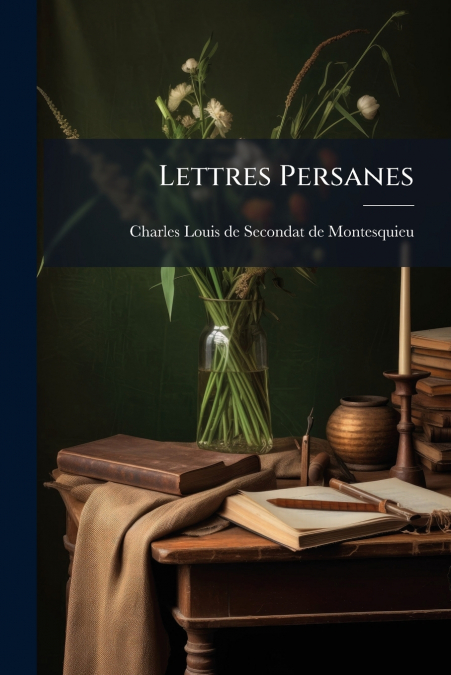
Lettres Persanes (Persian Letters) by Charles-Louis de Secondat, Baron de Montesquieu, is a satirical epistolary novel that offers a critical perspective on French society and European customs during the Enlightenment. Through the fictional correspondence of two Persian travelers, Usbek and Rica, Montesquieu cleverly critiques the political, religious, and social norms of 18th-century France.First published anonymously in 1721, this work explores themes of reason, tolerance, and the dangers of despotism. The Persians’ observations expose the absurdities and contradictions within French culture, providing a thought-provoking commentary on power, morality, and the human condition. Included with the letters are 'Arsace et Isménie' and 'Pensées Diverses', enriching the reader’s experience with further reflections on the era.'Lettres Persanes' remains a significant work of French literature, valued for its wit, philosophical insights, and enduring relevance to contemporary discussions about cultural relativism and the critique of established institutions.This work has been selected by scholars as being culturally important, and is part of the knowledge base of civilization as we know it. This work was reproduced from the original artifact, and remains as true to the original work as possible. Therefore, you will see the original copyright references, library stamps (as most of these works have been housed in our most important libraries around the world), and other notations in the work.This work is in the public domain in the United States of America, and possibly other nations. Within the United States, you may freely copy and distribute this work, as no entity (individual or corporate) has a copyright on the body of the work.As a reproduction of a historical artifact, this work may contain missing or blurred pages, poor pictures, errant marks, etc. Scholars believe, and we concur, that this work is important enough to be preserved, reproduced, and made generally available to the public. We appreciate your support of the preservation process, and thank you for being an important part of keeping this knowledge alive and relevant.