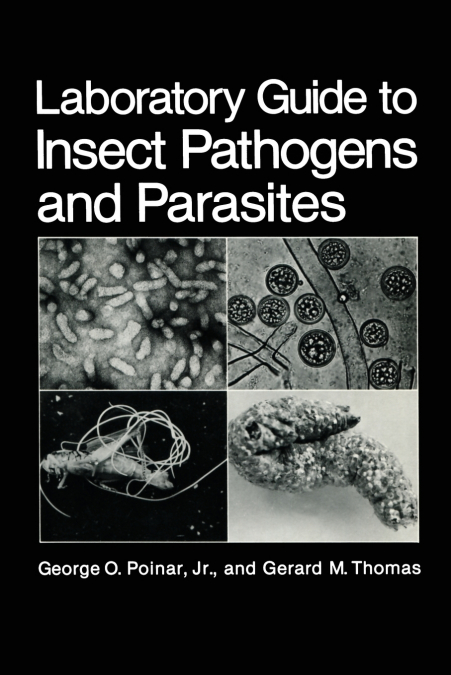
Laboratory Guide to Insect Pathogens and Parasites

Laboratory Guide to Insect Pathogens and Parasites

G. M. Thomas / G. O. Poinar Jr

136,67 €
IVA incluido
Disponible
Editorial:
Springer Nature B.V.
Año de edición:
2012
Materia
Evolución
ISBN:
9781468485462
136,67 €
IVA incluido
Disponible

Selecciona una librería:

  • Librería Samer Atenea
  • Librería Aciertas (Toledo)
  • Kálamo Books
  • Librería Perelló (Valencia)
  • Librería Elías (Asturias)
  • Donde los libros
  • Librería Kolima (Madrid)
  • Librería Proteo (Málaga)

After the publication of the Diagnostic Manual for the Identification of Insect Pathogens, the authors received many queries asking why they had not included the larger metazoan parasites as well as the microbial forms. An examination of the literature indicated that pictorial guides to the identification of nematodes and the immature stages of insect parasites were unavailable. Consequently we decided to rewrite the sections cover­ ing insect pathogens and combine these with new sections on ento­ mogenous nematodes and the immature stages of insect parasites. The result is the present laboratory guide, which is unique in covering all types of biotic agents which are found inside insects and cause them injury or disease. Included as parasites are insects and nematodes. Among the pathogens included are viruses, rickettsias, bacteria, fungi, and protozoans. Emphasis is placed on identification with an attempt to use the most easily recognizable characters. Use of a certain number of technical terms is unavoidable, and explanations of these can be found in most biological dictionaries or the glossary of invertebrate pathology prepared by Steinhaus and Martignoni (1970).
Artículos relacionados

  • From Logos to Bios
    Wynand de Beer
    ...
  • L’età dell’oro dei cacciatori
    Alberto Peruffo
    L'universo, il pianeta Terra, l'uomo. L'avventura della specie umana si dipana lentamente dall'essere unicellulare fino all'uomo dei giorni nostri che, tra mille travagli, ha raggiunto la condizione di assoluta supremazia.La presenza nell'uomo moderno dei geni del DNA dell'uomo di Neanderthal ha chiarito che, questi antichi uomini, facevano parte, a ...
    Disponible

    40,53 €

  • Exploring Genome’s Junkyard
    Subir Ranjan Kundu
    Exploring Genome’s Junkyard: In the Labyrinth of Evolution narrates the progress of biological evolution, beginning with the conceptual introspection of gene and continuing with the contemporary understanding of the structural and function aspects of the human genome. Recent advances in human genome research have led scientists to the term 'biological dark matter,' which refers...
  • European Hair, Eye, and Skin Color
    Peter Frost
    Europeans, especially those from northern and eastern Europe, are unique in having diverse hair and eye colors and a skin almost as pale as an albino’s. Those colors are not only brighter than the original black and brown but also 'purer'-they lie within thin slices of the visible spectrum. Overall, that color scheme is more developed in women, who naturally have a higher incid...
  • Mitochondrial Eve and Y-Chromosomal Adam
    Subir Ranjan Kundu
    Mitochondrial Eve and Y-Chromosomal Adam discusses theoretical ideas, interpretations, and paleontological evidence to narrate the origin and evolutionary story of Sapiens through the transitional stages of archaic human species involved in the evolutionary pilgrimage, from the great apes and to modern humans. Author Subir Ranjan Kundu investigates the DNA footprints of primate...
  • When Evolution Stops
    Armando Simon
    Evolution is a fact. The evidence for it is simply overwhelming. However, the original mechanism that generates the evolutionary process, as first put forth simultaneously by Charles Darwin and Alfred R. Wallace and which became known as Natural Selection, has now been seen to be too simplistic by some scientists aside from the hard-core neo-Darwinists who insist that nothing w...
    Disponible

    28,77 €