
Introduction à la culture du safran

Introduction à la culture du safran

Riddhi Patel

72,33 €
IVA incluido
Disponible
Editorial:
KS OmniScriptum Publishing
Año de edición:
2026
Materia
Botánica y ciencias de las plantas
ISBN:
9786630441871
72,33 €
IVA incluido
Disponible

Selecciona una librería:

  • Librería Samer Atenea

  • Kálamo Books
  • Librería Elías (Asturias)
  • Librería Kolima (Madrid)
  • Librería Proteo (Málaga)

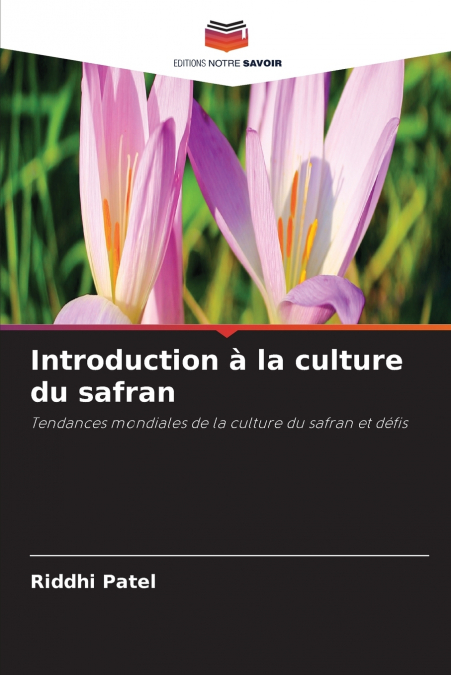
Le safran (Crocus sativus, Iridacées) est une plante qui pousse sous des températures modérées, sensible à l’engorgement du sol, et qui se multiplie par cormes. Cette épice de couleur rouge-orange possède un parfum, une saveur et un goût agréables. Les stigmates et les styles de cette plante fournissent le safran commercialisé, qui contient des combinaisons uniques de composés phytochimiques, à savoir la crocine, la crocétine, la picrocrocine, le safranal, etc., qui contribuent également à ses vertus médicinales. Le safran possède une longue histoire d’utilisation mentionnée dans divers textes anciens. Originaire du sud de l’Europe, on le trouve en Iran, en Inde, en Espagne, en France, en Grèce, en Argentine, aux États-Unis, au Japon, en Macédoine, en Autriche, en Italie, en Chine, en Allemagne, en Suisse, etc. Sa croissance limitée, les contraintes climatiques et la culture traditionnelle, très exigeante en main-d’œuvre, rendent sa culture difficile. À cela s’ajoutent les problèmes liés au changement climatique, à l’urbanisation, à la tendance à privilégier les cultures de rente, au manque de progrès techniques et à la méconnaissance du marché, qui ont détourné l’intérêt des producteurs. Il faut environ 150 000 fleurs pour obtenir 1 kg de safran, ce qui en fait une épice coûteuse. Plusieurs pays ont mis en place diverses stratégies de culture visant à garantir un rendement durable, à maintenir la qualité et à étendre les zones de production. L’ouvrage comprend une étude de cas sur le Jammu-et-Cachemire, en Inde.

Artículos relacionados

  • The Green Architecture
    Ali Mirshafieyan / Ghazal Yeganeh / Maryam Zamani Motlagh
    Protecting green energy as well as non-renewable energy, as well as their sustainable use, many advances in the technology of extracting oil products and other reserves under the ground have caused many improvements. In this regard, proposing the design of buildings in which the consumption of fossil fuels reaches its lowest level is considered one of the important solutions in...
    Disponible

    82,54 €

  • Responsible Use and Management of Agrochemicals
    Juan Carlos Nava
    Uso y manejo responsable de agroquímicos is a work product of the author’s experiences (undergraduate and graduate professor, with research and extension projects), aimed at producers, companies, professionals, students, advisors, researchers, among others.Due to its structure and content, it is expected to be a valuable aid to all people directly or indirectly involved in the ...
    Disponible

    49,45 €

  • Hope in the Soil
    Ellen G White
    Before edible classrooms began 'sprouting' in elementary schools, before buzzwords like 'sustainable agriculture', 'organic,' or 'veganic' came into existence, an exceptional woman named Ellen G. White penned numerous letters and articles on the importance of farming, an outdoor life, and manual labor. Though often remembered for other things, Mrs. White was actively engaged in...
    Disponible

    18,38 €

  • The Green Revolution
    Binitha Sophine Emmanuel
    The Green Revolution, a transformative era in the annals of agriculture, emerged as a game-changing force during the mid-20th century, fundamentally reshaping the methodology of food production and steering the trajectory of global food security. Characterized by a sequence of technological breakthroughs, the Green Revolution aimed to substantially augment agricultural producti...
    Disponible

    53,23 €

  • Utilization of Stingless Bees, Tetragonula laeviceps (Smith)
    Dr. J. J. Pastagia / Dr. V. C. Gadhiya
    The present investigations on utilization of stingless bees, T. laeviceps Smith in net house condition carried out with the broad aspects like flowers visited by stingless bees, T. laeviceps Smith, toxicity of insecticides to T. laeviceps Smith workers, floral biology of musk melon, foraging behavior of stingless bees, T. laeviceps Smith in net house condition, effect of pollin...
    Disponible

    84,80 €

  • La révolution verte
    Binitha Sophine Emmanuel
    La révolution verte, une ère transformatrice dans les annales de l’agriculture, est apparue comme une force qui a changé la donne au milieu du 20e siècle, remodelant fondamentalement la méthodologie de la production alimentaire et orientant la trajectoire de la sécurité alimentaire mondiale. Caractérisée par une série de percées technologiques, la révolution verte visait à augm...
    Disponible

    53,29 €

Otros libros del autor

  • Einführung in den Safran-Anbau
    Riddhi Patel
    Die Safranpflanze (Crocus sativus, Iridaceae) wächst bei gemäßigten Temperaturen, ist anfällig für Staunässe und vermehrt sich über Knollen. Dieses rötlich-orangefarbene Gewürz hat einen angenehmen Duft, Aroma und Geschmack. Aus den Narben und Griffeln dieser Pflanze wird der im Handel erhältliche Safran gewonnen, der eine einzigartige Kombination von sekundären Pflanzenstoffen...
    Disponible

    72,33 €

  • Introduzione alla coltivazione dello zafferano
    Riddhi Patel
    La pianta dello zafferano (Crocus sativus, Iridaceae) cresce in condizioni di temperatura moderata, è soggetta al ristagno idrico e si propaga tramite cormi. Questa spezia di colore rosso-arancio ha una fragranza, un aroma e un sapore gradevoli. Lo stigma e lo stilo di questa erba producono lo zafferano commerciale, che presenta combinazioni uniche di sostanze fitochimiche, qua...
    Disponible

    72,33 €

  • Wprowadzenie do uprawy szafranu
    Riddhi Patel
    Szafran (Crocus sativus, Iridaceae) to roślina rosnąca w umiarkowanej temperaturze, podatna na nadmierne nawodnienie, rozmnażająca się przez bulwy. Ta przypraw o czerwono-pomarańczowym kolorze charakteryzuje się przyjemnym zapachem, aromatem i smakiem. Z znamienia i słupka tej rośliny pozyskuje się szafran przeznaczony do handlu, zawierający unikalną kombinację fitochemikaliów,...
    Disponible

    72,33 €

  • Introdução à cultura do açafrão
    Riddhi Patel
    A planta do açafrão (Crocus sativus, Iridaceae) cresce em climas de temperatura moderada, é sensível ao encharcamento e propaga-se através de cormos. Esta especiaria de cor laranja-avermelhada possui uma fragrância, aroma e sabor agradáveis. O estigma e o estilo desta erva produzem o açafrão comercial, que possui combinações únicas de fitoquímicos, nomeadamente crocina, croceti...
    Disponible

    72,33 €

  • Introduction to Saffron Crop
    Riddhi Patel
    Saffron (Crocus sativus, Iridaceae) plant grows in a moderate temperature, prone to water logging & propagates through corms. This reddish-orange coloured spice has a pleasing fragrance, flavour and taste. This herb’s stigma and style part yields Saffron of commerce having unique combinations of Phytochemicals viz Crocin, Crocetin, Picrocrocin, Safranal etc. also contributes to...
    Disponible

    50,86 €