
Ideologues, Partisans, and Loyalists

Ideologues, Partisans, and Loyalists

Despina Alexiadou

160,67 €
IVA incluido
Consulta disponibilidad
Editorial:
Oxford University Press
Año de edición:
2016
Materia
Estructuras políticas: democracia
ISBN:
9780198755715

Selecciona una librería:

  • Librería Samer Atenea
  • Librería Aciertas (Toledo)
  • Kálamo Books
  • Librería Perelló (Valencia)
  • Librería Elías (Asturias)
  • Donde los libros
  • Librería Kolima (Madrid)
  • Librería Proteo (Málaga)

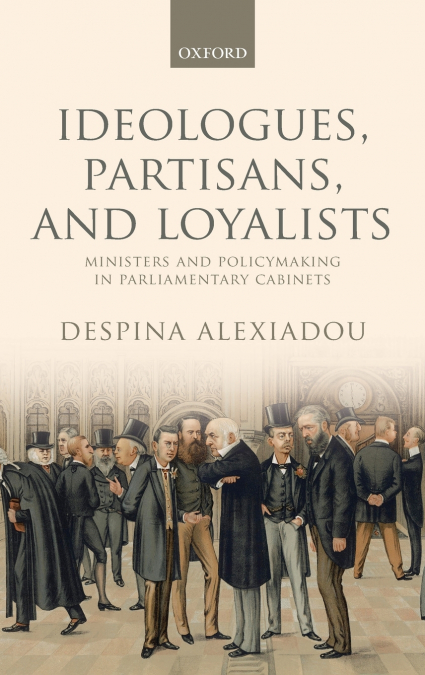
For the past thirty years scholars have debated the role of political parties in fiscal, monetary, and social welfare policies. Some argue that Social Democratic parties are more committed to advancing and maintaining welfare protection, while others claim that party ideology has ceased to explain parties’ policy choices due to the constraining forces of economic globalization, deindustrialization, and electoral volatility. Indeed, the empirical findings in support of partisan arguments are mixed. Much of this rich literature treats political parties as uniform and cohesive entities when it comes to forming government policy. Ideologues, Partisans, and Loyalists challenges this assumption and advances the argument that ideology and partisan policy preferences play a major role in policy choices, yet they are not necessarily observable at the government or even at the party level. Instead, we often need to look at the individual level -- particularly at the cabinet minister who is in charge of the policy in question to predict policy outcomes. Ideologues, Partisans, and Loyalists innovatively argues that cabinet ministers can have very important policy role as policy agenda setters. Yet, not all ministers are equally effective policy-makers. Some make a difference, while others do not. Loyalists are loyal to their party leader and prioritize office over policy; partisans are party heavyweights and aspiring leaders; and ideologues have fixed policy ideas and are unwilling to compromise for the perks of holding office. Only ideologues and partisans can effectively change social welfare and labour market policy, above and beyond what their government mandates.


Artículos relacionados

  • Argumentos de filosofía política de la tercera y cuarta transformaciones de México. Una aproximación interdisciplinar
    Ana Paola Tiro Chagoyán / Virginia Aspe Armella
    Presentamos al lector el tercero de los tres libros que fueron resultado del proyecto de investigación semilla Fondo Fomento a la Investigación de la Universidad Panamericana que en nuestro caso fue titulado Argumentos de filosofía política de las cuatro transformaciones de México, etapa primera, la Ilustración mexicana de los siglos XVIII y primeros años del XIX, la Independen...
    Disponible

    30,68 €

  • Making Democracy Fun
    Josh A. Lerner
    ...
    Disponible

    33,87 €

  • Resist Turbulent Times
    Verda Harris-Olayinka
    Resist Turbulent Times is for Everyday People and College students (who are also Everyday Ppl) - and their professors who assign textbooks for their students.Verda H. Olayinka followed the advice of noted Kemetic (African) American visionary, Harold Cruse who advised theCultural Intellectual to 'Synthesize a Black Social Science methodology in the process of developing a functi...
    Disponible

    16,64 €

  • By Executive Order
    Andrew Rudalevige
    How the executive branch-not the president alone-formulates executive orders, and how this process constrains the chief executive’s ability to act unilaterallyThe president of the United States is commonly thought to wield extraordinary personal power through the issuance of executive orders. In fact, the vast majority of such orders are proposed by federal agencies and shaped ...
    Disponible

    43,00 €

  • The Autocratic Middle Class
    Bryn Rosenfeld
    How middle-class economic dependence on the state impedes democratization and contributes to authoritarian resilienceConventional wisdom holds that the rising middle classes are a force for democracy. Yet in post-Soviet countries like Russia, where the middle class has grown rapidly, authoritarianism is deepening. Challenging a basic tenet of democratization theory, Bryn Rosenf...
  • The Autocratic Middle Class
    Bryn Rosenfeld
    How middle-class economic dependence on the state impedes democratization and contributes to authoritarian resilienceConventional wisdom holds that the rising middle classes are a force for democracy. Yet in post-Soviet countries like Russia, where the middle class has grown rapidly, authoritarianism is deepening. Challenging a basic tenet of democratization theory, Bryn Rosenf...
    Disponible

    54,14 €