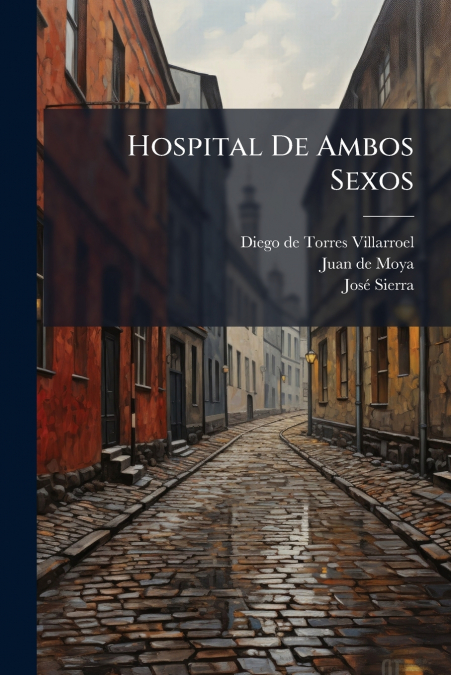
Diego de Torres Villarroel / José Sierra (ed.) / Juan de Moya (ed.)
 Librería Samer Atenea
 Librería Aciertas (Toledo)
 Kálamo Books
 Librería Perelló (Valencia)
 Librería Elías (Asturias)
 Donde los libros
 Librería Kolima (Madrid)
 Librería Proteo (Málaga)
Hospital De Ambos Sexos, subtitled 'Sala De Hombres, Segunda Parte De Los Desauciados Del Mundo Y De La Gloria ...', is a satirical work by Diego de Torres Villarroel, a prominent figure of 18th-century Spanish literature. This edition, carefully edited by Juan de Moya and José Sierra, offers readers a renewed opportunity to engage with Villarroel’s biting wit and social commentary. A continuation of Villarroel’s exploration of the marginalized and dispossessed, the book delves into the human condition with humor and critical insight.Hospital De Ambos Sexos showcases Villarroel’s distinctive prose and his penchant for blending entertainment with profound observations about society. It remains a significant work for those interested in Spanish literary history and the evolution of satirical writing.This work has been selected by scholars as being culturally important, and is part of the knowledge base of civilization as we know it. This work was reproduced from the original artifact, and remains as true to the original work as possible. Therefore, you will see the original copyright references, library stamps (as most of these works have been housed in our most important libraries around the world), and other notations in the work.This work is in the public domain in the United States of America, and possibly other nations. Within the United States, you may freely copy and distribute this work, as no entity (individual or corporate) has a copyright on the body of the work.As a reproduction of a historical artifact, this work may contain missing or blurred pages, poor pictures, errant marks, etc. Scholars believe, and we concur, that this work is important enough to be preserved, reproduced, and made generally available to the public. We appreciate your support of the preservation process, and thank you for being an important part of keeping this knowledge alive and relevant.