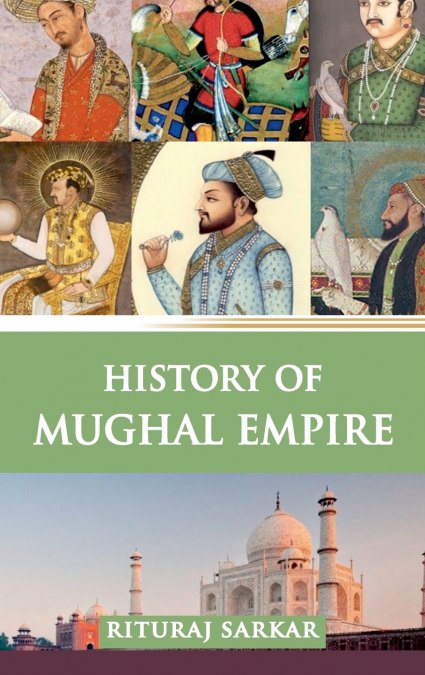

History of Mughal Empire

History of Mughal Empire

Rituraj Sarkar

28,90 €
IVA incluido
Consulta disponibilidad
Editorial:
Hawk Press
Año de edición:
2022
Materia
Historia de Asia
ISBN:
9789395034364

Selecciona una librería:

  • Librería Samer Atenea
  • Librería Aciertas (Toledo)
  • Kálamo Books
  • Librería Perelló (Valencia)
  • Librería Elías (Asturias)
  • Donde los libros
  • Librería Kolima (Madrid)
  • Librería Proteo (Málaga)

The Mughal Empire was an empire that at its greatest territorial extent ruled parts of what is todays Afghanistan, Pakistan and most of the Indian Subcontinent, then known as Hindustan, between 1526 and 1707. The empire was founded by the Timurid leader Babur in 1526, when he defeated Ibrahim Lodi, the last of the Delhi Sultans at the First Battle of Panipat. 'Mughal' is the Persian word for 'Mongol'. The religion of the Mughals was Islam.Under Akbar the Great, the empire grew considerably, and continued to expand until the end of Aurangzeb’s rule. Jahangir, the son of Akbar, ruled the empire between 1605 and 1627. When Shah Jahan, Jahangir’s son, became emperor in October 1627, the empire was large and wealthy enough to be considered one of the greatest empires in the world at that time. It was Shah Jahan who commissioned the building that represents the pinnacle of Mughal architectural achievement, the Taj Mahal, between 1630 and 1653. Sponsors of art and of learning, the Mughals left a rich heritage of buildings, paintings and literature.The Mughals effectively ruled India for about 150 years during the 16th and 17th centuries, a period roughly comparable with that of the British Raj. On the whole, comparisons favour the latter. The British bequeathed India an impressive network of communications, a legal system and viable administration, a tradition of democratic government that has survived, battered but unbroken.The Mughal Empire, which had reached its zenith during the rule of Shah Jahan and his son, began to decline after the rule of Aurangzeb. In fact, the decline began during the last days of Aurangzeb. There were many causes for the downfall of this great dynasty. Let us view the causes that hastened the fall of the Mughal Empire after Aurangzeb. The present book accounts all the major factors responsible for the downfall of Mughal empire.

Artículos relacionados

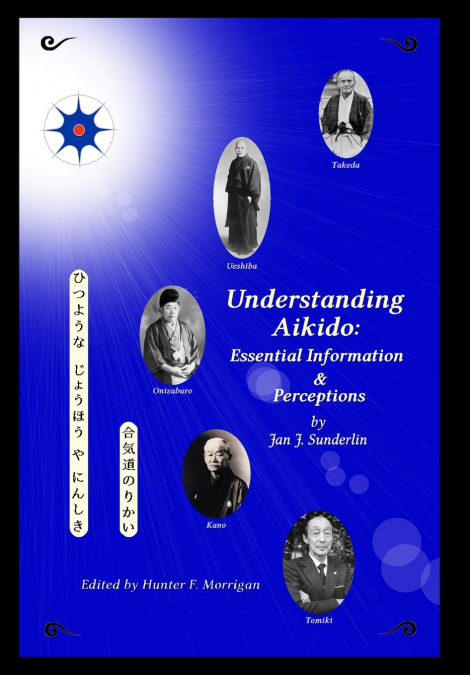
  • Understanding Aikido
    Jan J Sunderlin
    Understanding Aikido: Essential Information and Perceptions (Special Edition) presents an historical, cultural, and philosophical look at the development of the Japanese martial art of Aikido. Sunderlin focuses on the influences brought to bear on Morihei Ueshiba, the founder of Aikido, and the subsequent cultivation of the latter's martial art as a vessel of Budo. The author a...
    Disponible

    63,06 €

  • Not by Love Alone
    Margaret Mehl
    Suzuki Shin'ichi, the Tokyo String Quartet, Midori - How did Japanese violinists manage to revolutionize violin teaching, win international competitions, conquer Western concert stages, study at world-famous conservatoires and take up positions in leading orchestras and prestigious music faculties? What enabled the Japanese to master Western classical music within a few decades...
    Disponible

    29,32 €

  • Pictures in Transformation
    Luca Maria Olivieri
    ...
    Disponible

    54,79 €

  • Life and Death in the Korean Bronze Age (c. 1500-400 BC)
    Sunwoo Kim
    This research focuses on the Bronze Age in selected areas of Korea; Seoul, Incheon, and Gyeonggi province. Two forms of evidence - settlements and monuments - are taken into account to identify their relationship with landscape and the social changes occurring between ca. 1500 to 400 cal BC. Life and death in the Bronze Age in Korea has not been synthetically investigated befor...
    Disponible

    108,34 €

  • South Asian Archaeology 2007
    Proceedings of the 19th Meeting of the European Association of South Asian Archaeology in Ravenna, Italy, July 2007.                     ...
    Disponible

    182,04 €

  • CHINA THROUGH AMERICAN EYES
    Wenxian Zhang / ZHANG WENXIAN
    Cultural understanding between the United States and China has been a long and complex process. The period from the mid-nineteenth century to the early twentieth century is not only a critical era in modern Chinese history, but also the peak time of illustrated news reporting in the United States. Besides images from newspapers and journals, this collection also contains pictur...