 Librería Samer Atenea
 Kálamo Books
 Librería Elías (Asturias)
 Librería Kolima (Madrid)
 Librería Proteo (Málaga)
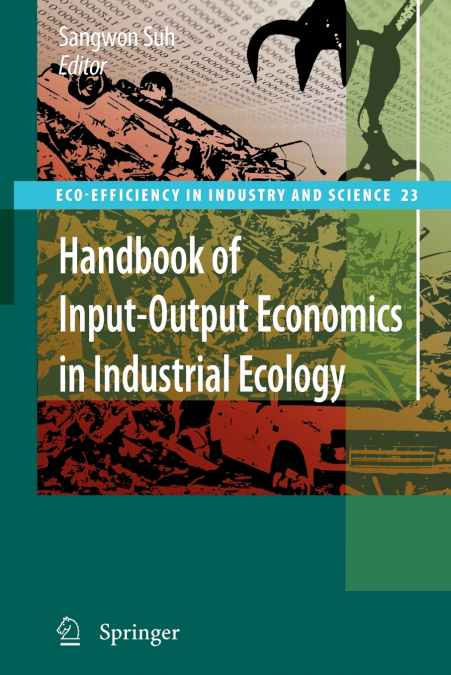
PART I. Introduction.- 1. Industrial Ecology In the Age of Input-Output Analysis.- 2. Input-Output Economics and Material Flows.- 3. Industrial Ecology and Input-Output Economics: A Brief History.- PART II. Material Flow Analysis.- 4. Conceptual Foundations and Applications of Physical Input-Output Tables.- 5. Modelling Manufactured Capital Stocks and Material Flows Framework.- 6. An Input-Output Framework to Enhance Consistency in Hybrid Modeling.- 7. Physical Input-Output Analysis and Disposals to Nature.- 8. Accounting and Modelling Global Resource Use.- 9. Constructing Physical Input-Output Table with Material Flow Analysis (MFA) Data: Bottom-up Case Studies.- 10. Analysing the Economic Impacts of a Material Efficiency Strategy.- PART III. Life Cycle Assessment.- 11. A Comparison between Conventional LCA and Hybrid EIO-LCA: Analyzing Crystal Giftware Contribution to Global Warming Potential.- 12. Application of the Sequential Interindustry Model (SIM) to Life Cycle Assessment.- 13. Life-Cycle Assessment as a Management Tool: An Emphasis on Electricity Generation, Global Climate Change, and Sustainability.- 14. Methods in the Life Cycle Inventory of a Product.- PART IV. Sustainable Consumption.- 15. Principal Methodological Approaches to Studying Sustainable Consumption: Scenario Analysis, Ecological Footprints and Structural Decomposition Analysis.- 16. Global Environmental Impact of Dutch Private Consumption.- PART V. Policy Applications.- 17. A Hybrid IO Energy Model to Analyse CO2 Reduction Policies: A Case of Germany.- 18. Carbon Tax and Its Short-Term Effects in Italy: An Evaluation Through the Input-Output Model.- 19. Comparing the Environmental Effects of Production and Consumption in a Region.- 20. Prioritising within the Product-Oriented Environmental Policy - The Danish Perspectives.- 21. Input-Output Equations Embedded within Climate and Energy Policy AnalysisModels.- PART VI. Energy and Climate Change.- 22. Application of the IO Methodology to the Energy and Environmental Analysis of a Regional Context.- 23. Thermodynamic Input-Output Analysis of Economic and Ecological Systems.- 24. A Step-wise Guide for Energy Analysis: How to Calculate the Primary Energy Requirements for Households?- 25. Application of IO Energy Analysis to Study CO2 Emissions by the Portuguese Economy: The Case of Portugal.- 26. Models for National CO2 Accounting.- PART VII. Waste Management.- 27. Waste Input-Output Analysis, LCA and LCC.- 28. Economy-Waste-Environment Input-Output Model: Effects of Portuguese Production and Consumption.- 29. Environmental Household Accounts with Waste Discharge using the Waste Input-Output Table.- PART VIII. National Accounts, Statistics and Databases.- 30. SEEA-2003 and the Economic Relevance of Physical Flow Accounting at Industry and National Economy Level.- 31. Environmental Input-Output Database Building in Japan.- 32. Development of Sectoral Environmental Database for Input-Output Analysis: Comprehensive Environmental Data Archive of the U.S..- PART IX. Advances In Modelling and Theory.- 33. Ecological Input-Output Analysis of Material Flows in Industrial Systems.- 34. Modelling Sustainability of the Austrian Economy with Input-Output Analysis: Modelling Framework and Empirical Application.- 35. Multistage Process-Based Make-Use System.- 36. Input-Output Analysis and Linear Programming.- 37. Time Use and Sustainability: An Input-Output Approach in Mixed Units.- 38. The Application of Multi-Regional Input-Output Analysis to Industrial Ecology: Evaluating Trans-boundary Environmental Impacts.- Index.