 Librería Samer Atenea
 Kálamo Books
 Librería Elías (Asturias)
 Librería Kolima (Madrid)
 Librería Proteo (Málaga)
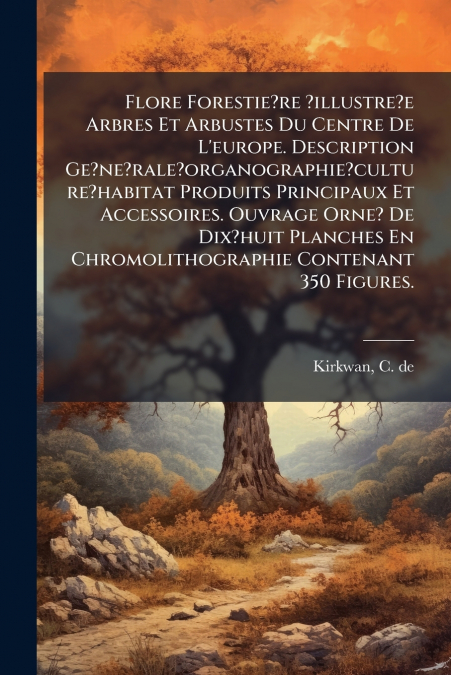
Flore Forestière Illustrée: Arbres et Arbustes du Centre de l’Europe, by C. de Kirkwan, is a comprehensive botanical study of the trees and shrubs of Central Europe, published in 1872. This meticulously detailed work offers a general description, organography, cultivation techniques, habitat information, and the principal and accessory products derived from these plants. Enhanced by eighteen chromolithographic plates containing 350 figures, this volume provides a visual feast for botanists, forestry professionals, and nature enthusiasts alike. The detailed illustrations bring the trees and shrubs to life, offering an unparalleled understanding of their form and structure. This historical text is a valuable resource for those interested in the botanical history of Central Europe and the early practices of forestry and horticulture. Kirkwan’s work remains a testament to the enduring importance of understanding and documenting the natural world.This work has been selected by scholars as being culturally important, and is part of the knowledge base of civilization as we know it. This work was reproduced from the original artifact, and remains as true to the original work as possible. Therefore, you will see the original copyright references, library stamps (as most of these works have been housed in our most important libraries around the world), and other notations in the work.This work is in the public domain in the United States of America, and possibly other nations. Within the United States, you may freely copy and distribute this work, as no entity (individual or corporate) has a copyright on the body of the work.As a reproduction of a historical artifact, this work may contain missing or blurred pages, poor pictures, errant marks, etc. Scholars believe, and we concur, that this work is important enough to be preserved, reproduced, and made generally available to the public. We appreciate your support of the preservation process, and thank you for being an important part of keeping this knowledge alive and relevant.