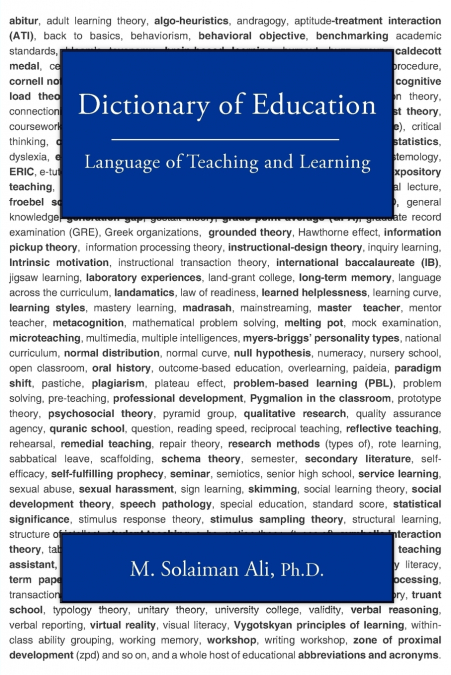
M. Solaiman Ali / M. Solaiman Ali Ph. D. / MSolaiman Ali / MSolaiman Ali PhD.
 Librería Samer Atenea
 Kálamo Books
 Librería Elías (Asturias)
 Librería Kolima (Madrid)
 Librería Proteo (Málaga)
Dr. M. Solaiman Ali’s multidisciplinary background, teaching experience in various countries, and sustained life-long interest in education have enhanced his understanding of education and proved helpful in compiling the terms. The present dictionary is a product of his life-long search for terms/concepts in education. The book is, thus, evidence of his own growth and development in pedagogy and learning. Dr. Ali was always eager to formally study education and enrolled (full-time) in a Lakehead University in Ontario, Canada, in 1980, and earned an MEd in Curriculum & Instruction and an MA in English Literature (with emphasis on Shakespeare and Elizabethan literature). His journey to understand education and educational concepts and terms did not end with his degrees (MEd and MA) from Lakehead University. In 1985, he enrolled in a Ph.D. program in Language Education at the School of Education, Indiana University, Bloomington, and graduated in 1991. Since October, 1991, he has been teaching English as a Foreign Language at King Abdulaziz University, Jeddah, Saudi Arabia. While in Saudi Arabia, he embarked on a personal project -- to collect the definitions of educational terms and concepts he learned over the years and also to find those related educational terms he did not know but are important for an educator to know, and to compile them into a book with consideration for publishing. Fortunately, his teaching job allowed me time to do that. This dictionary reflects the author’s own growth and development as a teacher and it answers questions that always persisted in his professional mind. During his university years (both UG and grad studies), and as a practicing teacher, he always wondered what terms such as the following mean: adult learning theory, algo-heuristics, andragogy, aptitude-treatment interaction (ATI), behaviorism, bloom’s taxonomy, brain-based learning, gestalt theory, grounded theory, information processing theory, instructional-design theory, international baccalaureate (IB), jigsaw learning, laboratory experiences, landamatics, metacognition, melting pot, mock examination, microteaching, multiple intelligences, myers-briggs’ personality types, null hypothesis, oral history, paradigm shift, Pygmalion in the classroom, pyramid group, reciprocal teaching, reflective teaching, remedial teaching, schema theory, student teaching, subsumption theory (types of), symbolic interaction theory, tabula rasa, tertiary college, test-retest reliability, transmission mode of teaching, triangulation, triarchic theory, truant school, typology theory, verbal reasoning, verbal reporting, virtual reality, Vygotskyan principles of learning, zone of proximal development (zpd) and so on. Unlike most dictionaries, this dictionary includes a comprehensive list of useful abbreviations and acronyms in education, definitions of major terms related to teaching methods and learning, e.g., landamatics, algo-heuristics, andragogy, myers-briggs’ personality types, and so on. Such dictionaries do not encompass important areas of education such as: Higher Education, Learning Theories, Instructional Theories/models, Educational Psychology, Testing, Statistics, Educational Research, college terms related to Reading, Writing and Study skill, etc. I believe my dictionary will help fill this knowledge gap. I think classroom instructors in K-12 and higher education, college students, especially Education majors and Foreign Teaching Assistants, foreign (undergraduate and graduate) students in American and British colleges and universities, and students having ESL backgrounds would find my work useful. My interest is purely academic/intellectual. I wanted to learn more about education by compiling these definitions of terms. I hope it serves a good purpose. Thus, this dictionary stands out from other dictionaries available on the market