
Democracy in Indonesia

Democracy in Indonesia


51,12 €
IVA incluido
Consulta disponibilidad
Editorial:
ISEAS-Yusof Ishak Institute
Año de edición:
2020
Materia
Estructuras políticas: democracia
ISBN:
9789814881517

Selecciona una librería:

  • Librería Samer Atenea
  • Librería Aciertas (Toledo)
  • Kálamo Books
  • Librería Perelló (Valencia)
  • Librería Elías (Asturias)
  • Donde los libros
  • Librería Kolima (Madrid)
  • Librería Proteo (Málaga)

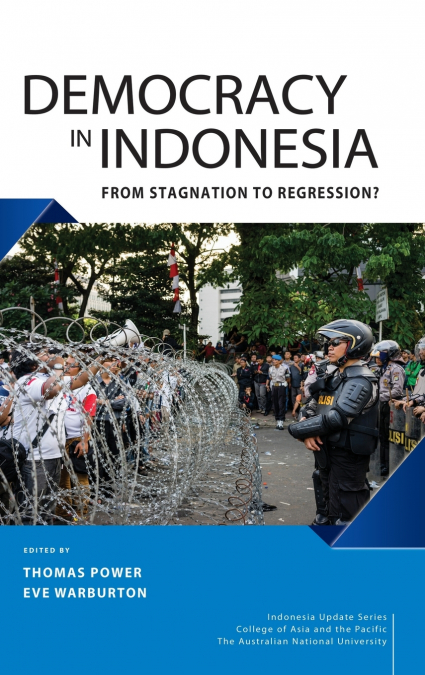
The majority of contributions to this volume, with the exception of those by Marcus Mietzner, Ross Tapsell and Thomas Power, were developed out of papers presented at the 37th annual Indonesia Update conference, held at the Australian National University (ANU), Canberra, on 6-7 September 2019.At each of the annual ANU Indonesia Updates since 2014, authors of the political update papers expressed growing concern about the downhill trajectory of Indonesia’s democracy. The 2019 Update took stock of this trend by posing a question: had Indonesian democracy shifted from a state of stagnation, as proposed at the same venue five years previously, to one of regression ? The excellent array of papers presented by the contributors to this book revealed an overwhelming, and profoundly troubling, answer.We wish to express our thanks to each of the authors represented in this volume for being part of this endeavour. Not only did the contributors travel to Canberra to share their expert analyses, but in the months that followed they gave much of their time to our editorial process. The result is, we believe, an important and comprehensive evaluation of Indonesia’s democratic decline at the outset of President Joko Widodo’s second term.Indonesia has long been hailed as a rare case of democratic transition and persistence in an era of global democratic setbacks. But as the country enters its third decade of democracy, such laudatory assessments have become increasingly untenable. The stagnation that characterized Susilo Bambang Yudhoyono’s second presidential term has given way to a more far-reaching pattern of democratic regression under his successor, Joko Widodo.This volume is the first comprehensive study of Indonesia’s contemporary democratic decline. Its contributors identify, explain and debate the signs of regression, including arbitrary state crackdowns on freedom of speech and organization, the rise of vigilantism, deepening political polarization, populist mobilization, the dysfunction of key democratic institutions, and the erosion of checks and balances on executive power. They ask why Indonesia, until recently considered a beacon of democratic exceptionalism, increasingly conforms to the global pattern of democracy in retreat.


Artículos relacionados

  • Argumentos de filosofía política de la tercera y cuarta transformaciones de México. Una aproximación interdisciplinar
    Ana Paola Tiro Chagoyán / Virginia Aspe Armella
    Presentamos al lector el tercero de los tres libros que fueron resultado del proyecto de investigación semilla Fondo Fomento a la Investigación de la Universidad Panamericana que en nuestro caso fue titulado Argumentos de filosofía política de las cuatro transformaciones de México, etapa primera, la Ilustración mexicana de los siglos XVIII y primeros años del XIX, la Independen...
    Disponible

    30,68 €

  • Making Democracy Fun
    Josh A. Lerner
    ...
    Disponible

    33,87 €

  • Resist Turbulent Times
    Verda Harris-Olayinka
    Resist Turbulent Times is for Everyday People and College students (who are also Everyday Ppl) - and their professors who assign textbooks for their students.Verda H. Olayinka followed the advice of noted Kemetic (African) American visionary, Harold Cruse who advised theCultural Intellectual to 'Synthesize a Black Social Science methodology in the process of developing a functi...
    Disponible

    16,64 €

  • By Executive Order
    Andrew Rudalevige
    How the executive branch-not the president alone-formulates executive orders, and how this process constrains the chief executive’s ability to act unilaterallyThe president of the United States is commonly thought to wield extraordinary personal power through the issuance of executive orders. In fact, the vast majority of such orders are proposed by federal agencies and shaped ...
    Disponible

    43,00 €

  • The Autocratic Middle Class
    Bryn Rosenfeld
    How middle-class economic dependence on the state impedes democratization and contributes to authoritarian resilienceConventional wisdom holds that the rising middle classes are a force for democracy. Yet in post-Soviet countries like Russia, where the middle class has grown rapidly, authoritarianism is deepening. Challenging a basic tenet of democratization theory, Bryn Rosenf...
  • The Autocratic Middle Class
    Bryn Rosenfeld
    How middle-class economic dependence on the state impedes democratization and contributes to authoritarian resilienceConventional wisdom holds that the rising middle classes are a force for democracy. Yet in post-Soviet countries like Russia, where the middle class has grown rapidly, authoritarianism is deepening. Challenging a basic tenet of democratization theory, Bryn Rosenf...
    Disponible

    54,14 €