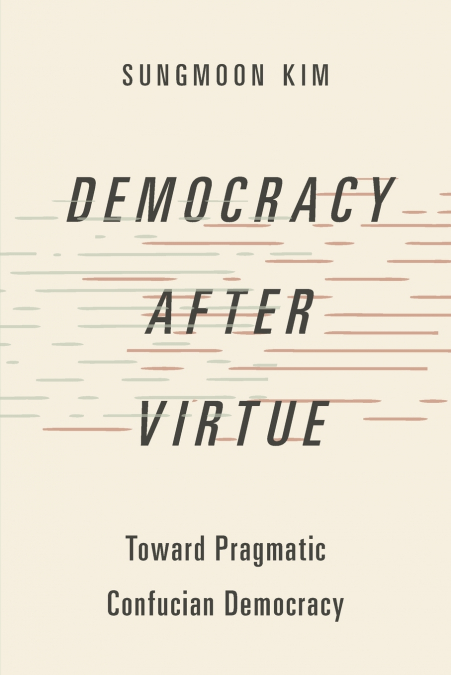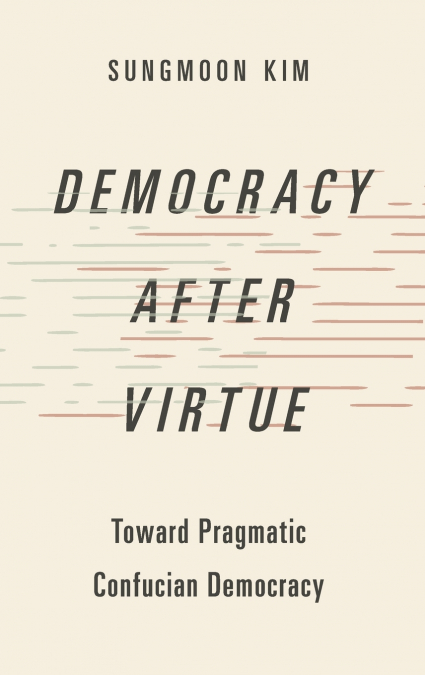

Democracy After Virtue

Democracy After Virtue

Sungmoon Kim

147,65 €
IVA incluido
Consulta disponibilidad
Editorial:
Oxford University Press
Año de edición:
2018
Materia
Estructuras políticas: democracia
ISBN:
9780190671235

Selecciona una librería:

  • Librería Samer Atenea
  • Librería Aciertas (Toledo)
  • Kálamo Books
  • Librería Perelló (Valencia)
  • Librería Elías (Asturias)
  • Donde los libros
  • Librería Kolima (Madrid)
  • Librería Proteo (Málaga)

Is Confucianism compatible with democracy? Ongoing debates among political theorists revolve around the question of whether the overarching goal of Confucianism--serving the people’s moral and material well-being--is attainable in modern day politics without broad democratic participation and without relying on a one person, one vote system. One side of the debate--voiced by traditional Confucian meritocrats--argues that only certain people are equipped with the moral character needed to lead and ensure broad public well-being. They emphasize moral virtue over civic virtue and the family over the state as the quintessential public institution. Moreover, they believe that a system of rule headed by meritorious elites can better handle complex modern public affairs than representative democracy. The other side--voiced by Confucian democrats--argues that unless all citizens participate equally in the public sphere, the kind of moral growth Confucianism emphasizes cannot be fully attained. Despite notable differences in political orientation, scholars of both positions acknowledge that democracy is largely of instrumental value for realizing Confucian moral ends in modern society. It would seem that Confucians of both types have largely dismissed democracy as a political system that can mediate clashing values and political views--or even that Confucian democracy is a system marked by pluralism. In this book, Sungmoon Kim lays out a normative theory of Confucian democracy--pragmatic Confucian democracy--to address questions of the right to political participation, instrumental and intrinsic values of democracy, democratic procedure and substance, punishment and criminal justice, social and economic justice, and humanitarian intervention. As such, this project is not only relevant to the much debated topic of Confucian democracy as a cultural alternative to Western-style liberal democracy in East Asia, but it further investigates the philosophical implications of the idea and institution of Confucian democracy in normative democratic theory, criminal justice, distributive justice, and just war. Ultimately, Kim shows us that the question is not so much about the compatibility of Confucianism and democracy, but of how the two systems can benefit from each other.
Artículos relacionados

  • Argumentos de filosofía política de la tercera y cuarta transformaciones de México. Una aproximación interdisciplinar
    Ana Paola Tiro Chagoyán / Virginia Aspe Armella
    Presentamos al lector el tercero de los tres libros que fueron resultado del proyecto de investigación semilla Fondo Fomento a la Investigación de la Universidad Panamericana que en nuestro caso fue titulado Argumentos de filosofía política de las cuatro transformaciones de México, etapa primera, la Ilustración mexicana de los siglos XVIII y primeros años del XIX, la Independen...
    Disponible

    30,68 €

  • Making Democracy Fun
    Josh A. Lerner
    ...
    Disponible

    33,87 €

  • Resist Turbulent Times
    Verda Harris-Olayinka
    Resist Turbulent Times is for Everyday People and College students (who are also Everyday Ppl) - and their professors who assign textbooks for their students.Verda H. Olayinka followed the advice of noted Kemetic (African) American visionary, Harold Cruse who advised theCultural Intellectual to 'Synthesize a Black Social Science methodology in the process of developing a functi...
    Disponible

    16,64 €

  • By Executive Order
    Andrew Rudalevige
    How the executive branch-not the president alone-formulates executive orders, and how this process constrains the chief executive’s ability to act unilaterallyThe president of the United States is commonly thought to wield extraordinary personal power through the issuance of executive orders. In fact, the vast majority of such orders are proposed by federal agencies and shaped ...
    Disponible

    43,00 €

  • The Autocratic Middle Class
    Bryn Rosenfeld
    How middle-class economic dependence on the state impedes democratization and contributes to authoritarian resilienceConventional wisdom holds that the rising middle classes are a force for democracy. Yet in post-Soviet countries like Russia, where the middle class has grown rapidly, authoritarianism is deepening. Challenging a basic tenet of democratization theory, Bryn Rosenf...
  • The Autocratic Middle Class
    Bryn Rosenfeld
    How middle-class economic dependence on the state impedes democratization and contributes to authoritarian resilienceConventional wisdom holds that the rising middle classes are a force for democracy. Yet in post-Soviet countries like Russia, where the middle class has grown rapidly, authoritarianism is deepening. Challenging a basic tenet of democratization theory, Bryn Rosenf...
    Disponible

    54,14 €

Otros libros del autor