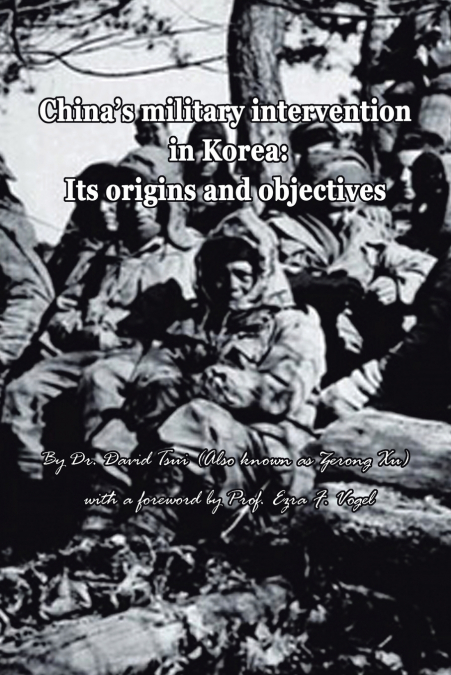
China’s Military Intervention in Korea

China’s Military Intervention in Korea

China's Military Intervention in Korea

Dr. David Tsui Also known as Yerong Xu / DrDavid Tsui Also known as Yerong Xu

36,25 €
IVA incluido
Consulta disponibilidad
Editorial:
Trafford Publishing
Año de edición:
2015
Materia
Historia de Asia
ISBN:
9781490738635

Selecciona una librería:

  • Librería Samer Atenea
  • Librería Aciertas (Toledo)
  • Kálamo Books
  • Librería Perelló (Valencia)
  • Librería Elías (Asturias)
  • Donde los libros
  • Librería Kolima (Madrid)
  • Librería Proteo (Málaga)

This study examines how and why China’s military intervention in the Korean War came into existence within the time span from May 1949 to July 1951.China was involved in the war preparations much earlier and deeper than was previously known. Beijing’s preconditions to enter the war boiled down to three: (1) its full control of China; (2) foreign enemy forces’ invasion of North Korea; and (3) Moscow’s logistic and air support. Beijing had incorrectly calculated that Washington would dispatch only Japanese field forces to Korea, which is the very reason underlying its inadequate though early preparations for the war, while it had correctly calculated that Washington would not invade China proper via Korea before it entered the war. Expecting an enemy troops’ landing at Inchon followed by their invasion of North Korea, Beijing planned to ambush them in northern North Korea. It therefore failed to dispatch a symbolic force into Korea to give credibility to diplomatic deterrence against Washington’s possible invasion of North Korea.China developed ten prime interventionist goals as follows: (1) to save North Korea; (2) to dispel Stalin’s suspicions and to pay Mao’s political debt owed to Stalin in 1941 and 1942; (3) to have the PLA experienced in modern warfare; (4) to have the PLA modernized with Soviet weaponry; (5) to have its economy revitalized with overall Soviet assistance; (6) to enter the United Nations; (7) to exchange South Korean territories for an American withdrawal from Taiwan; (8) to have Nationalist forces in Taiwan; (9) to defuse an American retaliatory or nuclear attach upon China proper; and (10) to have North Korea and South Korea almost return to the status quo ante bellum.It was Mao’s de facto dependence upon rather than his alleged independence from Stalin that had made him rise to power in 1949. This Soviet reign turned out to be considerably more decisive than the American threat in driving China into the war in 1950.
Artículos relacionados

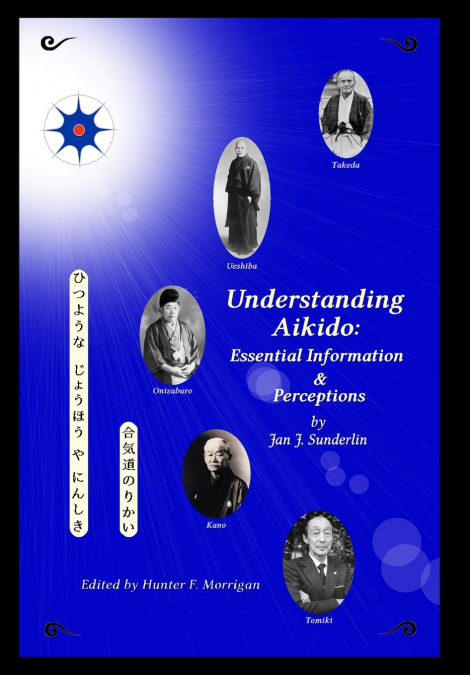
  • Understanding Aikido
    Jan J Sunderlin
    Understanding Aikido: Essential Information and Perceptions (Special Edition) presents an historical, cultural, and philosophical look at the development of the Japanese martial art of Aikido. Sunderlin focuses on the influences brought to bear on Morihei Ueshiba, the founder of Aikido, and the subsequent cultivation of the latter's martial art as a vessel of Budo. The author a...
    Disponible

    63,06 €

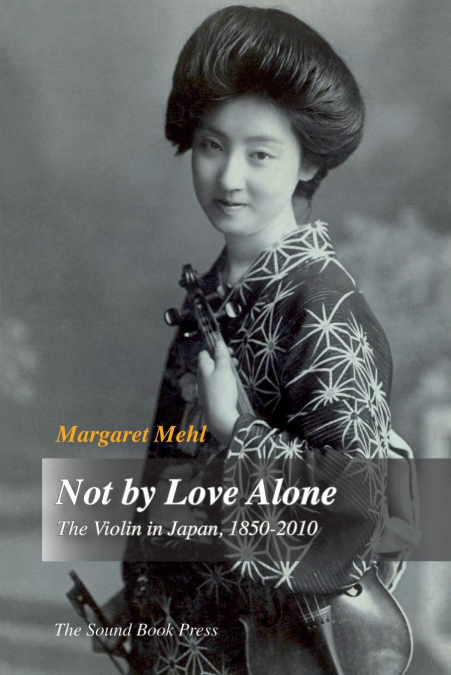
  • Not by Love Alone
    Margaret Mehl
    Suzuki Shin'ichi, the Tokyo String Quartet, Midori - How did Japanese violinists manage to revolutionize violin teaching, win international competitions, conquer Western concert stages, study at world-famous conservatoires and take up positions in leading orchestras and prestigious music faculties? What enabled the Japanese to master Western classical music within a few decades...
    Disponible

    29,32 €

  • Pictures in Transformation
    Luca Maria Olivieri
    ...
    Disponible

    54,79 €

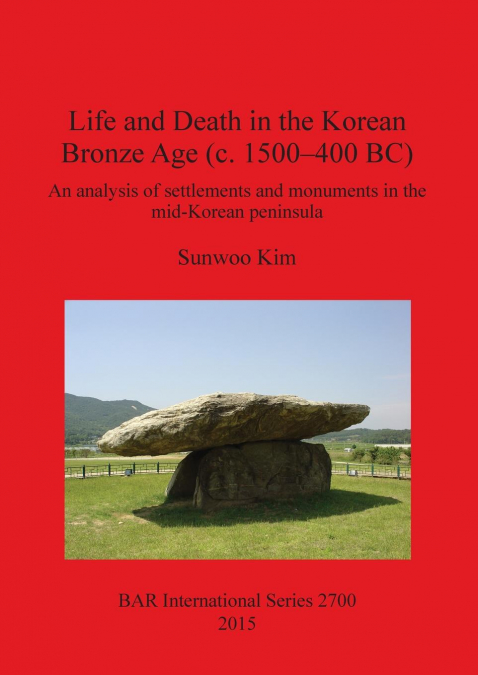
  • Life and Death in the Korean Bronze Age (c. 1500-400 BC)
    Sunwoo Kim
    This research focuses on the Bronze Age in selected areas of Korea; Seoul, Incheon, and Gyeonggi province. Two forms of evidence - settlements and monuments - are taken into account to identify their relationship with landscape and the social changes occurring between ca. 1500 to 400 cal BC. Life and death in the Bronze Age in Korea has not been synthetically investigated befor...
    Disponible

    108,34 €

  • South Asian Archaeology 2007
    Proceedings of the 19th Meeting of the European Association of South Asian Archaeology in Ravenna, Italy, July 2007.                     ...
    Disponible

    182,04 €

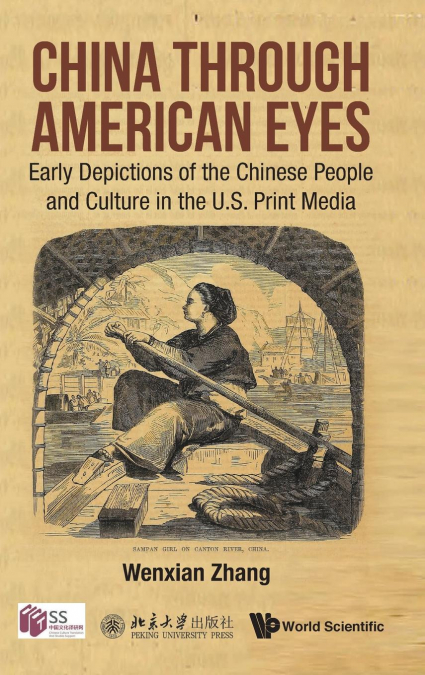
  • CHINA THROUGH AMERICAN EYES
    Wenxian Zhang / ZHANG WENXIAN
    Cultural understanding between the United States and China has been a long and complex process. The period from the mid-nineteenth century to the early twentieth century is not only a critical era in modern Chinese history, but also the peak time of illustrated news reporting in the United States. Besides images from newspapers and journals, this collection also contains pictur...

Otros libros del autor

  • China’s Military Intervention in Korea
    Dr. David Tsui Also known as Yerong Xu / DrDavid Tsui Also known as Yerong Xu
    This study examines how and why China’s military intervention in the Korean War came into existence within the time span from May 1949 to July 1951.China was involved in the war preparations much earlier and deeper than was previously known. Beijing’s preconditions to enter the war boiled down to three: (1) its full control of China; (2) foreign enemy forces’ invasion of North ...
    Disponible

    25,46 €