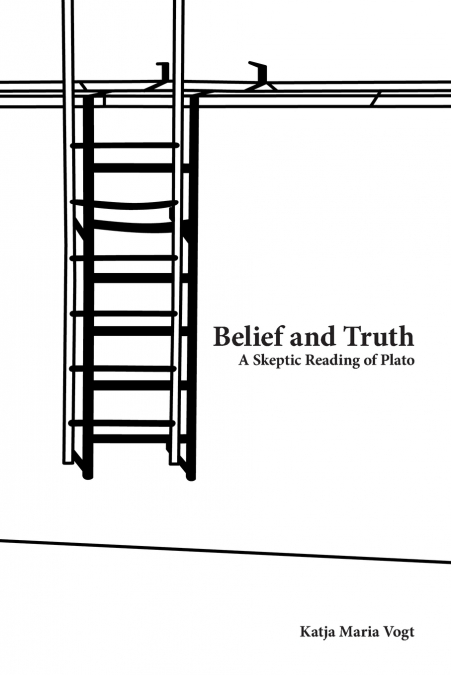

Belief and Truth

Belief and Truth

Katja Maria Vogt

69,71 €
IVA incluido
Disponible
Editorial:
Oxford University Press
Año de edición:
2015
Materia
Filosofía occidental: antigua, hasta c. 500
ISBN:
9780190277192
69,71 €
IVA incluido
Disponible

Selecciona una librería:

  • Librería Samer Atenea
  • Librería Aciertas (Toledo)
  • Kálamo Books
  • Librería Perelló (Valencia)
  • Librería Elías (Asturias)
  • Donde los libros
  • Librería Kolima (Madrid)
  • Librería Proteo (Málaga)

Katja Maria Vogt’s Belief and Truth: A Skeptic Reading of Plato explores a Socratic intuition about the difference between belief and knowledge. Beliefs -- doxai -- are deficient cognitive attitudes. In believing something, one accepts some content as true without knowing that it is true; one holds something to be true that could turn out to be false. Since our actions reflect what we hold to be true, holding beliefs is potentially harmful for oneself and others. Accordingly, beliefs are ethically worrisome and even, in the words of Plato’s Socrates, 'shameful.' As Vogt argues, this is a serious philosophical proposal and it speaks to intuitions we are likely to share. But it involves a notion of belief that is rather different from contemporary notions. Today, it is a widespread assumption that true beliefs are better than false beliefs, and that some true beliefs (perhaps those that come with justifications) qualify as knowledge. Socratic epistemology offers a genuinely different picture. In aiming for knowledge, one must aim to get rid of beliefs. Knowledge does not entail belief -- belief and knowledge differ in such important ways that they cannot both count as kinds of belief. As long as one does not have knowledge, one should reserve judgment and investigate by thinking through possible ways of seeing things. According to Vogt, the ancient skeptics and Stoics draw many of these ideas from Plato’s dialogues, revising Socratic-Platonic arguments as they see fit. Belief and Truth retraces their steps through interpretations of the Apology, Ion, Republic, Theaetetus, and Philebus, reconstructs Pyrrhonian investigation and thought, and illuminates the connections between ancient skepticism and relativism, as well as the Stoic view that beliefs do not even merit the evaluations 'true' and 'false.'

Artículos relacionados

  • The Nature of Things
    Lucretius Lucretius
    De rerum natura (On the Nature of Things) is a 1st century BC didactic poem by the Roman poet and philosopher Lucretius with the goal of explaining Epicurean philosophy to a Roman audience. Lucretius presents the principles of atomism; the nature of the mind and soul; explanations of sensation and thought; the development of the world and its phenomena; and explains a variety o...
  • Pompeii
    Fergus Mason
    Pompeii was one of most advanced cities of its time; it had a complex water system, gymnasium, and an amphitheater. Despite it's advancements, there was one thing it wasn't ready for: Mount Vesuvius—the volcano that led to its ultimate doom.  The 79 AD eruption of Mount Vesuvius was one of the worst disasters in all of European history. In a near instant, over 15,000 p...
    Disponible

    10,36 €

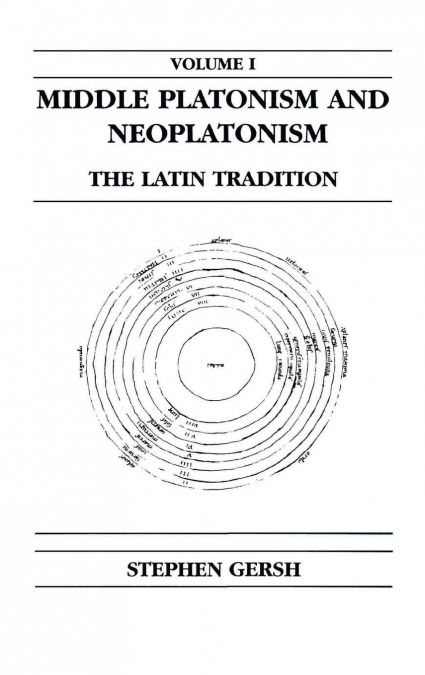
  • Middle Platonism and Neoplatonism, Volume 1
    Stephen Gersh
    'It is generally agreed that those types of philosophy that are loosely called ’Platonic’ and ’Neoplatonic’ played a crucial role in the history of European culture during the centuries between antiquity and the Renaissance. However, until now no scholar has attempted to describe the evolution of these forms of thought in a single comprehensive academic study.' So writes Stephe...
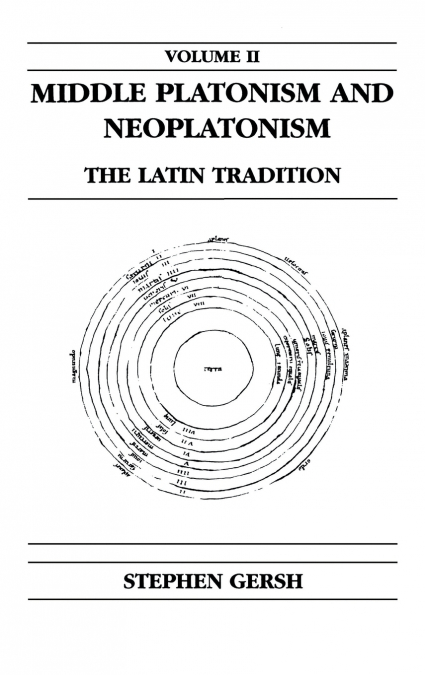
  • Middle Platonism and Neoplatonism, Volume 2
    Stephen Gersh
    It is generally agreed that those types of philosophy that are loosely called 'Platonic' and 'Neoplatonic' played a crucial role in the history of European culture during the centuries between antiquity and the Middle Ages. However, until now no scholar has attempted to describe the evolution of these forms of thought in a single comprehensive academic study. Middle Platonism a...
  • Porphyry’s Commentary on Ptolemy’s Harmonics
    Andrew Barker
    ...
    Disponible

    77,17 €

  • The Roots of Platonism
    John Dillon
    ...
    Disponible

    25,29 €

Otros libros del autor

  • Desiring the Good
    Katja Maria Vogt
    Desiring the Good defends a novel and distinctive approach in ethics that is inspired by ancient philosophy. Ethics, according to this approach, starts from one question and its most immediate answer: 'what is the good for human beings?'--'a well-going human life.' Ethics thus conceived is broader than moral philosophy. It includes a range of topics in psychology and metaphysic...
  • Law, Reason, and the Cosmic City
    Katja Maria Vogt
    ...
    Disponible

    76,11 €