 Librería Samer Atenea
 Kálamo Books
 Librería Elías (Asturias)
 Librería Kolima (Madrid)
 Librería Proteo (Málaga)
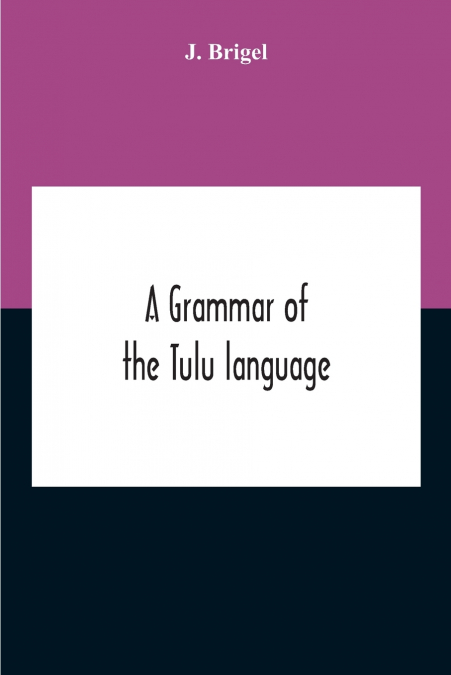
Brigel’s A Grammar of the Tulu Language brings into focus a careful, nineteenth-century study of Tulu - the coastal Dravidian tongue of South India. A rare grammar of Tulu. Meticulous yet readable, Brigel sets out a systematic tulu language grammar guide grounded in philological method and exacting description. The treatment ranges from sounds through word-formation to sentence patterns, offering language structure analysis that remains relevant for modern inquiry without lapsing into needless jargon. As a classical language reference it sits alongside later dictionaries and grammars in south indian linguistics, while as a historical linguistics resource it preserves usages and comparisons valuable to scholars working on comparative dravidian languages. Students encountering Dravidian language study will find a compact companion to academic language textbooks; it also belongs in a language learners collection where historical grammars help reveal earlier norms. Philologists will recognise its evidential value as a philology reference book, and researchers in south india studies use such primary materials when tracing regional variation and the contours of colonial-era fieldwork. Casual readers curious about linguistic history and regional culture will be rewarded by readable exposition and illuminating context; classic-literature collectors and institutional libraries will appreciate the work’s period authority and the steadiness of its scholarly voice. Beyond its technical descriptions, Brigel’s grammar offers a window into the methods and preoccupations of nineteenth-century India scholarship, making it both a practical handbook for comparative study and a rich source for historians of language. A modern reader will appreciate the document’s unadorned clarity and its usefulness as source material for sound-change studies, reconstruction and pedagogical reference. Librarians assembling collections for south India studies or comparative philology will find Brigel’s grammar a steady, discoverable presence among nineteenth-century India texts.Republished by Alpha Editions in a careful modern edition, this volume preserves the spirit of the original while making it effortless to enjoy today - a heritage title prepared for readers and collectors alike.