
Inicio > Artes > Artes: aspectos generales > Zur Entwicklung der Arbeiterbewegung in Rußland bis zur großen Revolution von 1905
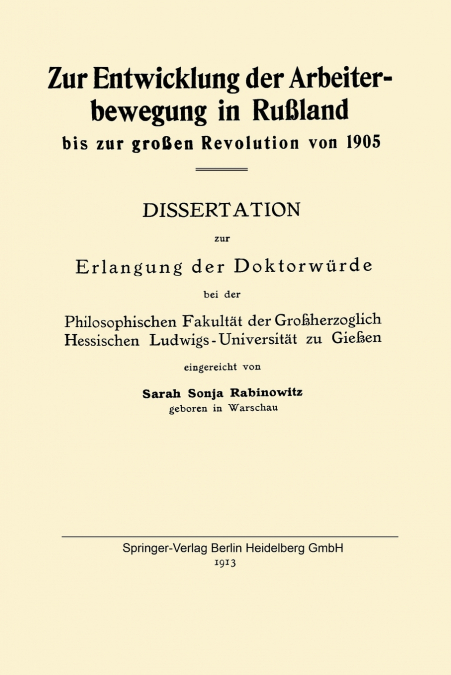
Zur Entwicklung der Arbeiterbewegung in Rußland bis zur großen Revolution von 1905

Zur Entwicklung der Arbeiterbewegung in Rußland bis zur großen Revolution von 1905

Sarah Sonja Rabinowitz

72,46 €
IVA incluido
Disponible
Editorial:
Springer Nature B.V.
Año de edición:
1913
Materia
Artes: aspectos generales
ISBN:
9783662279373
72,46 €
IVA incluido
Disponible

Selecciona una librería:

  • Librería Samer Atenea
  • Librería Aciertas (Toledo)
  • Kálamo Books
  • Librería Perelló (Valencia)
  • Librería Elías (Asturias)
  • Donde los libros
  • Librería Kolima (Madrid)
  • Librería Proteo (Málaga)

2 Schon im 17. Jahrhundert beginnt der Staat unter dem Druck der militärischen Zusammenstöße mit Polen und Schweden die ökonomische Entwicklung des Landes selbst anzuregen, den Handel und das Hand­ werk zu fördern. Waren dabei auch nur militär-technische und fiskalische Zwecke maßgebend, so hat doch die russische Regierung eine bedeutende Rolle in der Entwicklung des russischen Wirtschaftslebens gespielt. Vor allem das Protektionssystem hatte eine besondere Bedeutung für den Charakter und den Aufschwung der russischen Industrie. Die Hauptprinzipien der Industriepolitik Peters des Großen waren: das Verbot der Ausfuhr von Rohmaterialien, die Einführung eines hohen Zolltarüs, die Unterstützung der heimischen Industrie durch Staats­ aufträge. Die größten Fabrikunternehmungen : Gewebe-, Kanonen-, Guß-, Tuch- und Papierfabriken lieferten ihre Produkte dem Staate. Der Tarü von 1724 belegte alle Waren, deren Produktion in Rußland einigermaßen entwickelt war, mit einem Zoll bis zu 50-75% des Wertes. Unter den Fabriken, die zur Zeit Peters des Großen entstanden sind, gab es ziemlich große Betriebe; so beschäftigte die Staatssegeltuchfabrik zu Moskau 1162 Arbeiter. Auch bedeutende Fabriken gab es zur petri­ nischen Zeit in Moskau: so beschäftigte die Seidenmanufaktur der Gesellschaft Evreinow 1728 etwa 1500 Arbeiter!). Diese Politik Peters des Großen führte zur Entstehung der russischen Großindustrie. Doch konnte diese sich nicht ganz entfalten; dazu fehlte vor allem die Arbeiterklasse. Die Dorfbewohner waren zur Zeit Peters Leibeigene des Staates oder der Grundherren; die städtische Bevölkerung war sehr gering und bestand z. T. gleichfalls aus leibeigenen Elementen.
Artículos relacionados

  • The Art of Math and Science
    Jayanti Tambe
    The Art of Math and Science guides teachers to introduce masterpiece art to young children, so they can tell you about “paints with hidden floats” and ask questions like, “When painting the Sistine Chapel, do you think Michelangelo had many headaches?”This book helps parents and educators look at the subject through the prism of mathematical and scientific experiences. This boo...
  • Art and the Monad
    Keith Lincoln Cook
    Keith Lincoln Cook's essay centres on his diagram of the monad: a circular diagram, showing the relationship between external stimuli, the intellect and the emotions. Although everyone should be able to freely respond to the vast amount of external stimuli collected by the senses, many people will block off their responses, collecting the stimuli in the band of intellect an...
    Disponible

    6,17 €

  • Slow Down
    Todd Webb
    Color everything and color nothing on your path to mindfulness with this playful coloring book!Packed with just enough to keep you entertained in the present moment, SLOW DOWN is sure to become your go-to meditation guide as you color your way to a calmer, less stressful life. With simple illustrations and inspirational text it makes a great gift! "Art's purpose is to sober...
    Disponible

    12,17 €

  • Raising the Eyebrow
    Lauren Golden
    A lavish festschrift to John Onians with contributions by 28 distinguished academics. Any summary as to the direction of these contributions is, perhaps, best left to Martin Kemp and his affectionate preface, “Above all, he (John Onians) reminds us of the researchers’, writers’ and teachers’ true mission, that is the need to be radical in both asking and answering questions, an...
    Disponible

    182,20 €

  • Projective Processes and Neuroscience in Art and Design
    Rachel Zuanon
    Recent advances in neuroscience suggest that the human brain is particularly well-suited to design things: concepts, tools, languages and places. Current research even indicates that the human brain may indeed have evolved to be creative, to imagine new ideas, to put them into practice, and to critically analyze their results. Projective Processes and Neuroscience in Art and De...
  • Book of Jupiter
    Leo Valenzuela
    Book of Jupiter: Gone to Uranus is a work of imagination and fantasy by Leo Valenzuela. Explore a variety of unique creatures with interesting dialogue which included a few step tutorials on how to draw his style of work. 3 ...
    Disponible

    24,25 €