 Librería Samer Atenea
 Kálamo Books
 Librería Elías (Asturias)
 Librería Kolima (Madrid)
 Librería Proteo (Málaga)
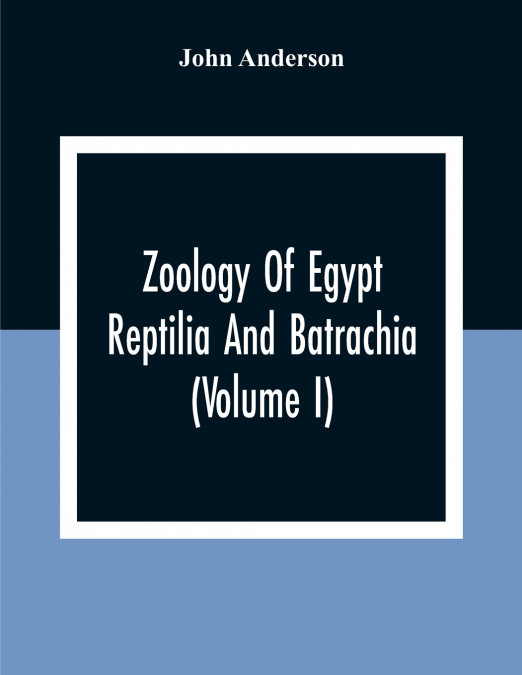
An authoritative window into Egypt’s cold-blooded fauna.A foundational guide for naturalists.John Anderson’s Zoology Of Egypt; Reptilia And Batrachia (Volume I) stands as a rigorous contribution to nineteenth century natural history, recording the anatomy, behaviour and classification of north Africa’s reptiles and amphibians with the careful observation of a professional naturalist. Part scientific reptile guide and part taxonomic monograph, it functions as an essential egyptian zoology reference and a practical herpetology field manual: clear species accounts, comparative notes and systematic keys make it useful to students, museum staff and field observers alike. The writing balances scholarly precision with vivid natural history, offering a comprehensive animal taxonomy grounded in direct study, and it remains a valuable academic zoology collection entry and museum research resource for anyone tracing the development of Victorian era science.Republished by Alpha Editions in a careful modern edition, this volume preserves the spirit of the original while making it effortless to enjoy today - a heritage title prepared for readers and collectors alike. As both a historic landmark and a working reference, Anderson’s account has special resonance for naturalists and scholars assembling a north africa wildlife study or for classic-literature collectors seeking authentic nineteenth century natural history works. The book’s illustrated Egypt fauna and methodical approach to classification invite casual readers fascinated by deserts, Nile habitats and faunal diversity, while satisfying collectors who prize provenance, scientific depth and cultural significance. Curators, librarians and students will find it a dependable museum research resource and a sound reference for cross-referencing specimens and historical records. Whether consulted for the pleasures of Victorian natural observation, used as a scientific reptile guide in comparative work, or housed within an academic zoology collection, the volume rewards close attention with insights that still matter to the study of North African biodiversity. More than an archival curiosity, it is a lively, usable resource for field comparison, museum cataloguing and anyone curious about how early herpetology shaped our knowledge of Egypt’s animal life.