 Librería Samer Atenea
 Kálamo Books
 Librería Elías (Asturias)
 Librería Kolima (Madrid)
 Librería Proteo (Málaga)
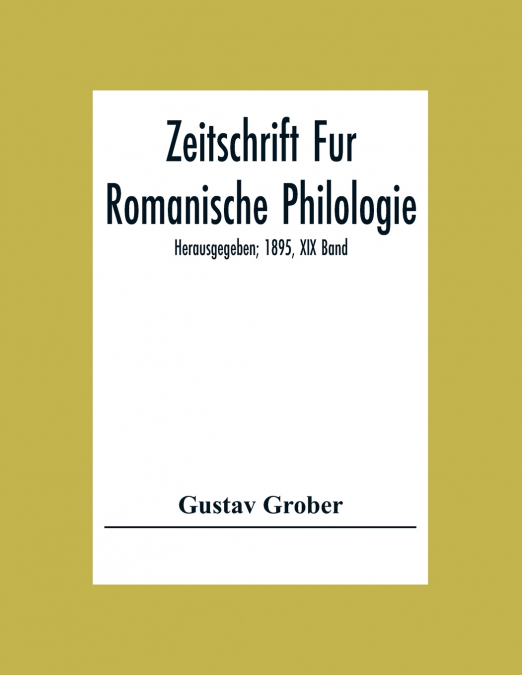
Zeitschrift Fur Romanische Philologie (1895, XIX Band), edited by Gustav Grober, is a defining romance philology journal from the heart of nineteenth-century linguistics. Scholarly rigour in compact form. This linguistic periodical series showcases comparative philology studies and scholarly language studies that chart the emergence of historical romance languages and the broader romance languages history. Drawn from 1890s European scholarship, its contents reflect the era’s emphasis on systematic comparison, textual criticism and historical reconstruction that underpin much of today’s understanding of Romance tongues. The volume thus functions as both a contemporaneous conversation among specialists and a preserved snapshot of methodological practice.Valuable both as an academic language anthology and a philological research collection, this volume speaks to specialists and curious readers alike. Contributors examine dialectal variation, etymology, and patterns of sound and morphology to map influence across Romance tongues; those using it as a university language reference or a graduate linguistics resource will encounter primary material for teaching and research, while the general reader gains a vivid sense of how scholars formulated hypotheses and tested evidence at the time. The scholarship remains methodical and evidence-driven, with apparatus and references that allow follow-up enquiry; as such the volume rewards close study and is adaptable to contemporary research needs.Out of print for decades and now republished by Alpha Editions. Restored for today’s and future generations. More than a reprint - a collector’s item and a cultural treasure. Historically significant as a record of comparative philology studies and institutional scholarship, this issue illuminates the foundations of modern Romance philology and the evolution of linguistic method. Appealing to casual readers and classic-literature collectors alike, it belongs in specialist libraries, university collections and the cabinets of discerning collectors who prize scholarly heritage. Libraries and institutions building historical linguistics collections will value this restored number for acquisition, while scholars tracing the genealogy of ideas in romance philology will find it a key reference.