
Inicio > Humanidades > Historia > Historia: acontecimientos y temas específicos > Historia social y cultural > Yekaterinoslav-Dnepropetrovsk Memorial Book (Dnipropetrovsk, Ukraine)
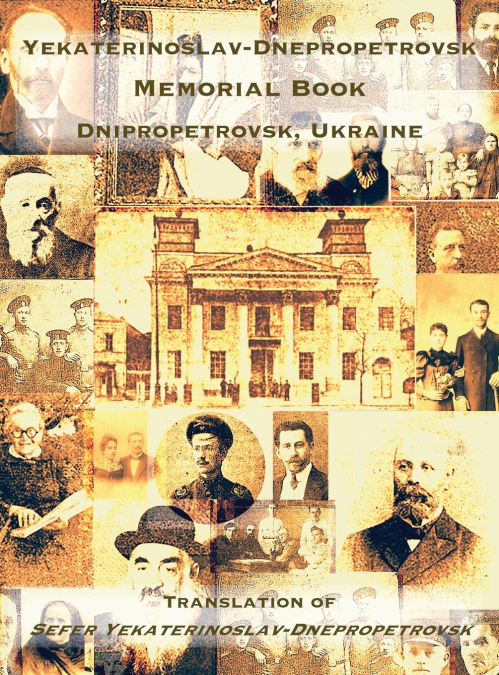
Yekaterinoslav-Dnepropetrovsk Memorial Book (Dnipropetrovsk, Ukraine)

Yekaterinoslav-Dnepropetrovsk Memorial Book (Dnipropetrovsk, Ukraine)

Yocheved Klausner

52,52 €
IVA incluido
Consulta disponibilidad
Editorial:
JewishGen
Año de edición:
2018
Materia
Historia social y cultural
ISBN:
9781939561718

Selecciona una librería:

  • Librería Samer Atenea
  • Librería Aciertas (Toledo)
  • Kálamo Books
  • Librería Perelló (Valencia)
  • Librería Elías (Asturias)
  • Donde los libros
  • Librería Kolima (Madrid)
  • Librería Proteo (Málaga)

Jews first settled in Dnipropetrovsk (Ukraine) after its foundation in 1778, and in 1804 the town was included in the Pale of Settlement. The community numbered 376 in 1805 and 1,699 in 1847. With the growth of the city in the second half of the 19th century Jews began to move there from other parts of Russia and played an important role in its commerce and industry. Pogroms occurred in Dnepropetrovsk and the vicinity on July 20–21, 1883, in which 350 homes and many Jewish shops were looted and destroyed. By 1897 the Jewish population had increased to 41,240.  Most of the shops and houses in the city center were owned by Jews. There were three Talmud Torah schools with 500 pupils, 885 studied in the hadarim, and a yeshivah and 16 private schools were in operation. In 1860 a hospital was founded with 14 beds, growing to 29 in 1886. In 1880 an old age home was opened for the poor. Pogroms again broke out on October 21–23, 1905, and 74 Jews were killed, hundreds injured, and much property was looted and destroyed. Local self-defense was organized in 1904, comprising 600 members. It did much to protect the community. In World War I and the civil war in Russia, thousands of Jews took refuge in Dnepropetrovsk, which numbered 72,928 Jews in 1920. In the Civil War (1917–20) the city changed hands a number of times, suffering from tributes, looting, rape, and murder. In June 1919 the Denikin army raped about 1,000 women and in May 1919 the Grigoryev band killed 150 Jews. After the establishment of Soviet rule, Jewish community life ceased there as elsewhere in the Soviet Union. Zionist activity was forbidden, and on September 18–22, 1922 about 1,000 were arrested. The Jewish population numbered 62,073 in 1926 Dnepropetrovsk was occupied by the Germans on August 25, 1941. Thanks to evacuation and flight, only about 17,000 Jews remained. In September 179 were killed. On October 13–14, 13,000–15,000 Jews were assembled and led to the botanical gardens, where they were murdered. The remaining 2,000 Jews were executed at the end of 1941 and the beginning of 1942. At the end of summer 1943 a unit of Operation Group 1005 opened the mass graves, burned the bodies, and dispersed the ashes. The city was liberated on October 25, 1943, and many Jews returned. According to the 1959 census there were 53,400 Jews living in Dnepropetrovsk. In 1970 there was one synagogue still functioning in the city. Subsequent census figures put the Jewish population at 45,622 in 1979 and 17,869 in 1989. Immigration to Israel diminished the number significantly during the 1990s.  

Artículos relacionados

  • Arizal
    Raphael Afilalo
    The Ari overflowed with Torah. He was expert in Scripture, Mishnah, Talmud, Midrash, Maaseh Bereishit and Maaseh Merkavah. About all the different levels of prophecy, their details and from which level the prophets had their revelations.  He understood the whistling of the trees, the grass and stones, the language of the birds and other animals, the conversations of angels, the...
  • Rose-tinted Memory
    Michael S Fryer
    “Those who deny Auschwitz would be ready to remake it”.  ~ Primo Levi, Holocaust survivor and author Seventy years after the mass murder of the Jews of Europe, Holocaust denial and Holocaust revisionism are creeping into our overall perception of what actually happened.Christendom has not ‘denied’ Holocaust, but it has attempted to create a memory of Holocaust which suggests th...
    Disponible

    8,84 €

  • Pan Kapitan of Jordanow
    William Leibner
    Yeshayahu Drucker devoted a good part of his life to rescuing Jewish children from non-Jewish homes. Many parents had given their children to Polish neighbors for safekeeping during the war. Unfortunately most of the parents did not survive the Shoah. At the end of the war, there was no one to claim the children and they remained with the “adopted” Polish families. Following hi...
  • Holy Dissent
    Glenn Dynner
    BThe religious communities of early modern Eastern Europe—particularly those with a mystical bent—are typically studied in isolation. Yet the heavy Slavic imprint on Jewish popular mysticism and pervasive Judaizing tendencies among Christian dissenters call into question the presumed binary quality of Jewish-Christian interactions. In Holy Dissent: Jewish and Christian Mystics ...
  • AL-FARD
    Ali Mahdi Muhammad
    The Al-Fard, or the The Dawn, has captured the early rays of Our history. This history is essential if we are to be brought face to face with the One true and living God of the universe. The purpose of this writing is to bring the reader step by step, one degree at a time to the reality of God in person. The teachings of Our Father elevates the believer to the level of Godhood ...
  • Wild Things. Nature and the Social Imagination
    HISTORIES OF HUMAN CONSTRUCTIONS OF NATUREWild Things: Nature and the Social Imagination assembles eleven substantive and original essays on the cultural and social dimensions of environmental history. They address a global cornucopia of social and ecological systems, from Africa to Europe, North America and the Caribbean, and their temporal range extends from the 1830s into th...