 Librería Samer Atenea
 Kálamo Books
 Librería Elías (Asturias)
 Librería Kolima (Madrid)
 Librería Proteo (Málaga)
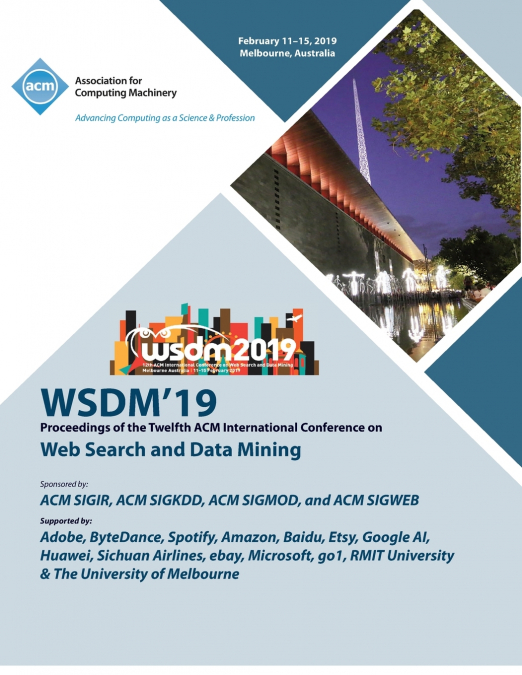
We are delighted to welcome you to the proceedings volume of the Twelfth ACM International Conference onWeb Search and Data Mining (WSDM 2019), held in Melbourne, Australia on February 11-15, 2019. Now in its twelfth year, WSDMis a top tier conference in web-inspired research relating to search and data mining. Headline features of WSDM 2019 will include the sequence of very strong keynote presentations by Jaime Teevan, H. V. Jagadish, Rohit Prasad, Aleksandra Korolova, and Maarten de Rijke, and we thank them for their willingness to attend the conference and provide their insights. As in previous years, there was a strong pool of research submissions, with 511 full-length papers received, a similar number compared to Los Angeles (2018) and Cambridge (2017), which had 514 and 505 submissions respectively. The submissions originated from 43 countries. Of the papers received, 84 were accepted and are included in these proceedings (the same number as were accepted in 2018), representing an acceptance rate of 16.4% (versus 16.1% in 2018) and within the range established through the previous eleven years (minimum 15.5%, maximum 22.3%). The final 84 papers are from 23 countries and span six continents, making WSDM a truly international forum. In 2019 we continued the single-track model that is a hallmark of WSDM, with a mix of long-talk presentations and short-talk presentations, an approach that was introduced in 2012. Of the 84 accepted papers, 50 were assigned a five-minute talk, and 34 were assigned a longer fifteen-minute slot. All authors also had an opportunity to engage in detailed interactions during a 45-minute afternoon poster session held on the same day as their oral presentation. The selection between long-talk and short-talk presentation was made by the Program Chairs, based on whether the topic and content of the paper was better suited to large group presentation or to focused and interactive presentation, and was independent of the paper reviewing process. All accepted papers have equal standing in the proceedings. The program committee worked hard to assess the submissions and provide feedback to help improve the papers. At least three program committee members reviewed each submission, together with a senior PC member who oversaw discussion amongst the reviewers and provided an overall recommendation. To discuss papers and ensure consistency across the entire decision process a PC meeting of available SPC members and the PC Chairs was held in Los Angeles on October 18th, with other SPC members participating remotely. We acknowledge the tremendous work of the 208 members of the Program Committee (representing 27 countries), and in particular the efforts of the 65 Senior Program Committee members. They are the cornerstone of the high-quality program that has emerged in 2019. After discussion with past WSDM chairs and the WSDM Steering Committee, the reviewing model used in 2019 was a mix of single- and double-blind evaluation. Submissions were prepared using a doubleblind format, with no author information allowed (however authors were permitted to indicate the source of their data set and/or deployment environment, to avoid references to major commercial search engines as has occurred in the past). First-tier PC members had no access to author names or affiliations, allowing them to provide double-blind bias-free review. However, to more rigorously vet for conflict of interest (CoI) issues between authors and first-tier referees, SPC members could see both author names and author affiliations.