
Wooden Ships and Iron Men

Wooden Ships and Iron Men

David Bruhn

40,12 €
IVA incluido
Disponible
Editorial:
Heritage Books
Año de edición:
2012
ISBN:
9780788449093
40,12 €
IVA incluido
Disponible

Selecciona una librería:

  • Librería Samer Atenea
  • Librería Aciertas (Toledo)
  • Kálamo Books
  • Librería Perelló (Valencia)
  • Librería Elías (Asturias)
  • Donde los libros
  • Librería Kolima (Madrid)
  • Librería Proteo (Málaga)

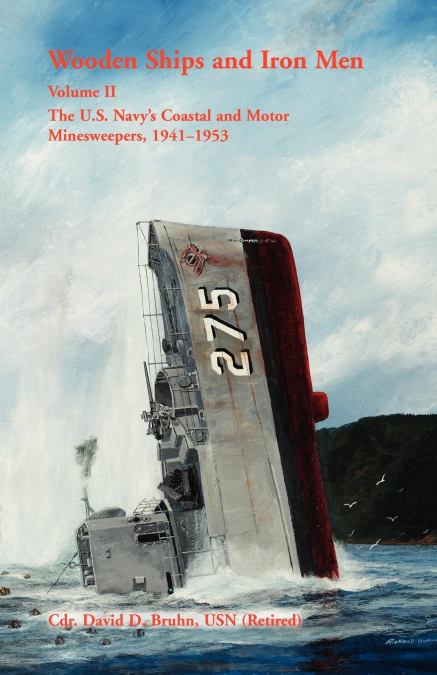
Possessing insufficient minesweepers to protect U.S. harbors and bays as the threat of war in Europe spread, in the winter of 1939-40 the Navy began purchasing fishing vessels and modifying them to combat mines. One of them, Condor (AMc-14), first sighted the Japanese Type-A midget submarine that destroyer Ward (DD-139) sank on December 7, 1941 with the first shots fired by American forces during World War II. She would be one of six coastal minesweepers to receive a battle star. From boat- and shipyards across America came the largest production run of any World War II warship, 561 scrappy little 136-foot wooden-hulled vessels characterized by Arnold Lott in Most Dangerous Sea as 'belligerent-looking yachts wearing grey paint.' Although their designers envisioned that they would operate primarily in the vicinity of yards or bases, the YMSs (too numerous to be given names) would see action in every theater of war, earning almost 700 battle stars, twenty-one Presidential Unit Citations, and fifteen Navy Unit Commendations. YMSs were present in the North African campaign, in Sicily, at Anzio, Salerno, and elsewhere in Italy, and swept ahead of invasion forces at Normandy and in Southern France. In the Pacific, they operated in the Marshall Islands, New Guinea, Solomons, Treasury Island, Gilbert Islands, New Britain, Admiralty Islands, Guam, Palau, Leyte, Luzon, Manila Bay, Iwo Jima, Southern Philippines, Okinawa, and Borneo. Following the war, they cleared mines from the East China Sea, Yangtze River approaches, and throughout Japanese waters, and their activities gave rise to the proud slogan of the mine force: 'Where the Fleet Goes, We’ve Been.' During the Korean War, a mere sixteen auxiliary motor minesweepers (former YMSs) performed the bulk of mine clearance, often while inside the range of enemy coastal artillery, necessary for larger naval vessels to close the coast to support operations ashore. Garnering collectively 124 battle stars, seven Presidential Unit Citations, and seven Navy Unit Commendations, the men aboard these ships were then, and remain to date, the most highly decorated crews of minesweepers in the history of the U.S. Navy.
Artículos relacionados

  • U.S. Coast Guard in World War II
    Malcolm F Willoughby / Malcolm F. Willoughby
    The intimate view of the U.S. Coast Guard’s dramatic World War II record has long been considered a classic. First published in 1957 and out of print for years, the book is now available in paperback. Handsomely illustrated with more than two hundred photographs, the book serves as a unique memento of one of the most illustrious periods in the Coast Guard’s two hundred year his...
    Disponible

    47,08 €

  • The War for Muddy Waters
    Joshua Tallis
    Historically, operations and studies regarding maritime security focus on individual threats (e.g., piracy, terrorism, narcotics) and individual measures to target them (e.g., counterpiracy, counterterrorism, counternarcotics). This book explores, for the first time, an overall strategy for maritime security, integrating these issues into a single framework. Tallis argues that...
    Disponible

    30,24 €

  • Passage
    Angus Wardlaw
    ’PASSAGE’ is the shocking account of the tragic John Franklin Expedition, brilliantly told in a new novel by Angus Wardlaw, descendant of Captain Francis Crozier who commanded the HMS Terror, sister ship to the HMS Erebus.Wardlaw dramatically unveils the spine-tingling true story of this ambitious but ultimately fated expedition, that ended in death and cannibalism.Meticulously...
    Disponible

    21,85 €

  • Until the Sea Shall Free Them
    Robert Frump / Robert R. Frump
    In 1983 the Marine Electric, a reconditioned World War II vessel, was on a routine voyage thirty miles off the East Coast of the United States when disaster struck: The old coal carrier sank in the frigid forty-foot waves and subzero winds of the Atlantic, and of the thirty-four men aboard, only three survived. Until the Sea Shall Free Them recounts in compelling detail the wr...
    Disponible

    25,30 €

  • U.S. Navy Minecraft
    Ken W. Sayers
    In modern naval warfare, offensive and defensive mine operations and the ships that perform them often take a back seat to the more glamorous carrier strike groups, strategic deterrence patrols and anti-submarine operations. Despite their relatively small size and numbers, minecraft have enormous strategic and tactical value. With more than 200 photos, this book details the ...
    Disponible

    81,45 €

  • PT Boat Bases
    Frank J. Andruss Sr. / Harold E. Walther
    In today’s world, where logistics and supply chains dominate headlines, understanding the challenges and triumphs of wartime base construction and operation offers valuable (and timely) insights. The US and an expansionist East Asian power are once again jockeying to acquire (and deny) access to the remote, undeveloped, and beautiful island bases in the Southwest Pacific descri...
    Disponible

    46,66 €

Otros libros del autor

  • Sanctuary Not Certain
    David Bruhn
    During World War II, German and Italian aircraft bombed and sank thirteen Allied hospital ships (7 British, 5 Greek, 1 Norwegian) in the European Theatre. A fourteenth hospital ship (British) was sunk by a German sea mine during the Normandy invasion. As a result of these illegal, purposeful attacks on clearly marked hospital ships, wounded servicemen could not be assured of sa...
    Disponible

    36,73 €

  • Sandscrapers
    David Bruhn
    A total of 558 Medium Landing Ships were built in WWII. The modest 203-foot ships had bow ramps like those of much larger LSTs, and a deck house resembling the turret of a medieval castle. So unique were their looks, that it was not uncommon when an LSM entered port, for someone to yell out, 'What type of ship is that?' Despite their large numbers, the ships were relatively unk...
    Disponible

    40,01 €

  • Stride Out
    David Bruhn
    Chico State, long known as a party school-Playboy magazine ranked it number one in the nation from 1987 through 2002-offered students an inviting environment in which to enjoy social life on and off campus while pursuing their studies. The non-athletic scholarship school drew runners to Chico like San Juan Capistrano beckons swallows homeward. One reason was Bidwell Park, which...
    Disponible

    32,31 €

  • Toe the Mark
    David Bruhn
    Running programs in Chico in the 1970s were similar to those elsewhere. Famed University of Oregon coach Bill Bowerman had introduced the sport of jogging; American Frank Shorter was the winner of the marathon at the 1972 Olympics; and Steve Prefontaine, running for Oregon, drew thousands of fans to see him race. A distant 384 miles south of Eugene, Oregon, lay Chico, a small r...
    Disponible

    32,21 €

  • Turn into the Wind, Volume I. US Navy and Royal Navy Light Fleet Aircraft Carriers in World War II, and Contributions of the British Pacific Fleet
    David Bruhn
    In the Pacific in World War II, the dearth of US Navy fleet aviation capabilities became acute following the loss, in 1942, of four aircraft carriers to combat action. New Essex-class fleet aircraft carriers were being built, but would not be ready soon enough. Time was of the essence. President Franklin D. Roosevelt intervened to solve the problem - directing reluctant Navy 't...
    Disponible

    43,45 €

  • Turn into the Wind, Volume II. US Navy, Royal Navy, Royal Australian Navy, and Royal Canadian Navy Light Fleet Aircraft Carriers in the Korean War and through end of service, 1950-1982
    David Bruhn
    American and British light fleet aircraft carriers, an expedient of war at a time of dire need in World War II, answered their nations’ call a second time during the Korean War. While larger US Navy fleet carriers plied their trade in the deeper Sea of Japan off Korea’s east coast, their svelte sisters - USS Bataan, HMS Glory, HMS Ocean, HMS Theseus, HMS Triumph, and HMAS Sydne...
    Disponible

    35,39 €