
Sanctuary Not Certain

Sanctuary Not Certain

David Bruhn

36,73 €
IVA incluido
Disponible
Editorial:
Heritage Books
Año de edición:
2025
Materia
Historia militar
ISBN:
9780788450396
36,73 €
IVA incluido
Disponible

Selecciona una librería:

  • Librería Samer Atenea
  • Librería Aciertas (Toledo)
  • Kálamo Books
  • Librería Perelló (Valencia)
  • Librería Elías (Asturias)
  • Donde los libros
  • Librería Kolima (Madrid)
  • Librería Proteo (Málaga)

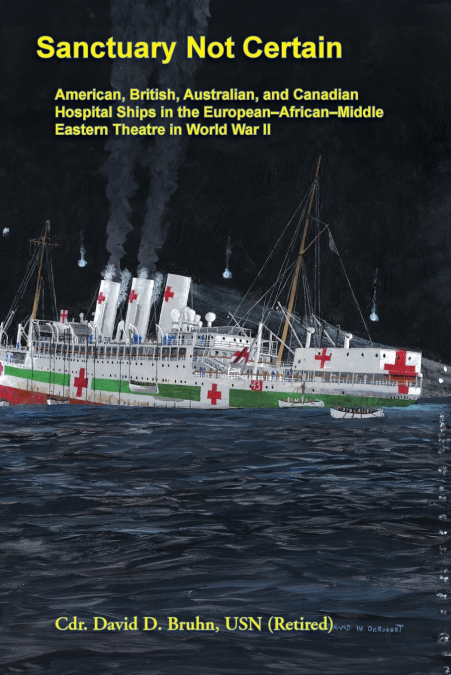
During World War II, German and Italian aircraft bombed and sank thirteen Allied hospital ships (7 British, 5 Greek, 1 Norwegian) in the European Theatre. A fourteenth hospital ship (British) was sunk by a German sea mine during the Normandy invasion. As a result of these illegal, purposeful attacks on clearly marked hospital ships, wounded servicemen could not be assured of sanctuary on board presumed safe havens; neither could the ships’ crews nor the doctors, nurses and other medical staff on board to provide patient care. The chain of medical care began with servicemen brought to field hospitals near the front lines, then, if necessary, transferred to more distant evacuation hospitals. Critically wounded patients were further transported to station and general hospitals via hospital ships, hospital trains, or aircraft, attended by nurses and other medical personnel.Typically, though scarcely recognized by authorities paying tribute to WWII veterans’ groups, Allied nurses were on the front lines as well as on board hospital ships in combat zones and at more rearward hospitals. During the invasion of North Africa marking America’s entry into the war in Europe, U.S. Army nurses waded ashore from landing craft with assault troops; it being too dangerous for hospital ships to enter port. Over the course of the war, women of the U.S. Army Nurse Corps suffered death and wounds as they treated soldiers, sailors, and airmen.U.S. Army nurses (in all theatres of war) were decorated for meritorious service and bravery under fire. Decorations included the Distinguished Service Medal, Silver Star, Legion of Merit, Distinguished Flying Cross, Soldier’s Medal, Bronze Star Medal, Purple Heart, Air Medal, and Army Commendation Medal.British, Canadian, Australian, and New Zealand Nursing Sisters serving aboard Commonwealth hospital ships shared these same dangers and hardships of war. But those in charge were also mindful of appearances. A Matron directed her junior Nursing Sisters, 'here borrow my comb, and try not to look like survivors!' following several hours in Mediterranean water, clinging to wreckage after their British Army hospital ship was sunk, and having been brought ashore in Oran where their bedraggled uniforms were exchanged for men’s clothing.

Artículos relacionados

  • Waterloo Betrayed
    Stephen M. Beckett / Stephen MBeckett
    THIS BOOK HAS BEEN SUPERCEDEDSee Operations of the Armée du Nord : 1815, The Analysis for the definitive guide of French operations in 1815.   Discover why Napoleon really lost the Waterloo Campaign Napoleon was betrayed during 1815 There is no doubt of this. The Traitors admitted as much, and the Allied powers documented their acts. In the immediate aftermath of Napoleon's...
    Disponible

    38,86 €

  • The Price They Paid
    Michael Putzel
    The Price They Paid is the stunning and dramatic true story of a legendary helicopter commander in Vietnam and the flight crews that followed him into the most intensive helicopter warfare ever-and how that brutal experience has changed their lives in the forty years since the war ended. ...
    Disponible

    11,07 €

  • Uniforms of Russian army during the Napoleonic war vol.17
    Aleksandr Vasilevich Viskovatov / Mark Conrad
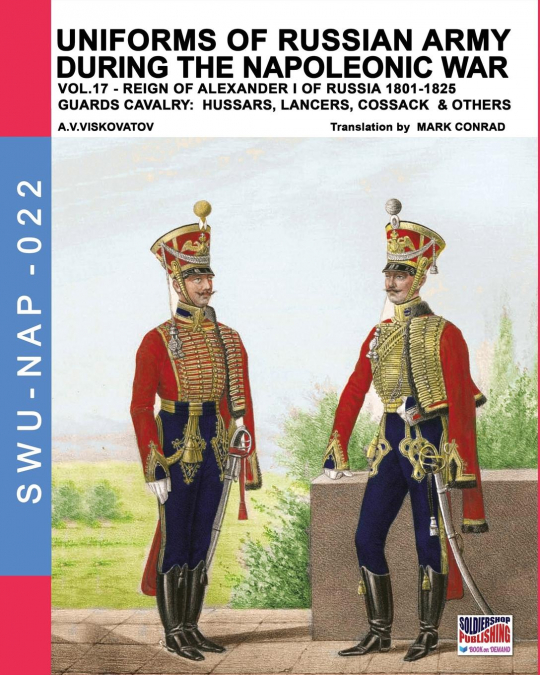
    This volume is related to the Russian Army during the zar Alexander I era, and are about the Guard cavalry regiments (part 1). Compiled at Saint Petersburg during the year from 1837 and 1851, the Historical Description of the Clothing and Arms of the Russian Army has had an enormous impact and great importance for the study on the history of Russian costume and uniformology dev...
    Disponible

    40,78 €

  • Cyber Warfare and Cyber Terrorism
    ...
    Disponible

    217,45 €

  • Armed Robotic Systems Emergence
    Robert j. Bunker / Robert jBunker
    The fielding of armed robotic systems--droids and drones that are teleoperated, semi-autonomous, and even autonomous--has been slowly but surely transitioning from pure science fiction into military reality on the battlefields of the early 21st century. These systems currently have no artificial intelligence (AI) whatsoever and, in most cases, are simply operated by soldiers (a...
    Disponible

    8,64 €

  • SNIPER ONE
    DAN MILLS
    ...
    Disponible

    18,71 €

Otros libros del autor

  • Sandscrapers
    David Bruhn
    A total of 558 Medium Landing Ships were built in WWII. The modest 203-foot ships had bow ramps like those of much larger LSTs, and a deck house resembling the turret of a medieval castle. So unique were their looks, that it was not uncommon when an LSM entered port, for someone to yell out, 'What type of ship is that?' Despite their large numbers, the ships were relatively unk...
    Disponible

    40,01 €

  • Stride Out
    David Bruhn
    Chico State, long known as a party school-Playboy magazine ranked it number one in the nation from 1987 through 2002-offered students an inviting environment in which to enjoy social life on and off campus while pursuing their studies. The non-athletic scholarship school drew runners to Chico like San Juan Capistrano beckons swallows homeward. One reason was Bidwell Park, which...
    Disponible

    32,31 €

  • Toe the Mark
    David Bruhn
    Running programs in Chico in the 1970s were similar to those elsewhere. Famed University of Oregon coach Bill Bowerman had introduced the sport of jogging; American Frank Shorter was the winner of the marathon at the 1972 Olympics; and Steve Prefontaine, running for Oregon, drew thousands of fans to see him race. A distant 384 miles south of Eugene, Oregon, lay Chico, a small r...
    Disponible

    32,21 €

  • Turn into the Wind, Volume I. US Navy and Royal Navy Light Fleet Aircraft Carriers in World War II, and Contributions of the British Pacific Fleet
    David Bruhn
    In the Pacific in World War II, the dearth of US Navy fleet aviation capabilities became acute following the loss, in 1942, of four aircraft carriers to combat action. New Essex-class fleet aircraft carriers were being built, but would not be ready soon enough. Time was of the essence. President Franklin D. Roosevelt intervened to solve the problem - directing reluctant Navy 't...
    Disponible

    43,45 €

  • Turn into the Wind, Volume II. US Navy, Royal Navy, Royal Australian Navy, and Royal Canadian Navy Light Fleet Aircraft Carriers in the Korean War and through end of service, 1950-1982
    David Bruhn
    American and British light fleet aircraft carriers, an expedient of war at a time of dire need in World War II, answered their nations’ call a second time during the Korean War. While larger US Navy fleet carriers plied their trade in the deeper Sea of Japan off Korea’s east coast, their svelte sisters - USS Bataan, HMS Glory, HMS Ocean, HMS Theseus, HMS Triumph, and HMAS Sydne...
    Disponible

    35,39 €

  • Support for the Fleet
    David Bruhn
    During the Vietnam War, 136 U.S. Navy and three Royal Australian Navy Service Force ships served in Vietnam. It was not glamorous duty, and the men who toiled aboard the ships received little recognition. It wouldn’t make good reading in Des Moines that the warships on the gunline could not fire their guns, or that carriers on Yankee and Dixie stations could not fly airstrikes ...
    Disponible

    35,84 €