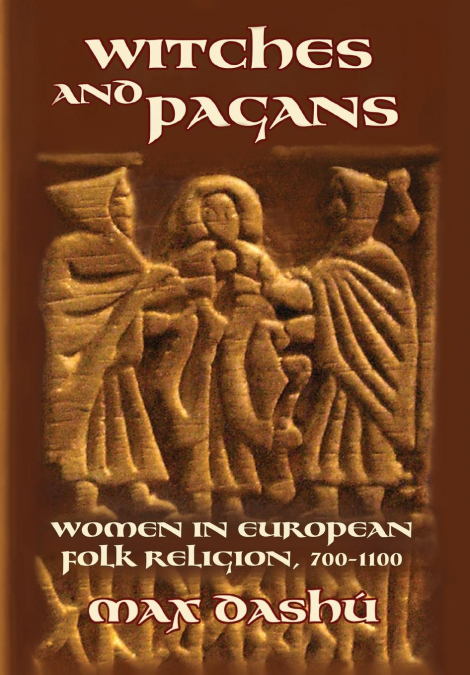

Witches and Pagans

Witches and Pagans

Witches and Pagans

Max Dashu

26,93 €
IVA incluido
Disponible
Editorial:
Veleda Press
Año de edición:
2017
Materia
Historia social y cultural
ISBN:
9780692740286
Páginas:
340
Encuadernación:
Rústica
26,93 €
IVA incluido
Disponible

Selecciona una librería:

  • Librería Samer Atenea
  • Librería Aciertas (Toledo)
  • Kálamo Books
  • Librería Perelló (Valencia)
  • Librería Elías (Asturias)
  • Donde los libros
  • Librería Kolima (Madrid)
  • Librería Proteo (Málaga)

In this compelling exploration of language, archaeology, and early medieval literature, Max Dashu illuminates hidden cultural heritages. She shows that the old ethnic names for “witch” signify ‘wisewoman,’ ‘prophetess,’ ‘diviner,’ ‘chanter,’ ‘herbalist,’ and ‘healer.’ She fleshes out the oracular ceremonies of the Norse völur (“staff-women”), their incantations and “sitting-out” on the land seeking vision. Archaeological finds of their ritual staffs show that many symbolize the distaff, a spinner’s wand that connects with wider European themes of goddesses, fates, witches, and female power. They include Berthe Pédauque, also known as the “Swan-footed Queen,” whose spinning began at the proverbial beginning of time. Veneration of the Fates persisted under many titles, as the Norns, sudice, fatas and fées, Wyrd or the Three Weird Sisters.Witches and Pagans looks at women’s sacraments in early medieval Europe, a subject that has been buried deep for centuries. Women set out offering tables for the Three Sisters or the “good women,” chanted over herbs, and healed children by passing them through ‘elf-bores.’ Spinning and weaving were ceremonial acts with divinatory or protective power, as bishops’ scoldings reveal. Churchmen also railed against the Women Who Go by Night with Diana or Holda or Herodias, in shamanic flight on spirit animals. This was the foundational witch-legend that demonologists seized upon in later centuries. But witch persecution was already underway, as a chapter on the sexual politics of early medieval witch burnings documents.A thousand years ago, an Old English scribe condemned people who “bring their offerings to earth-fast stone and also to trees and to wellsprings, swa wiccan taeca∂—as the witches teach.” This indicates that people still regarded witches as spiritual teachers, and that they performed ceremonies of reverence to Earth. Many aspects of ethnic spiritual culture survived the state conversions to Christianity: ancestor veneration, crystal balls, amulets—and witches’ wands. Artists depicted Mother Earth giving her breast to serpents, animals, and children. Stories of ancestral women—the Cailleach and the Scandinavian dísir —were handed down over countless generations.Gathering together forgotten strands from heathen European heritages, Witches and Pagans reweaves the ripped webs of women’s culture.  
Artículos relacionados

  • Arizal
    Raphael Afilalo
    The Ari overflowed with Torah. He was expert in Scripture, Mishnah, Talmud, Midrash, Maaseh Bereishit and Maaseh Merkavah. About all the different levels of prophecy, their details and from which level the prophets had their revelations.  He understood the whistling of the trees, the grass and stones, the language of the birds and other animals, the conversations of angels, the...
  • Rose-tinted Memory
    Michael S Fryer
    “Those who deny Auschwitz would be ready to remake it”.  ~ Primo Levi, Holocaust survivor and author Seventy years after the mass murder of the Jews of Europe, Holocaust denial and Holocaust revisionism are creeping into our overall perception of what actually happened.Christendom has not ‘denied’ Holocaust, but it has attempted to create a memory of Holocaust which suggests th...
    Disponible

    8,84 €

  • Pan Kapitan of Jordanow
    William Leibner
    Yeshayahu Drucker devoted a good part of his life to rescuing Jewish children from non-Jewish homes. Many parents had given their children to Polish neighbors for safekeeping during the war. Unfortunately most of the parents did not survive the Shoah. At the end of the war, there was no one to claim the children and they remained with the “adopted” Polish families. Following hi...
  • Holy Dissent
    Glenn Dynner
    BThe religious communities of early modern Eastern Europe—particularly those with a mystical bent—are typically studied in isolation. Yet the heavy Slavic imprint on Jewish popular mysticism and pervasive Judaizing tendencies among Christian dissenters call into question the presumed binary quality of Jewish-Christian interactions. In Holy Dissent: Jewish and Christian Mystics ...
  • AL-FARD
    Ali Mahdi Muhammad
    The Al-Fard, or the The Dawn, has captured the early rays of Our history. This history is essential if we are to be brought face to face with the One true and living God of the universe. The purpose of this writing is to bring the reader step by step, one degree at a time to the reality of God in person. The teachings of Our Father elevates the believer to the level of Godhood ...
  • Wild Things. Nature and the Social Imagination
    HISTORIES OF HUMAN CONSTRUCTIONS OF NATUREWild Things: Nature and the Social Imagination assembles eleven substantive and original essays on the cultural and social dimensions of environmental history. They address a global cornucopia of social and ecological systems, from Africa to Europe, North America and the Caribbean, and their temporal range extends from the 1830s into th...