
Wissenschaft kommuniziert

Wissenschaft kommuniziert

René Wilke

60,12 €
IVA incluido
Disponible
Editorial:
Springer Nature B.V.
Año de edición:
2022
Materia
Sociedad y cultura: general
ISBN:
9783658367039
60,12 €
IVA incluido
Disponible

Selecciona una librería:

  • Librería Samer Atenea
  • Librería Aciertas (Toledo)
  • Kálamo Books
  • Librería Perelló (Valencia)
  • Librería Elías (Asturias)
  • Donde los libros
  • Librería Kolima (Madrid)
  • Librería Proteo (Málaga)

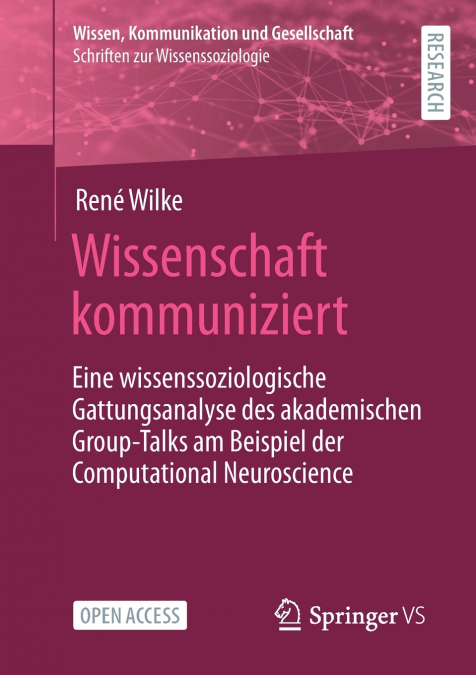
In diesem Open-Access-Buch steht der akademische Group-Talk als Format der wissenschaftsinternen Wissenskommunikation im Fokus. Group-Talk ist die Feldbezeichnung für das wöchentliche Arbeitstreffen einer teilnehmend beobachteten Forschungsgruppe in der Computational Neuroscience (CNS). Dass (soziale) Wirklichkeit in Interaktionsprozessen erzeugt und institutionalisiert wird, ist eine aus der Wissenssoziologie bzw. dem Sozialkonstruktivismus bereits wohlbekannte Erkenntnis. Dass diese Erzeugung maßgeblich durch kommunikatives Handeln prozessiert wird, ist spätestens seit dem Kommunikativen Konstruktivismus bekannt. Zentral in vorliegender Analyse ist daher die spezifische Form des kommunikativen Handelns, das besondere Format, in dem die CNS, als relativ junger und interdisziplinärer Forschungskontext, von den disziplinär heterogenen Wissenschaftler/-innen im Feld, kommunikativ (re-)konstruiert wird. Die wissenssoziologische Gattungsanalyse dient dabei dazu, den reinen Situationalismus zu überschreiten und die soziologische Mikroanalyse (Handeln), vor dem Hintergrund einer fokussiert-ethnographischen Feldstudie, mit gesellschaftlichen Emergenzphänomenen auf Meso- und Makroebene zu verknüpfen. Erst diese systematische Verbindung des direkt beobachtbaren Wie der Kommunikation mit dem durch ethnographisches Wissen rekonstruierten Warum, überschreitet den Horizont reiner Beschreibung und führt in die Bereiche des soziologischen Verstehens und Erklärens.


Artículos relacionados

  • The Gandhian Iceberg
    Chris D Moore-Backman
    The Gandhian Iceberg presents a bold, new interpretation of Gandhian nonviolence from the rare perspective of an author who is equal parts writer, scholar, and frontlines practitioner. The book faces the current crisis of climate change and the intensification of social unrest around the world, and calls for a new convergence of serious, spiritually-rooted US nonviolence activi...
    Disponible

    11,52 €

  • Contemporary Developments in Child Protection
    Nigel Parton
    Volume 1 "Policy Changes and Challenges" takes as its central theme the ongoing and challenging issues which child protection agencies have to address and the policy and practice initiatives that are developed to try and address these. The volume includes papers on: the relationship between the decline in the rate of ‘unnatural’ deaths and the growth of concern about child abus...
  • Diversity in Information Technology Education
    Goran Trajkovski
    ...
  • Model-Driven Software Development
    Model-driven software development (MDSD) drastically alters the software development process, characterized by a high degree of innovation and productivity. However, quality assurance application in the domain of software models and model-driven software development is still in an emergent phase. Model-Driven Software Development: Integrating Quality Assurance provides in-depth...
  • Evidence-Based Practice in Nursing Informatics
    Andrew Chasin
    Because of the constant advances and dynamics within the nascent field of nursing informatics, many nurses struggle in practice as they continue to try and apply habitual communication practices in the new environment without any critical reflection on, and adaptation of, those practices. Evidence-Based Practice in Nursing Informatics: Concepts and Applications serves as a valu...
  • Actor-Network Theory and Technology Innovation
    Arthur Tatnall
    About 25 years ago, the first developments of ANT (Actor-Network Theory) took place, but it wasn’t until much later that researchers began to take it seriously. In the late 1990s, ANT began to take hold in the scientific community as a new and exciting approach to socio-technical research and social theory. Actor-Network Theory and Technology Innovation: Advancements and New Co...