

 Librería Samer Atenea
 Kálamo Books
 Librería Elías (Asturias)
 Librería Kolima (Madrid)
 Librería Proteo (Málaga)
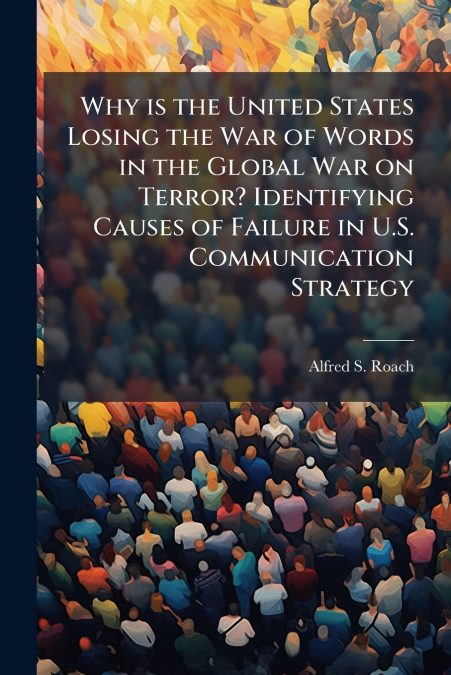
The U.S. (U.S.) Government’s ability to influence friends and foes around the world has immense strategic implications that can either enhance U.S. strategic objectives or contribute to a loss of U.S. power. Nine years after the beginning of the Global War on Terror, America’s credibility is at an all time low in the eyes of world opinion. This is largely due to the loss of effectiveness of U.S. information management. This paper proposes that the U.S. Government’s failure to communicate its strategic message is due to three causative factors-poorly defined policy, no central agency to dictate and manage messages, and an outdated message model. The author analyzes each of these factors and proposes alternatives. Additionally, in order to reinforce this analysis this paper demonstrates a comparison of failed U.S. methodologies to successful Jihadi Extremist methodologies. The author posits that Jihadi extremist communications methodologies are succeeding because they are easily recognizable, managed by a central organization, and rely on the most contemporary media models to target specific audiences. The author concludes that unless the U.S. defines a recognizable message, establishes a cabinet-level information agency, and updates its messaging model, it will never be able to counter effectively the rhetoric of Jihadi extremists.This work has been selected by scholars as being culturally important, and is part of the knowledge base of civilization as we know it. This work was reproduced from the original artifact, and remains as true to the original work as possible. Therefore, you will see the original copyright references, library stamps (as most of these works have been housed in our most important libraries around the world), and other notations in the work.This work is in the public domain in the United States of America, and possibly other nations. Within the United States, you may freely copy and distribute this work, as no entity (individual or corporate) has a copyright on the body of the work.As a reproduction of a historical artifact, this work may contain missing or blurred pages, poor pictures, errant marks, etc. Scholars believe, and we concur, that this work is important enough to be preserved, reproduced, and made generally available to the public. We appreciate your support of the preservation process, and thank you for being an important part of keeping this knowledge alive and relevant.





