
Who’s in Charge Here?

Who’s in Charge Here?

Noel Epstein

36,63 €
IVA incluido
Disponible
Editorial:
Bloomsbury Publishing plc
Año de edición:
2006
Materia
Organización y gestión educativa
ISBN:
9780815724711
36,63 €
IVA incluido
Disponible

Selecciona una librería:

  • Librería Samer Atenea
  • Librería Aciertas (Toledo)
  • Kálamo Books
  • Librería Perelló (Valencia)
  • Librería Elías (Asturias)
  • Donde los libros
  • Librería Kolima (Madrid)
  • Librería Proteo (Málaga)

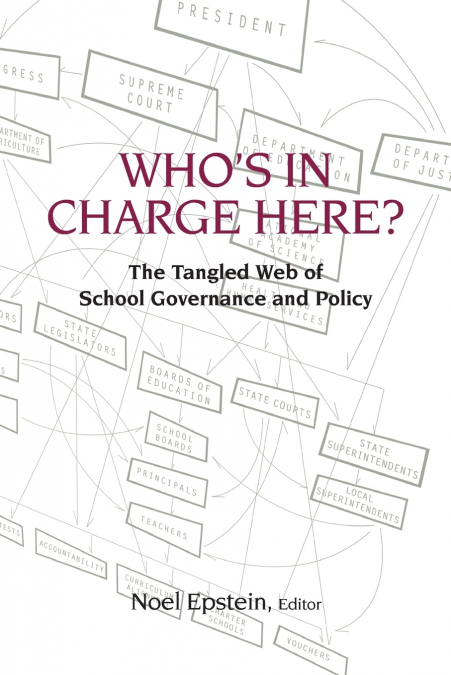
'A Brookings Institution Press and the Education Commission of the States PublicationBehind the scenes, a revolution is taking place in primary and secondary education. Once thought sacrosanct, the principle of local lay control has come under growing attack. In the 1970s and 1980s, governors sought greater influence by promulgating academic standards and even taking over failing schools. Mayors soon followed, with some wresting control of struggling local school systems. Atop this, the president and Congress greatly extended their reach into U.S. classrooms with enactment of the No Child Left Behind Act of 2001, which requires annual reading and math tests in grades 3 through 8, tougher yardsticks to measure whether pupils are making sufficient progress, and penalties for schools that persistently fall short.The result is a spider's web of responsibility. It is difficult, if not impossible, to figure out where accountability lies. Not only have municipal, state, and federal authorities reasserted control over the separate education government that the nation long ago created, but an array of other institutions—including the courts, community-based organizations, and education management companies—are also deeply involved in school decisions. These trends have created a growing gap between those who make education policy and those responsible for the results. What's more, they have contributed to widespread confusion about how to fix public education.In Who's in Charge Here? some of the finest minds in education cut through the confusion to analyze key issues such as the Constitution's role in allocating responsibility for education, the pros and cons of growing federal control, how to ensure a supply of talented teachers for the underprivileged, the impact of the school-choice movement, and the expanding non-academic role of schools. Other chapters explore the history of U.S. education governance and propose principles for creating a new system that especially benefits the children who are most in need. The question of who should be'

Artículos relacionados

  • Walking the Law and History
    Michelle Janene
    The companion student workbook for the Bible curriculum of Walking the Law and History Genesis. Students will participate in deep Bible study of the creation of the world, the foundations of the Christian faith, and the formation of the Jewish nation.  ...
    Disponible

    9,81 €

  • Reforming Education for the Real World
    George P Waldheim
    Education, as we know it in America, is too often characterized as living in a world by itself; unaccountable and unimproved--so different from the Real World.  Year after year 'Band-Aid' attempts are initiated to improve education and again, year after year, those attempts only produce marginal improvement--if any.  Thus, our international ranking is still depicted as 'mediocr...
    Disponible

    12,21 €

  • Let’s Talk Sex & STDs
    Dr. Katina Davis-Kennedy / DrKatina Davis-Kennedy
    There comes a time when every person has to learn about sex; typically, students learn within their middle school years about sex education. Unfortunately, by then they have been influenced by others with the wrong information, or have heard rumors that are mostly untrue. Let's Talk Sex and STDs: The Student Edition is here to lay all of the misleading information and stori...
    Disponible

    25,31 €

  • Learning with Mobile Technologies, Handheld Devices, and Smart Phones
    Mobile Learning is a new trend in pedagogical communities. It matches the speed of fast moving methodologies in pedagogical world. The theories of activity-based learning, problem-based learning, work-based learning, and opinion-based learning, learner-centered learning, and so forth, can be integrated with these tiny handheld devices. Students and teachers communicate effectiv...
  • Cultural Awareness and Competency Development in Higher Education
    As the world becomes more globalized, student populations in university settings will continue to grow in diversity. To ensure students develop the cultural competence to adapt to new environments, universities and colleges must develop policies and programs to aid in the progression of cultural acceptance and understanding. Cultural Awareness and Competency Development in High...
  • Advancing Next-Generation Teacher Education through Digital Tools and Applications
    The implementation of the Common Core State Standards program has spearheaded many changes within the education field. As this initiative is ultimately designed to optimize student performance and success, it is critical that teacher education programs and technological tools being utilized in classrooms align with Common Core State Standards. Advancing Next-Generation Teacher ...