
Who Owns Antiquity?

Who Owns Antiquity?

James Cuno

26,49 €
IVA incluido
Disponible
Editorial:
Princeton University Press
Año de edición:
2010
Materia
Artes: aspectos generales
ISBN:
9780691148106
26,49 €
IVA incluido
Disponible

Selecciona una librería:

  • Librería Samer Atenea
  • Librería Aciertas (Toledo)
  • Kálamo Books
  • Librería Perelló (Valencia)
  • Librería Elías (Asturias)
  • Donde los libros
  • Librería Kolima (Madrid)
  • Librería Proteo (Málaga)

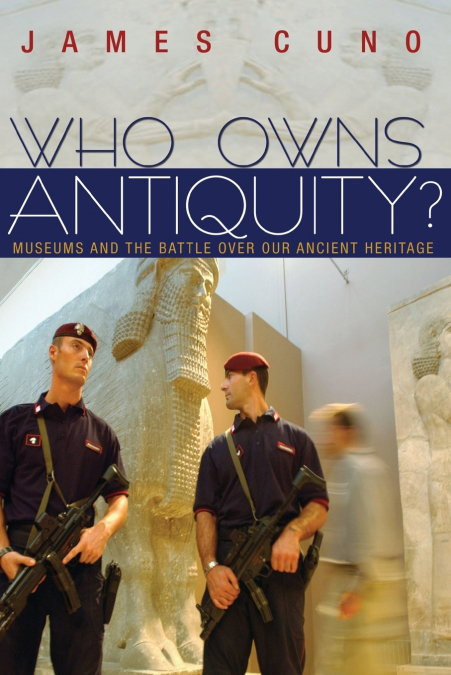
Whether antiquities should be returned to the countries where they were found is one of the most urgent and controversial issues in the art world today, and it has pitted museums, private collectors, and dealers against source countries, archaeologists, and academics. Maintaining that the acquisition of undocumented antiquities by museums encourages the looting of archaeological sites, countries such as Italy, Greece, Egypt, Turkey, and China have claimed ancient artifacts as state property, called for their return from museums around the world, and passed laws against their future export. But in Who Owns Antiquity?, one of the world’s leading museum directors vigorously challenges this nationalistic position, arguing that it is damaging and often disingenuous. 'Antiquities,' James Cuno argues, 'are the cultural property of all humankind,' 'evidence of the world’s ancient past and not that of a particular modern nation. They comprise antiquity, and antiquity knows no borders.' Cuno argues that nationalistic retention and reclamation policies impede common access to this common heritage and encourage a dubious and dangerous politicization of antiquities--and of culture itself. Antiquities need to be protected from looting but also from nationalistic identity politics. To do this, Cuno calls for measures to broaden rather than restrict international access to antiquities. He advocates restoration of the system under which source countries would share newly discovered artifacts in exchange for archaeological help, and he argues that museums should again be allowed reasonable ways to acquire undocumented antiquities. Cuno explains how partage broadened access to our ancient heritage and helped create national museums in Cairo, Baghdad, and Kabul. The first extended defense of the side of museums in the struggle over antiquities, Who Owns Antiquity? is sure to be as important as it is controversial.
Artículos relacionados

  • The Art of Math and Science
    Jayanti Tambe
    The Art of Math and Science guides teachers to introduce masterpiece art to young children, so they can tell you about “paints with hidden floats” and ask questions like, “When painting the Sistine Chapel, do you think Michelangelo had many headaches?”This book helps parents and educators look at the subject through the prism of mathematical and scientific experiences. This boo...
  • Art and the Monad
    Keith Lincoln Cook
    Keith Lincoln Cook's essay centres on his diagram of the monad: a circular diagram, showing the relationship between external stimuli, the intellect and the emotions. Although everyone should be able to freely respond to the vast amount of external stimuli collected by the senses, many people will block off their responses, collecting the stimuli in the band of intellect an...
    Disponible

    6,17 €

  • Slow Down
    Todd Webb
    Color everything and color nothing on your path to mindfulness with this playful coloring book!Packed with just enough to keep you entertained in the present moment, SLOW DOWN is sure to become your go-to meditation guide as you color your way to a calmer, less stressful life. With simple illustrations and inspirational text it makes a great gift! "Art's purpose is to sober...
    Disponible

    12,17 €

  • Raising the Eyebrow
    Lauren Golden
    A lavish festschrift to John Onians with contributions by 28 distinguished academics. Any summary as to the direction of these contributions is, perhaps, best left to Martin Kemp and his affectionate preface, “Above all, he (John Onians) reminds us of the researchers’, writers’ and teachers’ true mission, that is the need to be radical in both asking and answering questions, an...
    Disponible

    182,20 €

  • Projective Processes and Neuroscience in Art and Design
    Rachel Zuanon
    Recent advances in neuroscience suggest that the human brain is particularly well-suited to design things: concepts, tools, languages and places. Current research even indicates that the human brain may indeed have evolved to be creative, to imagine new ideas, to put them into practice, and to critically analyze their results. Projective Processes and Neuroscience in Art and De...
  • Book of Jupiter
    Leo Valenzuela
    Book of Jupiter: Gone to Uranus is a work of imagination and fantasy by Leo Valenzuela. Explore a variety of unique creatures with interesting dialogue which included a few step tutorials on how to draw his style of work. 3 ...
    Disponible

    24,25 €