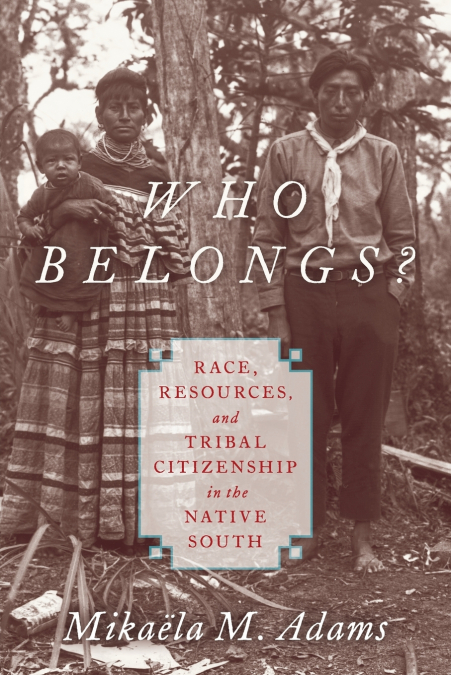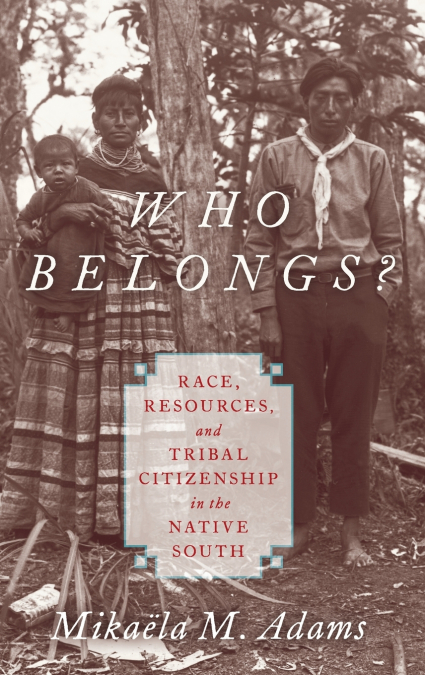

Who Belongs?

Who Belongs?

Mikaëla M Adams

114,65 €
IVA incluido
Consulta disponibilidad
Editorial:
Oxford University Press
Año de edición:
2016
Materia
Historia de América
ISBN:
9780190619466

Selecciona una librería:

  • Librería Samer Atenea
  • Librería Aciertas (Toledo)
  • Kálamo Books
  • Librería Perelló (Valencia)
  • Librería Elías (Asturias)
  • Donde los libros
  • Librería Kolima (Madrid)
  • Librería Proteo (Málaga)

Who can lay claim to a legally-recognized Indian identity? Who decides whether or not an individual qualifies? The right to determine tribal citizenship is fundamental to tribal sovereignty, but deciding who belongs has a complicated history, especially in the South. Indians who remained in the South following removal became a marginalized and anomalous people in an emerging biracial world. Despite the economic hardships and assimilationist pressures they faced, they insisted on their political identity as citizens of tribal nations and rejected Euro-American efforts to reduce them to another racial minority, especially in the face of Jim Crow segregation. Drawing upon their cultural traditions, kinship patterns, and evolving needs to protect their land, resources, and identity from outsiders, southern Indians constructed tribally-specific citizenship criteria, in part by manipulating racial categories - like blood quantum - that were not traditional elements of indigenous cultures. Mika�la M. Adams investigates how six southern tribes-the Pamunkey Indian Tribe of Virginia, the Catawba Indian Nation of South Carolina, the Mississippi Band of Choctaw Indians, the Eastern Band of Cherokee Indians of North Carolina, the Seminole Tribe of Florida, and the Miccosukee Tribe of Indians of Florida-decided who belonged. By focusing on the rights and resources at stake, the effects of state and federal recognition, the influence of kinship systems and racial ideologies, and the process of creating official tribal rolls, Adams reveals how Indians established legal identities. Through examining the nineteenth and twentieth century histories of these Southern tribes, Who Belongs? quashes the notion of an essential 'Indian' and showcases the constantly-evolving process of defining tribal citizenship.
Artículos relacionados

  • Pan-Africanism and Education
    Kenneth J. King / Kenneth JKing
    This is an analysis of the complex links between Black America and Africa in the period of 1880 to 1945. It examines an extended white attempt to pattern politics and education in colonial Africa upon the example of the U.S. South. This export of United States race relations to Africa was resisted by Black intellectuals in the United States and many of the early nationalists in...
    Disponible

    24,60 €

  • The Native American Cookbook Recipes From Native American Tribes
    G.W. Mullins
    Light Of The Moon Publishing along with Author G.W. Mullins and Illustrator / Artist C.L. Hause have joined together to explore Native American Indian Cooking.  More than just a cookbook, this Native American recipe collection offers a look into a forgotten past.  'The Native American Cookbook Recipes From Native American Tribes,' offers a large collection of recipes from and i...
    Disponible

    24,56 €

  • A Public Spirit
    George H. Atkinson
    George Henry Atkinson (1819-89) was a son of New England who arrived in the Oregon Territory in 1848, sent by the American Home Missionary Society. Although his commission from the Society specified that his work was to be ecclesiastical and educational, he took an approach to that assignment which went well beyond his mandate. Well-informed and energetic, he made an impact on ...
    Disponible

    10,45 €

  • North Carolina Women of the Confederacy
    Lucy London Anderson
    Long out of print, this volume of recollections, stories, and verse provides a glimpse of women's lives on the home front-and sometimes in the thick of battle-during the War between the States. Nearly fifty years after the American Civil War, Lucy Worth London Anderson (Mrs. John Huske Anderson) of Fayetteville, N.C., compiled one of the first memorial collections honoring the...
    Disponible

    17,20 €

  • Freedom by a Thread
    Freedom by a Thread: The History of Quilombos in Brazil brings together some of the best scholars in the world working on the history of quilombos (maroon societies) in Brazil from a variety of perspectives and approaches. Over 40 percent of the total volume of captive Africans arrived in Brazil during a 400-year period of legal and contraband transatlantic slaving. If slavery ...
    Disponible

    36,71 €

  • Nashville Baseball History
    Bill Traughber
    Nashville is a Big League city despite never having been home to a major league team. From the Civil War era, to star-studded exhibitions, to outstanding Negro Leagues teams, to some of the great minor league franchises of all time, few cities have as rich a baseball tradition as Nashville, Tennessee.Nashville sports historian Bill Traughber, who has been writing about baseball...
    Disponible

    13,15 €

Otros libros del autor

  • Who Belongs?
    Mikaëla M Adams
    Who can lay claim to a legally-recognized Indian identity? Who decides whether or not an individual qualifies? The right to determine tribal citizenship is fundamental to tribal sovereignty, but deciding who belongs has a complicated history, especially in the South.Indians who remained in the South following removal became a marginalized and anomalous people in an emerging bir...
    Disponible

    57,42 €