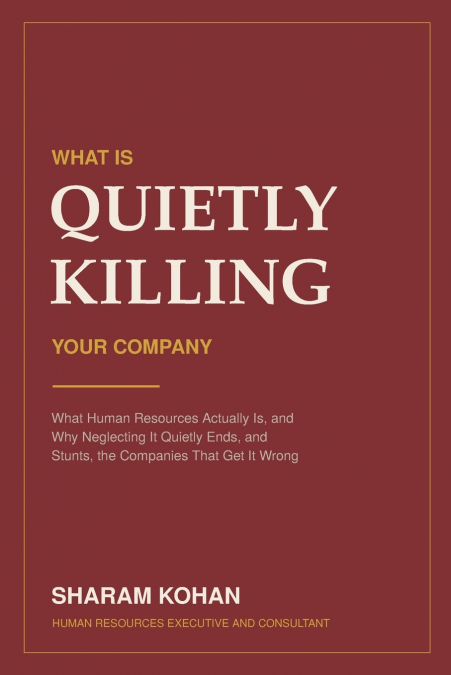

What Is Quietly Killing Your Company

What Is Quietly Killing Your Company

Sharam Kohan

22,54 €
IVA incluido
Disponible
Editorial:
Doxprint LLC
Año de edición:
2026
Materia
Gestión: liderazgo y motivación
ISBN:
9798234114211
22,54 €
IVA incluido
Disponible

Selecciona una librería:

  • Librería Samer Atenea

  • Kálamo Books
  • Librería Elías (Asturias)
  • Librería Kolima (Madrid)
  • Librería Proteo (Málaga)

Companies are supposed to die dramatically, from a disruptive rival, a failed product, a scandal with a date attached. Most do not. They decline quietly, from the inside, from a cause their own instruments are built not to see.In What Is Quietly Killing Your Company, Sharam Kohan makes an evidence-based case that the most expensive failures in business trace to a single, chronically misunderstood function: the management of people. Most organizations treat human resources as overhead, a department to be kept lean and kept away from the decisions that matter, and then blame the market when their best people leave, their strategies fail in execution, and their culture quietly erodes.Drawing on behavioral economics, organizational psychology, and the documented histories of companies that rose and fell on how they managed their people, from Nokia and Boeing to Wells Fargo and Costco, Kohan shows that human resources, rightly understood, is not the picnic-and-benefits department but the strategic stewardship of the one asset that decides whether a company thrives, scales, or quietly fails.This is not a book of slogans. It puts a price on the costs no financial statement records: the regretted departure, the bad hire, the disengaged team, the succession that was never planned. It explains why managers account for most of the variation in engagement, why culture reaches the balance sheet, and why the chief executive is so often the barrier to the very outcomes he wants. And it makes its case in the only language the boardroom cannot wave away: money, risk, and return.For executives, managers, and the human resources professionals who serve them, this is a field guide to the part of the company most leaders have been managing blind, and a clear account of what it has been costing them.


Artículos relacionados

  • Friend Grief in the Workplace
    Victoria Noe
    They’re friends and coworkers, so when they die, it’s not only a personal and professional loss but a challenge: How can you grieve and get your work done, too?In the fifth book in the Friend Grief series, Friend Grief in the Workplace: More Than an Empty Cubicle you’ll meet people whose friends were coworkers, too: in a TV newsroom, a rectory, a Broadway show and on a baseball...
    Disponible

    4,35 €

  • Consequences
    Susan Popoola
    The August riots of 2011 started off in London and spread across different parts of the country. People questioned whether or not the riots were really about the shooting of a young black man by the police. That is open to debate. What is, however, unquestionable is that there are segments of society that are disengaged from the mainstream. While some may believe that this was ...
    Disponible

    13,80 €

  • So You Want a Seat at the Table
    Jeanne Kerr
    So You Want a Seat at the Table, a Practical Guide to Being a True Strategic HR Business Partner is a refreshing approach to a long-debated challenge. It is targeted to new and experienced human resources business partners and human resources leaders who want to expand their ability to think and act strategically. Whether an HR practitioner is in a large or small corporation, n...
    Disponible

    16,88 €

  • Feedback Flow
    Georgia Murch
    Let’s face it, we all want to create a high-performing team, culture, product or service that ripples throughout our business and into the market. But what is required to do this? How do we go about it?So, we do some clever thinking and come up with some strategies to get there.  We improve systems, processes, create new products or services. We implement with some success but ...
  • Stakeholder Centered Coaching
    Marshall Goldsmith / Sal Silvester
    Executives buy results, not coaching. The problem is that most leadership and executive coaches do not measure the impact of their coaching engagements. They can’t prove that their coaching is actually making a difference. They rely too heavily on coach satisfaction surveys and other methods that simply measure reaction and not change.It doesn’t have to be that way. We can and ...
    Disponible

    25,91 €