Inicio > Sociedad y ciencias sociales > Sociedad y cultura: general > WHAT IF I’M WRONG?!? (YOU’RE NOT)
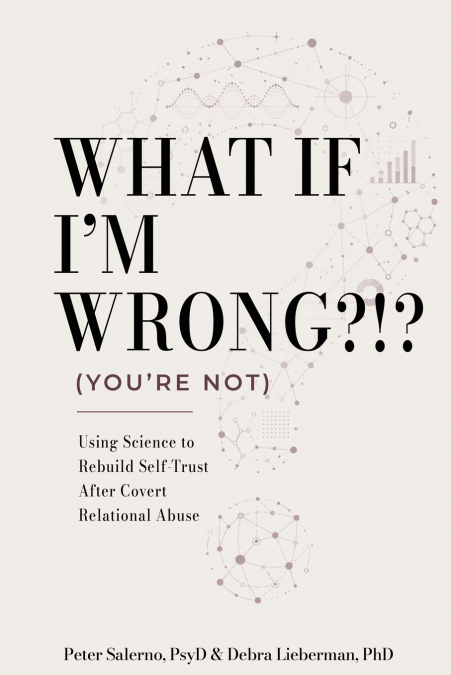
WHAT IF I’M WRONG?!? (YOU’RE NOT)

WHAT IF I’M WRONG?!? (YOU’RE NOT)

Debra Lieberman PhD / Peter Salerno PsyD

25,72 €
IVA incluido
Disponible
Editorial:
Peter Salerno
Año de edición:
2026
Materia
Sociedad y cultura: general
ISBN:
9798991975568
25,72 €
IVA incluido
Disponible

Selecciona una librería:

  • Librería Samer Atenea
  • Kálamo Books
  • Librería Elías (Asturias)
  • Librería Kolima (Madrid)
  • Librería Proteo (Málaga)

You replay the conversations. You question your memory. You wonder if you’re being unfair. The relationship felt loving once - and sometimes still does - but something in you knows that what is happening is not what you were told it was.This is not weakness, and it is not indecision. It is epistemic injury - what happens when your mind’s ability to update beliefs is repeatedly interfered with by someone who depends on your confusion to maintain control. It has nothing to do with how smart, insightful, or self-aware you are.What If I’m Wrong?!? (You’re Not) gives you something most recovery books do not: a structured, science-based method for reconstructing what actually happened and weighing the evidence honestly. Drawing on Bayesian reasoning - the formal logic used in mathematics, physics, and medicine to update conclusions from new data - Dr. Peter Salerno and Dr. Debra Lieberman walk you through a Triangle Tool for mapping the relational system, a Reality Ledger for separating what occurred from what you were told it meant, and a clear stopping rule for knowing when the pattern has converged.This is not affirmations. It is not 'feel differently.' It is a workbook that helps you re-run the inference with the distortion removed - so the conclusion your mind has been quietly reaching all along can finally settle, and you can act from clarity instead of confusion.Your perception is trustworthy. Your reasoning is intact. This book will help you trust both again.


Artículos relacionados

  • The Gandhian Iceberg
    Chris D Moore-Backman
    The Gandhian Iceberg presents a bold, new interpretation of Gandhian nonviolence from the rare perspective of an author who is equal parts writer, scholar, and frontlines practitioner. The book faces the current crisis of climate change and the intensification of social unrest around the world, and calls for a new convergence of serious, spiritually-rooted US nonviolence activi...
    Disponible

    11,52 €

  • Contemporary Developments in Child Protection
    Nigel Parton
    Volume 1 "Policy Changes and Challenges" takes as its central theme the ongoing and challenging issues which child protection agencies have to address and the policy and practice initiatives that are developed to try and address these. The volume includes papers on: the relationship between the decline in the rate of ‘unnatural’ deaths and the growth of concern about child abus...
  • Diversity in Information Technology Education
    Goran Trajkovski
    ...
  • Model-Driven Software Development
    Model-driven software development (MDSD) drastically alters the software development process, characterized by a high degree of innovation and productivity. However, quality assurance application in the domain of software models and model-driven software development is still in an emergent phase. Model-Driven Software Development: Integrating Quality Assurance provides in-depth...
  • Evidence-Based Practice in Nursing Informatics
    Andrew Chasin
    Because of the constant advances and dynamics within the nascent field of nursing informatics, many nurses struggle in practice as they continue to try and apply habitual communication practices in the new environment without any critical reflection on, and adaptation of, those practices. Evidence-Based Practice in Nursing Informatics: Concepts and Applications serves as a valu...
  • Actor-Network Theory and Technology Innovation
    Arthur Tatnall
    About 25 years ago, the first developments of ANT (Actor-Network Theory) took place, but it wasn’t until much later that researchers began to take it seriously. In the late 1990s, ANT began to take hold in the scientific community as a new and exciting approach to socio-technical research and social theory. Actor-Network Theory and Technology Innovation: Advancements and New Co...