Inicio > Humanidades > Filosofía > What hope for what philosophy
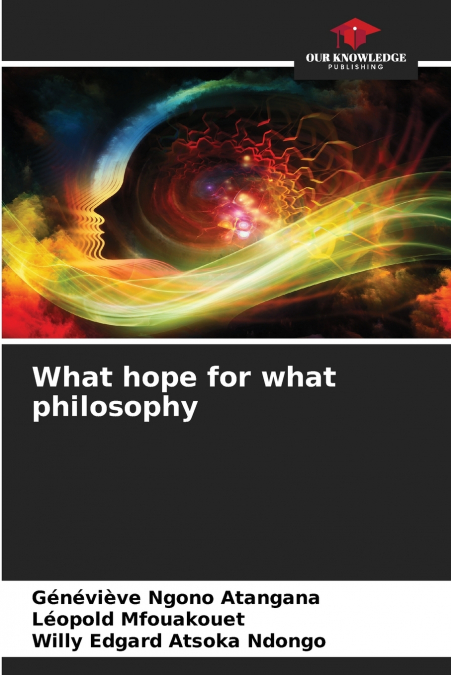
What hope for what philosophy

What hope for what philosophy

Généviève Ngono Atangana / Léopold MFOUAKOUET / Willy Edgard Atsoka Ndongo

73,64 €
IVA incluido
Disponible
Editorial:
KS OmniScriptum Publishing
Año de edición:
2026
Materia
Filosofía
ISBN:
9786209759925
73,64 €
IVA incluido
Disponible

Selecciona una librería:

  • Librería Samer Atenea
  • Kálamo Books
  • Librería Elías (Asturias)
  • Librería Kolima (Madrid)
  • Librería Proteo (Málaga)

If the elevation of hope to the dignity of an explicitly philosophical question takes the form of an interrogation ('What am I allowed to hope for?' (Kant), it is above all a question addressed: to whom? To what Bloch calls the 'utopian animal', but whom Marcel elegantly calls 'homo viator'. Is it the march of humanity that would resemble the construction of a dwelling that only the last generation would have the leisure to inhabit, a presupposition well and truly inscribed in the perspective of progress inherited from the Enlightenment? Even Kant found the idea inconceivable. To be intelligible, the despairing catastrophes of the 20th and 21st centuries require a dialectic of future and past, of the memory of the future (Marcel) that takes into account the wounded memories of the past (Benjamin). A 'docta spes africana' (Bidima) is thus proposed, and quickly put to the test in this book. All that remains credible and reasonable is a hope that first hopes for the unhoped-for, which is the sole domain of the event, and therefore of a gift. Thinking this way is the condition for a philosophical practice that promises openness to the future.

Artículos relacionados

  • Introduction to a Future Way of Thought
    Kostas Axelos / Kenneth Mills
    'Technologists only change the world in various ways in generalized indifference; the point is to think the world and interpret the changes in its unfathomability, to perceive and experience the difference binding being to the nothing.'Anticipating the age of planetary technology Kostas Axelos, a Greek-French philosopher, approaches the technological question in this book, firs...
    Disponible

    18,58 €

  • Capsule
    John Kenneth Press
    Join John and Adam as they wander the mean streets of Japan on a psychedelic fueled search for identity. While fun for the average reader, this book could also serve as a philosphy textbook because of its ordered exploration of sources of identity. Ultimately this trip through nationalist attacks, sex, and drugs, will take you to a better understanding of yourself and your pl...
    Disponible

    11,51 €

  • If you look at it long enough...
    Paul Hallam
    Originally written for an academic journal, If you look at it long enough... is primarily a personal account of Paul Hallam’s recollections of “self-abuse” through the consumption of porn over several decades. Challenging the familiar form of an “academic essay,” this autobiographical narrative raises several questions in relation to our contemporary morals related to sex in ge...
    Disponible

    11,30 €

  • The Teachers of Gurdjieff
    Rafael Lafort / Rafael Lefort
    When The Teachers of Gurdjieff was first published more than 50 years ago, it made a considerable stir. George Ivanovich Gurdjieff had been one of the most famous mystics in the West in the first half of the 20th century - a teaching master who had many fashionable and influential pupils. He had a striking appearance and manner of teaching, and his teaching proved to be very in...
    Disponible

    20,45 €

  • Manifesto of the Communist Party
    Karl Marx
    The Communist Manifesto was first published on February 21, and it is one of the world’s most influential political tracts. Commissioned by the Communist League and written by communist theorists Karl Marx and Friedrich Engels, it laid out the League’s purposes and program. The Manifesto suggested a course of action for a proletarian (working class) revolution to overthrow the ...
  • The Art of Literature
    Arthur Schopenhauer
    Collected here are eight short essays, On Authorship, On Style, On the Study of Latin, On Men of Learning, On Thinking for Ones Self, On Criticism, On Reputation, On Genius, by the world renowned philosopher Arthur Achopenhauer. ...

Otros libros del autor

  • Quale speranza per quale filosofia
    Généviève Ngono Atangana / Léopold MFOUAKOUET / Willy Edgard Atsoka Ndongo
    Se l’elevazione della speranza alla dignità di domanda esplicitamente filosofica assume la forma di un interrogativo ('Che cosa mi è permesso sperare?' (Kant)), è soprattutto una domanda rivolta: a chi? A quello che Bloch chiama 'animale utopico', ma che Marcel chiama elegantemente 'homo viator'. È la marcia dell’umanità che assomiglierebbe alla costruzione di una dimora che so...
    Disponible

    73,70 €

  • Welche Hoffnung für welche Philosophie
    Généviève Ngono Atangana / Léopold MFOUAKOUET / Willy Edgard Atsoka Ndongo
    Wenn die Erhebung der Hoffnung in den Rang einer explizit philosophischen Frage die Form einer Befragung hat ('Was ist mir erlaubt zu hoffen?' (Kant)), so ist sie vor allem eine an wen gerichtete Forderung: an wen? An denjenigen, den Bloch als 'utopisches Tier' bezeichnet, der aber von Marcel elegant als 'homo viator' bezeichnet wird. Handelt es sich dabei um die Wanderung eine...
    Disponible

    99,96 €

  • Jaka nadzieja na jaką filozofię
    Généviève Ngono Atangana / Léopold MFOUAKOUET / Willy Edgard Atsoka Ndongo
    Jeśli podniesienie nadziei do godności pytania wyraźnie filozoficznego przybiera formę pytania ('Na co wolno mi mieć nadzieję?' (Kant)), to jest to przede wszystkim pytanie skierowane: do kogo? Do tego, co Bloch nazywa 'utopijnym zwierzęciem', a kogo Marcel elegancko nazywa 'homo viator'. Czy to marsz ludzkości przypominałby budowę mieszkania, w którym tylko ostatnie pokolenie ...
    Disponible

    73,70 €

  • Que esperança para que filosofia
    Généviève Ngono Atangana / Léopold MFOUAKOUET / Willy Edgard Atsoka Ndongo
    Se a elevação da esperança à dignidade de uma questão explicitamente filosófica assume a forma de uma interrogação ('O que é que me é permitido esperar?' (Kant)), ela é sobretudo uma questão dirigida: a quem? Àquele a que Bloch chama o 'animal utópico', mas a quem Marcel chama elegantemente o 'homo viator'. É a marcha da humanidade que se assemelharia à construção de uma habita...
    Disponible

    73,70 €

  • Quelle espérance pour quelle philosophie
    Généviève Ngono Atangana / Léopold MFOUAKOUET / Willy Edgard Atsoka Ndongo
    Si l’élévation de l’espérance à la dignité d’une question explicitement philosophique a la forme d’une interrogation ( que m’est-il permis d’espérer ? (Kant), elle est surtout une demande adressée : à qui ? À celui que Bloch appelle animal utopique , mais que Marcel nomme élégamment homo viator . S’agit-il de la marche d’une humanité qui ressemblerait à la construction d’une...
    Disponible

    46,14 €