 Librería Samer Atenea
 Librería Aciertas (Toledo)
 Kálamo Books
 Librería Perelló (Valencia)
 Librería Elías (Asturias)
 Donde los libros
 Librería Kolima (Madrid)
 Librería Proteo (Málaga)
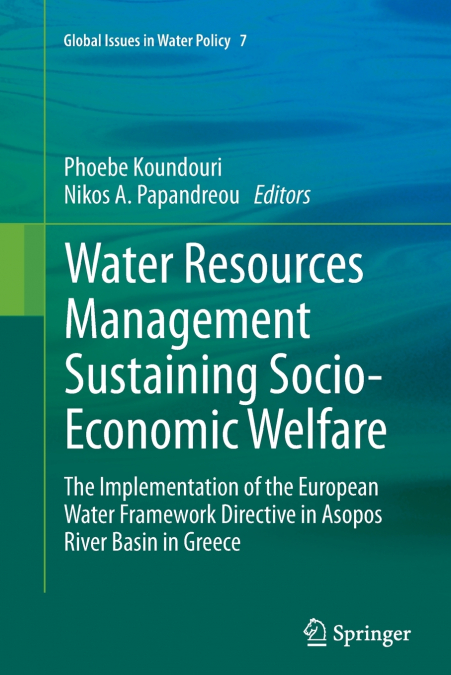
The aim of this book is to offer a river-basin management plan which is directly implementable and consistent with the European Union -Water Framework Directive (EU WFD).The contributors, who are leading world experts in their respective fields, develop an integrated water resources management plan for the Asopos river basin in Greece which is economically efficient, socially equitable and environmentally sustainable. The program offers explicit technical and investment solutions, socioeconomic and legal instruments and recommendations for institutional restructuring. The introductory chapter describes the water situation in Greece and assesses the potential of timely implementation of the EU WFD. Special emphasis is given to the cost-recovery principle. Chapter 2 introduces the case study area highlighting the particular pressures and impacts as well as the environmental functions and values of Asopos River and Oropos Lagoon. Chapters 3 and 4 focus on the economic characterisation of Asopos River Basin in order to identify the economic sectors and social groups that will bear the cost and benefits of the implementation of the EU WFD. In particular, Chapter 3 presents the main water uses and pricing for water supply in the industrial and the agricultural sectors. Chapter 4 completes the baseline appraisal, presenting the details of water use by the residential and touristic sectors. The following chapters assess valuation and decision-making tools from a range of perspectives, including agricultural needs, valuing the impacts of industrial activity, the costs and benefits of environmental preservation and management. The water resources management plan is presented in Chapter 9; the concluding chapter offers recommendations on institutional changes and presents the lessons learned as resources applicable to other river basins in Greece and elsewhere. The book applies state-of-the art market and non-market valuation methods to estimate water demands in the residential, industrial, agricultural, tourism, environmental and health sectors and to balance these, over time and space, with water supply. Given the well-known challenge of managing natural resources in a way that maximizes and sustains social welfare, this book will provide an invaluable point of reference for applied researchers and policy makers working in water resources management.