
Inicio > Sociedad y ciencias sociales > Sociedad y cultura: general > Waldesruh statt Gottesacker. Der Friedwald als neues Bestattungskonzept. Eine kulturwissenschaftliche Spurensuche
Waldesruh statt Gottesacker. Der Friedwald als neues Bestattungskonzept. Eine kulturwissenschaftliche Spurensuche

Waldesruh statt Gottesacker. Der Friedwald als neues Bestattungskonzept. Eine kulturwissenschaftliche Spurensuche

Waldesruh statt Gottesacker. Der Friedwald als neues Bestattungskonzept. Eine kulturwissenschaftliche Spurensuche

Sylvie Assig

31,97 €
IVA incluido
Disponible
Editorial:
ibidem
Año de edición:
2007
Materia
Sociedad y cultura: general
ISBN:
9783898217378
31,97 €
IVA incluido
Disponible

Selecciona una librería:

  • Librería Samer Atenea
  • Librería Aciertas (Toledo)
  • Kálamo Books
  • Librería Perelló (Valencia)
  • Librería Elías (Asturias)
  • Donde los libros
  • Librería Kolima (Madrid)
  • Librería Proteo (Málaga)

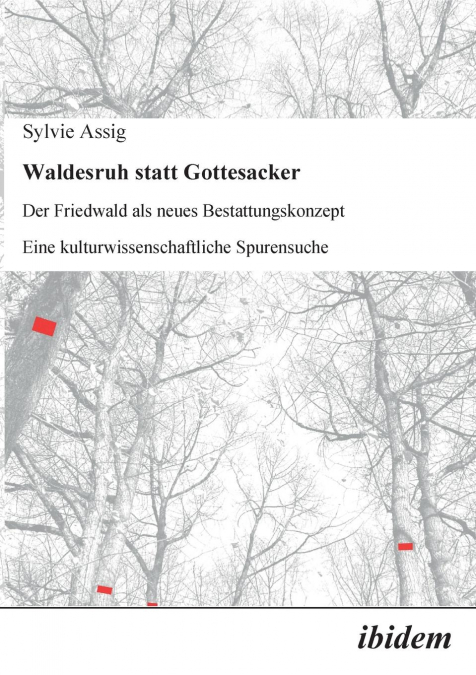
„Hier in kühler Walderde unauffällig begraben zu liegen, müßte süß sein. [...] Ein Grab im Wald zu haben, wäre schön. [...]. Ich wünschte mir solches.' , schrieb Robert Walser bereits vor 90 Jahren in seiner Erzählung Der Spaziergang.Seit einigen Jahren sorgt ein neues Bestattungskonzept immer wieder für Aufmerksamkeit - die Beisetzung im Wald. In ausgewählten Waldgebieten kann unter Bäumen bereits zu Lebzeiten ein Grabplatz reserviert werden. Diese Alternative zum Friedhof erfährt eine große Resonanz und verbreitet sich stetig. Wie kommt es, dass der Wald als 'letzter Ort' derart viel Zuspruch erhält? Wie ist die zunehmende Verbreitung der Bestattung unter Bäumen kulturwissenschaftlich und soziologisch zu erklären? Sylvie Assig geht in ihrer Studie der Bedeutung der Grabstätte in Vergangenheit und Gegenwart auf den Grund. Nicht nur die alltäglichen Lebensumstände, auch der Umgang mit Tod, Trauer und Bestattung haben sich innerhalb der vergangenen Jahrzehnte grundlegend gewandelt. Der Friedwald ist Ausdruck und Folge dieser Veränderungen - Sylvie Assig bringt ihn in Beziehung zu den zeitgeschichtlichen Entwicklungstrends der Anonymisierung und Individualisierung im Bestattungswesen.


Artículos relacionados

  • The Gandhian Iceberg
    Chris D Moore-Backman
    The Gandhian Iceberg presents a bold, new interpretation of Gandhian nonviolence from the rare perspective of an author who is equal parts writer, scholar, and frontlines practitioner. The book faces the current crisis of climate change and the intensification of social unrest around the world, and calls for a new convergence of serious, spiritually-rooted US nonviolence activi...
    Disponible

    11,52 €

  • Contemporary Developments in Child Protection
    Nigel Parton
    Volume 1 "Policy Changes and Challenges" takes as its central theme the ongoing and challenging issues which child protection agencies have to address and the policy and practice initiatives that are developed to try and address these. The volume includes papers on: the relationship between the decline in the rate of ‘unnatural’ deaths and the growth of concern about child abus...
  • Diversity in Information Technology Education
    Goran Trajkovski
    ...
  • Model-Driven Software Development
    Model-driven software development (MDSD) drastically alters the software development process, characterized by a high degree of innovation and productivity. However, quality assurance application in the domain of software models and model-driven software development is still in an emergent phase. Model-Driven Software Development: Integrating Quality Assurance provides in-depth...
  • Evidence-Based Practice in Nursing Informatics
    Andrew Chasin
    Because of the constant advances and dynamics within the nascent field of nursing informatics, many nurses struggle in practice as they continue to try and apply habitual communication practices in the new environment without any critical reflection on, and adaptation of, those practices. Evidence-Based Practice in Nursing Informatics: Concepts and Applications serves as a valu...
  • Actor-Network Theory and Technology Innovation
    Arthur Tatnall
    About 25 years ago, the first developments of ANT (Actor-Network Theory) took place, but it wasn’t until much later that researchers began to take it seriously. In the late 1990s, ANT began to take hold in the scientific community as a new and exciting approach to socio-technical research and social theory. Actor-Network Theory and Technology Innovation: Advancements and New Co...