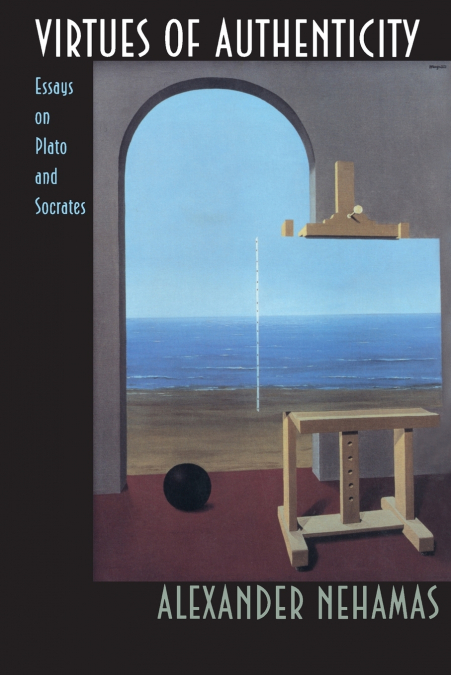

Virtues of Authenticity

Virtues of Authenticity

Virtues of Authenticity

Alexander Nehamas

56,47 €
IVA incluido
Disponible
Editorial:
Princeton University Press
Año de edición:
1998
Materia
Filosofía occidental: antigua, hasta c. 500
ISBN:
9780691001784
56,47 €
IVA incluido
Disponible

Selecciona una librería:

  • Librería Samer Atenea
  • Librería Aciertas (Toledo)
  • Kálamo Books
  • Librería Perelló (Valencia)
  • Librería Elías (Asturias)
  • Donde los libros
  • Librería Kolima (Madrid)
  • Librería Proteo (Málaga)

The eminent philosopher and classical scholar Alexander Nehamas presents here a collection of his most important essays on Plato and Socrates. The papers are unified in theme by the idea that Plato’s central philosophical concern in metaphysics, ethics, and aesthetics was to distinguish the authentic from the fake, the original from its imitations. In approach, the collection displays Nehamas’s characteristic combination of analytical rigor and sensitivity to the literary form and dramatic effect of Plato’s work. Together, the papers represent Nehamas’s distinct and original contributions to scholarship on Plato and Socrates and serve as a comprehensive introduction to the thought of these two philosophers. In the book’s opening section, Nehamas discusses Plato’s representation of Socrates as a model of authentic human goodness, showing that Plato’s Socrates is a more skeptical, troubling, and individualistic thinker than is usually supposed. The papers in the second section form a sustained defense of a new and important understanding of Plato’s theory of the forms and the evolution of that theory in Plato’s later writings. The third section examines Plato’s contention that popular entertainment--by which he meant Greek epic and tragic poetry--misleads its audience into a debased life, an argument Nehamas relates to modern anxieties about television and other forms of popular culture. The collection also includes a discussion of Plato’s use of the dialogue form in his representation of Socrates and carefully examines the combination of literary and philosophical elements in his work. Nehamas argues in the book that Plato’s specific judgments of what is authentic are often flawed, but that his idea of authenticity as the mark of truth, beauty, and goodness is stronger than many modern scholars have assumed. In drawing together Nehamas’s many influential ideas about Plato and Socrates, Virtues of Authenticity is a major contribution to the study of ancient Greek philosophy.


Artículos relacionados

  • The Nature of Things
    Lucretius Lucretius
    De rerum natura (On the Nature of Things) is a 1st century BC didactic poem by the Roman poet and philosopher Lucretius with the goal of explaining Epicurean philosophy to a Roman audience. Lucretius presents the principles of atomism; the nature of the mind and soul; explanations of sensation and thought; the development of the world and its phenomena; and explains a variety o...
  • Pompeii
    Fergus Mason
    Pompeii was one of most advanced cities of its time; it had a complex water system, gymnasium, and an amphitheater. Despite it's advancements, there was one thing it wasn't ready for: Mount Vesuvius—the volcano that led to its ultimate doom.  The 79 AD eruption of Mount Vesuvius was one of the worst disasters in all of European history. In a near instant, over 15,000 p...
    Disponible

    10,36 €

  • Middle Platonism and Neoplatonism, Volume 1
    Stephen Gersh
    'It is generally agreed that those types of philosophy that are loosely called ’Platonic’ and ’Neoplatonic’ played a crucial role in the history of European culture during the centuries between antiquity and the Renaissance. However, until now no scholar has attempted to describe the evolution of these forms of thought in a single comprehensive academic study.' So writes Stephe...
  • Middle Platonism and Neoplatonism, Volume 2
    Stephen Gersh
    It is generally agreed that those types of philosophy that are loosely called 'Platonic' and 'Neoplatonic' played a crucial role in the history of European culture during the centuries between antiquity and the Middle Ages. However, until now no scholar has attempted to describe the evolution of these forms of thought in a single comprehensive academic study. Middle Platonism a...
  • Porphyry’s Commentary on Ptolemy’s Harmonics
    Andrew Barker
    ...
    Disponible

    77,17 €

  • The Roots of Platonism
    John Dillon
    ...
    Disponible

    25,29 €