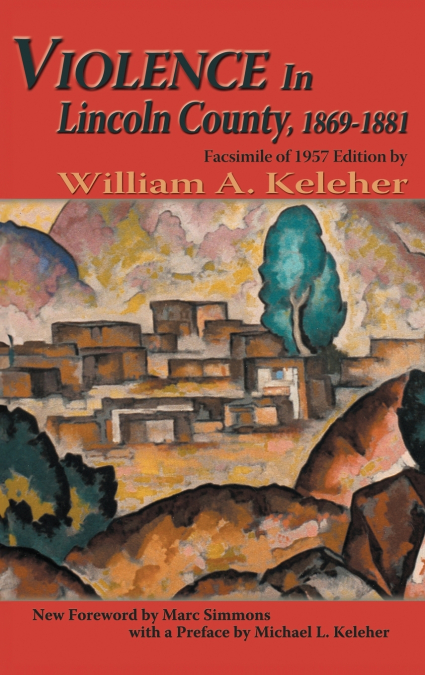

Violence in Lincoln County, 1869-1881

Violence in Lincoln County, 1869-1881

William A. Keleher

36,33 €
IVA incluido
Consulta disponibilidad
Editorial:
Sunstone Press
Año de edición:
2007
Materia
Historia de América
ISBN:
9781632936196

Selecciona una librería:

  • Librería Samer Atenea
  • Librería Aciertas (Toledo)
  • Kálamo Books
  • Librería Perelló (Valencia)
  • Librería Elías (Asturias)
  • Donde los libros
  • Librería Kolima (Madrid)
  • Librería Proteo (Málaga)

Lincoln County, New Mexico was once one of the largest counties in the United States and was the setting for a famous feud which lit up the horizon of history. Here between 1869 and 1881 were all the explosive ingredients for violence. On one side of the county was the Mescalero Apache reservation. A day away was an Army fort to keep the Indians 'subdued.' Along the Pecos River were hundreds of thousands of acres of public land, much of it claimed by settlers with deeds of 'Squatters’ Rights.' Conflicts over land, politics, cattle and money, sparked by the tempers of young men fueled with six-shooters and cheap whiskey, set fire to the whole tinderbox. What became known as The Lincoln County War began over a dispute for the insurance money of Emil Fritz. It flared when the killing of John H. Tunstall became an international incident and started a chain reaction of murders. The Battle of Blazer’s Mill presaged the four sultry days in July when Colonel N. A. M. Dudley marched U.S. troops into Lincoln and sided with the Dolan-Riley contingent against the McSween faction. This, along with the crack of Pat Garrett’s pistol which ended the life of Billy the Kid, signaled the end of the outlaw heyday. Lew Wallace, governor of New Mexico (and author of Ben Hur), then wrote to Washington: 'It gives me pleasure to report New Mexico in a state of quiet,' thus bringing to a close a conflagration without parallel in the American West. Long out of print, the book is available once again with a new foreword by Marc Simmons and preface by Michael L. Keleher, William A. Keleher’s son.

Artículos relacionados

  • Pan-Africanism and Education
    Kenneth J. King / Kenneth JKing
    This is an analysis of the complex links between Black America and Africa in the period of 1880 to 1945. It examines an extended white attempt to pattern politics and education in colonial Africa upon the example of the U.S. South. This export of United States race relations to Africa was resisted by Black intellectuals in the United States and many of the early nationalists in...
    Disponible

    24,60 €

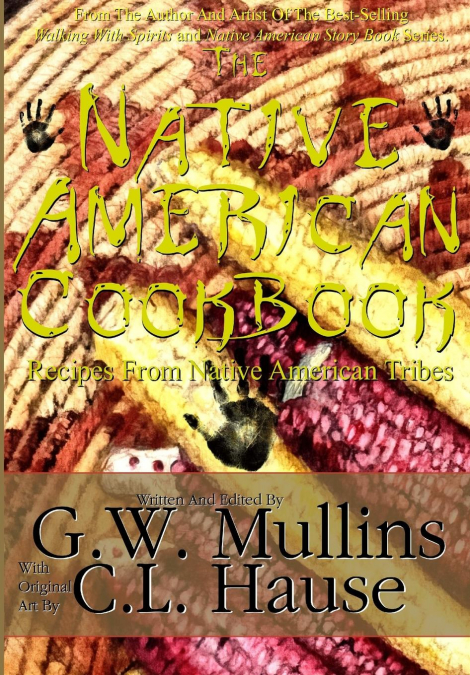
  • The Native American Cookbook Recipes From Native American Tribes
    G.W. Mullins
    Light Of The Moon Publishing along with Author G.W. Mullins and Illustrator / Artist C.L. Hause have joined together to explore Native American Indian Cooking.  More than just a cookbook, this Native American recipe collection offers a look into a forgotten past.  'The Native American Cookbook Recipes From Native American Tribes,' offers a large collection of recipes from and i...
    Disponible

    24,56 €

  • A Public Spirit
    George H. Atkinson
    George Henry Atkinson (1819-89) was a son of New England who arrived in the Oregon Territory in 1848, sent by the American Home Missionary Society. Although his commission from the Society specified that his work was to be ecclesiastical and educational, he took an approach to that assignment which went well beyond his mandate. Well-informed and energetic, he made an impact on ...
    Disponible

    10,45 €

  • North Carolina Women of the Confederacy
    Lucy London Anderson
    Long out of print, this volume of recollections, stories, and verse provides a glimpse of women's lives on the home front-and sometimes in the thick of battle-during the War between the States. Nearly fifty years after the American Civil War, Lucy Worth London Anderson (Mrs. John Huske Anderson) of Fayetteville, N.C., compiled one of the first memorial collections honoring the...
    Disponible

    17,20 €

  • Freedom by a Thread
    Freedom by a Thread: The History of Quilombos in Brazil brings together some of the best scholars in the world working on the history of quilombos (maroon societies) in Brazil from a variety of perspectives and approaches. Over 40 percent of the total volume of captive Africans arrived in Brazil during a 400-year period of legal and contraband transatlantic slaving. If slavery ...
    Disponible

    36,71 €

  • Nashville Baseball History
    Bill Traughber
    Nashville is a Big League city despite never having been home to a major league team. From the Civil War era, to star-studded exhibitions, to outstanding Negro Leagues teams, to some of the great minor league franchises of all time, few cities have as rich a baseball tradition as Nashville, Tennessee.Nashville sports historian Bill Traughber, who has been writing about baseball...
    Disponible

    13,15 €

Otros libros del autor

  • The Fabulous Frontier, 1846-1912
    William A. Keleher
    Recapturing the atmosphere of Territorial days, this 1962 extensively annotated edition of a Southwestern classic focuses on southeastern New Mexico, where 'murder was a common offense' and stagecoach robberies were 'nothing to get excited about.' The delineation of this last, lively frontier begins in 1846 and ends in 1912 with New Mexico statehood. Here are the deeds, lives a...
  • Maxwell Land Grant
    William A. Keleher
    When the United States acquired New Mexico by invasion and conquest on August 15, 1846, it inherited a land grant problem of considerable magnitude. This problem continued for decades until 1870 when the United States Congress suddenly declined to act at all on any New Mexico grant claim. Among the grants that had been confirmed, however, was the Miranda and Beaubien, or Maxwel...
  • Turmoil in New Mexico, 1846-1868
    William A. Keleher
    The vital history of New Mexico and Arizona during the formative years between the American Occupation and the coming of the railroad has been compressed by the author into one volume with hundreds of footnotes and many profiles that make this book of vital importance to teachers, students, and researchers. The book is broken into four parts: 'General Kearny Comes to Santa Fe,'...