
Inicio > Derecho > > Derecho y procedimiento penal > Victims’ Rights in Flux
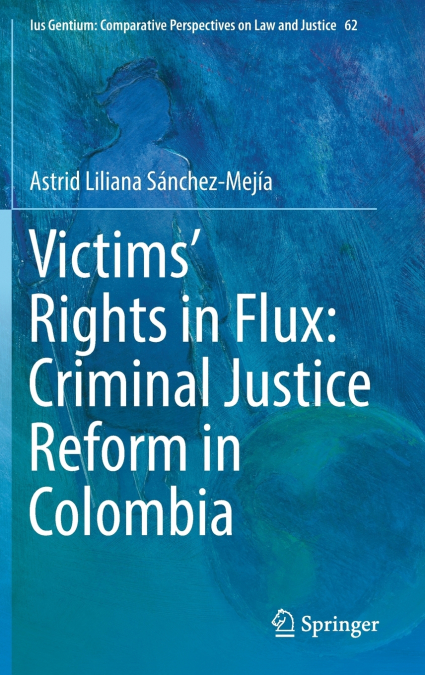
Victims’ Rights in Flux

Victims’ Rights in Flux

Astrid Liliana Sánchez-Mejía

194,01 €
IVA incluido
Consulta disponibilidad
Editorial:
Springer Nature B.V.
Año de edición:
2017
Materia
Derecho y procedimiento penal
ISBN:
9783319598512

Selecciona una librería:

  • Librería Samer Atenea
  • Librería Aciertas (Toledo)
  • Kálamo Books
  • Librería Perelló (Valencia)
  • Librería Elías (Asturias)
  • Donde los libros
  • Librería Kolima (Madrid)
  • Librería Proteo (Málaga)

Contributing to the literature on comparative criminal procedure and Latin American law, this book examines the effects of adversarial criminal justice reforms on victim’s rights by specifically analyzing the Colombian criminal justice reform of the early 2000s. This research focuses on the production, interpretation, and implementation of rules and institutions by exploring how different actors have employed the concept of victims and victims’ rights to promote their agendas in the context of criminal justice reforms. It also analyzes how the goals of these agendas have interplayed in practice. By the early 2000s, it seemed that the Colombian criminal justice system was headed towards a process characterized by broader victim participation, primarily because of the doctrine of the Constitutional Court on victims’ rights. But in 2002, the Colombian Attorney General promoted a more adversarial criminal justice reform. This book argues that this reform represented a sudden and unpredicted reversal of the Constitutional Court’s doctrine on victim participation, even though one of the central justifications for the reform was the need to satisfy human rights standards and adhere to the jurisprudence of the Constitutional Court on victims’ rights. In the criminal justice reform of the early 2000s and its subsequent modifications, the promotion of a dichotomous interpretation of the adversarial model-which conceived the criminal process as a competition between prosecution and defense-served to limit victim participation. This study examines how conceptions of victims’ rights emerged out of the struggles between different and at times competing agendas. In the Colombian process of reform, victims’ rights have been invoked both as a justification for criminal sanctions and as an explanation for crime prevention and restorative justice. After assessing quantitative and qualitative data, this book concludes that punitive approaches to victims’ rights have prevailed over restorative justice perspectives. Furthermore, it argues that punitiveness in the criminal justice system has not resulted in more protection for victims. Ultimately, this research reveals that the adversarial criminal justice reform of the early 2000s has not substantially improved the protection of victims’ rights in Colombia.

Artículos relacionados

  • Data Mining Trends and Applications in Criminal Science and Investigations
    The field of data mining is receiving significant attention in today’s information-rich society, where data is available from different sources and formats, in large volumes, and no longer constitutes a bottleneck for knowledge acquisition. This rich information has paved the way for novel areas of research, particularly in the crime data analysis realm. Data Mining Trends and ...
  • Compulsion to Kill
    Stephen C. Challis
    Forward by Robert M. Ekes, M.AWhen we hear of an atrocity such as a mass murder in a mall, or a theater, or of someone’s murderous rampage against children in a school it affects us all. We recoil in shock, disbelief, horror, and with many questions. What exactly happened? How did it happen? How was it allowed to happen? And most importantly what can be done to stop it fro...
    Disponible

    14,51 €

  • Courtroom
    Quentin Reynolds
    ...
    Disponible

    26,85 €

  • The responsibility of UN staff in the context of PKOs
    Mireille Esther Batjom
    The accountability of United Nations personnel in peacekeeping operations is a topical issue in view of the many human rights violations and other reprehensible acts perpetrated by peacekeeping personnel against the civilian population, including acts of sexual exploitation and abuse, organised prostitution, murder, disappearances of persons, arms trafficking, and so on. Severa...
    Disponible

    114,89 €

  • A Practical Guide to Non-Molestation Orders and Occupation Orders in Family Proceedings
    Stephanie Coker
    Molestation can have detrimental impacts on an individual’s health, safety, and wellbeing. In such instances, parties may consider it necessary to seek the court’s intervention by way of a non-molestation order and occupation order to keep them and any relevant children safe. This book provides a practical guide to non-molestation orders and occupation orders in family law proc...
    Disponible

    77,49 €

  • Cooperação Jurídica Internacional em Matéria Penal
    Iris Saraiva Russowsky
    O século XX foi marcado pela facilitação de circulação de bens, capitais e pessoas entre países. A integração regional desenvolvida a partir dos blocos de integração regional como União Europeia e Mercosul acabaram por desenvolver economicamente os países que deles fazem parte, havendo ainda, na União Europeia um avanço grande no bloco com a instauração da moeda única. Toda ess...
    Disponible

    10,73 €