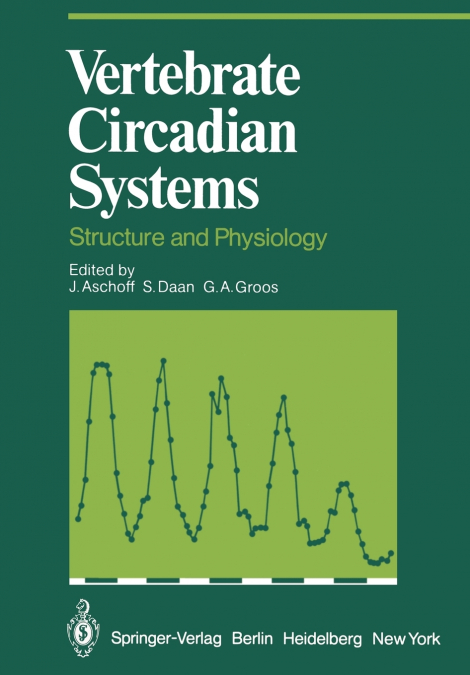

Vertebrate Circadian Systems

Vertebrate Circadian Systems


207,25 €
IVA incluido
Disponible
Editorial:
Springer Nature B.V.
Año de edición:
2012
Materia
Zoología y ciencias animales
ISBN:
9783642686535
207,25 €
IVA incluido
Disponible

Selecciona una librería:

  • Librería Samer Atenea
  • Librería Aciertas (Toledo)
  • Kálamo Books
  • Librería Perelló (Valencia)
  • Librería Elías (Asturias)
  • Donde los libros
  • Librería Kolima (Madrid)
  • Librería Proteo (Málaga)

By evolutionary adaptation to the perpetual day-night changes in envi­ ronmental conditions, eukaryotic organisms have acquired an endogen­ ous programme. This mechanism exhibits the characteristics of a self­ sustaining oscillation the period of which approximates that of the earth’s rotation. For animals such a property was first clearly demon­ strated by Maynard S. Johnson (1939) who recorded, in constant conditions, free-running activity rhythms of white-footed mice (Peromyscus /eucopus). Johnson concluded from his observations that 'this animal has an exceptionally substantial and durable self-winding and self-regulating clock, the mechanism of which remains to be worked out'. Twenty years later, the formal properties of this 'circadian' clock and its use by organisms as a time-keeping device were summa­ rized at the Cold Spring Harbor Symposium in 1960 (Chovnick 1961). During the following two decades, investigations have turned towards an analysis of the physiological mechanisms involved in and the search for a central masterclock. These efforts led to the discovery that the pineal organ of submammalian vertebrates and the suprachiasmatic nuclei of birds and mammals are major candidates for a role as central circadian pacemakers. At the same time the neural pathways through which these structures are coupled to the light-dark cycle were identi­ fied. Furthermore, it was established that the pineal gland and the suprachiasmatic nuclei are closely related structures that integrate the functions of circadian timekeeping and photoperiodic time measure­ ment.

Artículos relacionados

  • Animaltown
    Urban space constitutes a place where people and animals live together in close proximity with each other, creating changing landscapes of co-existence, conflict, mutual dependencies and exploitation. The medieval animals found in the articles of Animaltown: Beasts in Medieval Urban Space, appear in text and image, as well as archaeological find materials in the form of butcher...
    Disponible

    109,24 €

  • Pleasurable Kingdom
    Jonathan Balcombe
    Pleasurable Kingdom presents new evidence that animals--like humans--enjoy themselves. From birds to baboons, insects to iguanas, animals feel good thanks to play, sex, touch, food, anticipation, comfort, aesthetics, and more. Combining rigorous evidence, elegant argument and amusing anecdotes, leading animal behavior researcher Jonathan Balcombe shows that the possibility of p...
    Disponible

    18,96 €

  • SECOND NATURE
    Jonathan Balcombe
    ...
    Disponible

    16,52 €

  • Experimental Zoology
    Manisha R Gejage / Ramesh M Gejage
    The goal of the book is to present the practical knowledge of Zoology. Animal diversity, venomous and non-venomous snakes, study of birds, brain of fowl and hyoid apparatus, sclerotic plates, pecten and collumella of fowl, scales of fishes, biochemical tests, activity of salivary amylase, estimation of total protein and lipid, DNA isolation and estimation of uric acid are given...
  • TOXICOLOGY
    M A SUBRAMANIAN
    In an era defined by burgeoning human populations, rampant industrialization, cutting-edge technological progress, and expanding urban landscapes, the integrity of our natural environment faces unprecedented challenges. The relentless march of progress has ushered in a flood of chemicals, seeping into the very fabric of our ecosystems and posing insidious threats to biological ...
    Disponible

    23,69 €

  • Leaders in Animal Behavior
    Donald Dewsbury / Lee Drickamer
    ...
    Disponible

    64,68 €