 Librería Samer Atenea
 Kálamo Books
 Librería Elías (Asturias)
 Librería Kolima (Madrid)
 Librería Proteo (Málaga)
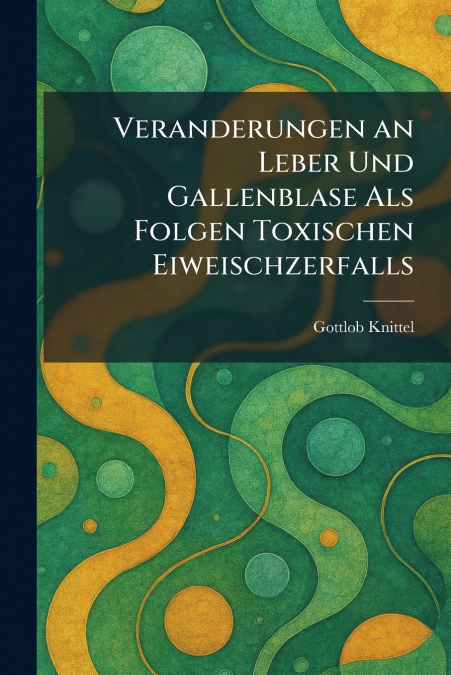
'Veranderungen an Leber Und Gallenblase Als Folgen Toxischen Eiweischzerfalls' von Gottlob Knittel ist eine detaillierte medizinische Untersuchung, die sich intensiv mit den pathologischen Auswirkungen des toxischen EiweiÃzerfalls auf zentrale menschliche Organe auseinandersetzt. Das Werk konzentriert sich insbesondere auf die morphologischen und funktionellen Veränderungen, die in der Leber und der Gallenblase als Folge biochemischer Abbauprozesse beobachtet werden können.In dieser wissenschaftlichen Abhandlung analysiert der Autor die Zusammenhänge zwischen toxischen Zuständen im Organismus und den daraus resultierenden Gewebeschäden. Durch die systematische Dokumentation klinischer Beobachtungen und pathologischer Befunde liefert das Buch wertvolle Einblicke in die medizinische Forschung und die diagnostischen Ansätze des frühen 20. Jahrhunderts. Es richtet sich an Medizinhistoriker, Pathologen und Fachleute, die an der historischen Entwicklung der Hepatologie und der Erforschung toxikologischer Wirkmechanismen interessiert sind.Knittels Arbeit stellt einen fundierten Beitrag zur Literatur über Organpathologie dar und beleuchtet die Komplexität des Stoffwechsels unter extremen Bedingungen. Die Schrift bleibt ein bedeutendes Dokument für das Verständnis der wissenschaftlichen Grundlagen zur Erforschung von Leber- und Gallenwegserkrankungen im historischen Kontext der inneren Medizin.This work has been selected by scholars as being culturally important, and is part of the knowledge base of civilization as we know it. This work was reproduced from the original artifact, and remains as true to the original work as possible. Therefore, you may see the original copyright references, library stamps (as most of these works have been housed in our most important libraries around the world), and other notations in the work.This work is in the public domain in the United States of America, and possibly other nations. Within the United States, you may freely copy and distribute this work, as no entity (individual or corporate) has a copyright on the body of the work.As a reproduction of a historical artifact, this work may contain missing or blurred pages, poor pictures, errant marks, etc. Scholars believe, and we concur, that this work is important enough to be preserved, reproduced, and made generally available to the public. We appreciate your support of the preservation process, and thank you for being an important part of keeping this knowledge alive and relevant.