 Librería Samer Atenea
 Kálamo Books
 Librería Elías (Asturias)
 Librería Kolima (Madrid)
 Librería Proteo (Málaga)
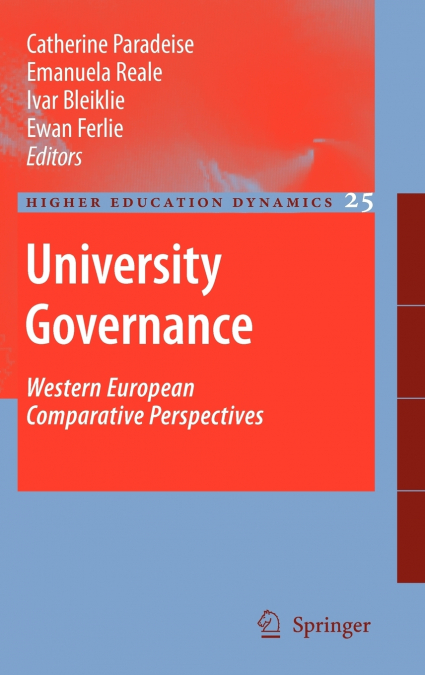
Higher education reforms have been on the agenda of Western European countries for 25 years, trying to deal with self governed professional bureaucracies politically weakened by massification when an emerging common understanding enhanced their role as major actors in knowledge based economies. While university systems are deeply embedded in national settings, the ex post rationale of still on-going reforms is surprisingly uniform and 'de-nationalized'. They promote (1) the 'organizational turn' of universities, to varying extent substituting collegial loosely coupled entities by 'integrated, goal-oriented entities deliberately choosing their own actions (and therefore open to differentiation), that can thus be held responsible for what they do' (2) the diversification of stakeholders, supposedly offering solutions to problems as various as the democratisation of universities, the shrinking of State budget resources and the diversification of university missions offering answers to changes in the making and in the use of science.When it comes to accounting for these reforms, two grand narratives of public management share the floor. NPM implies a strengthening of the capacity of the core State to direct public services organizations through management by objectives and results or contractualization, assessment, evaluation and. 'Governance' focuses on 'network-based' governance systems, where coordinating power and control are collectively shared between the major ’social actors or partners’ at all levels of the decision-making system. Our results suggest that all higher education systems under study were more or less transformed according to both these narratives. It is therefore needed to understand how they combine or create contradictions. This leads us to test a third neo-weberian model. This model reaffirms the role of the State, of representative democracy, (central, regional and local), of public law (suitably modernized), preserves the idea of a public service with a distinctive status, culture and terms and conditions. It shifts from an internal orientation to bureaucratic rules towards an external orientation in meeting citizens’ needs and wishes by means of standardization of work processes and their products, based on a distinctive public service and a particular legal order survived as the foundations beneath the various packages of modernizing reforms.This book traces the national dynamics of public policies, organizational design and steering tools in seven European higher education and research systems, using these narratives to interpret and test the actual changes and the degree of national specificities and European convergence.This book is not a sum of national chapters like other presumably comparative. It does not intend to tell once again the story of the transformation of the relationships between the state and universities. It tries to use Higher education system to discuss issues on state intervention and steering and more generally the NPM, governance and neo-weberian models in a specific field.Furthermore, this book intends breaking the walls between specialists in higher education and specialist in public management and research policy. This well rooted division of labour is less that ever justified as the university mission in research (fundamental, applied, strategic) is underscored by commentors and reformers themselves. For that reason, we have chosen to observe the consequences of the dynamics of public policies, organizational design and steering tools on two specific issues related to the development of research training and organizing within universities: the transformation of research funding on the one hand and the expansion of graduate studies and doctoral schools on the other.